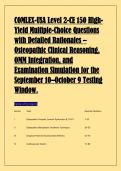
COMLEX-USA Level 2-CE 150 High-
Yield Multiple-Choice Questions
with Detailed Rationales –
Osteopathic Clinical Reasoning,
OMM Integration, and
Examination Simulation for the
September 10–October 9 Testing
Window.
Section Topic Question Numbers
I Osteopathic Principles, Somatic Dysfunction & T.A.R.T. 1–25
II Osteopathic Manipulative Treatment Techniques 26–50
III Chapman Points & Viscerosomatic Reflexes 51–70
IV Cardiovascular System 71–85
,Section Topic Question Numbers
V Respiratory System 86–95
VI Gastrointestinal & Nutritional 96–110
VII Musculoskeletal System 111–125
VIII Nervous System & Mental Health 126–135
IX Ethics, Professionalism & Medical Law 136–145
X Biostatistics & Epidemiology 146–150
A 34-year-old woman presents with 3 weeks of dull, aching low back pain that worsens with
prolonged sitting. Physical examination reveals warmth and boggy tissue texture changes at the L3–L4
paraspinal musculature, asymmetric restriction of rotation, and point tenderness. Which of the
following best describes the somatic dysfunction identified?
A. Chronic somatic dysfunction
B. Acute somatic dysfunction
C. Viscerosomatic reflex
D. Facilitated segment
Acute somatic dysfunction is characterized by edema, boggy tissue texture, warmth,
hypertonicity, and tenderness. Chronic somatic dysfunction presents with cool, dry skin, decreased
muscle tone, and no edema. The warmth and boggy texture in this vignette indicate an acute process.
Which of the following is NOT a component of the T.A.R.T. diagnostic criteria for somatic
dysfunction?
,A. Tissue texture changes
B. Asymmetry
C. Restriction of motion
D. Radiographic confirmation
The T.A.R.T. mnemonic stands for Tissue texture changes, Asymmetry, Restriction of
motion, and Tenderness. Radiographic imaging is not required for the diagnosis of somatic dysfunction,
which is a clinical diagnosis.
A 45-year-old man is diagnosed with somatic dysfunction of the thoracic spine. The physician
notes that at the T5–T6 segment, rotation and sidebending occur in opposite directions when the spine
is in neutral. This finding is consistent with which of the following?
A. Fryette's Type I mechanics
B. Fryette's Type II mechanics
C. Somatic dysfunction of a single vertebra
D. Non-physiologic motion
Fryette's Type I mechanics describes group curves in the neutral position where
sidebending and rotation occur in opposite directions. Type II mechanics occurs in non-neutral positions
(flexion or extension) where sidebending and rotation occur in the same direction.
A 52-year-old woman with a history of gastroesophageal reflux disease presents with mid-
thoracic pain. Physical examination reveals tissue texture changes and tenderness at the T5–T9
paraspinal region. The most likely viscerosomatic relationship is with which of the following organs?
A. Heart
B. Stomach
C. Gallbladder
D. Appendix
The upper gastrointestinal tract, including the stomach, has sympathetic innervation
from T5–T9. Viscerosomatic reflexes from the stomach would be expected in this distribution.
, A 28-year-old man presents with acute onset of torticollis. Examination reveals a C2 vertebra
that is rotated and sidebent to the right, with restriction of left rotation. Which Fryette principle governs
this dysfunction?
A. Type I mechanics
B. Type II mechanics
C. Type III mechanics
D. Neutral mechanics
Fryette's Type II mechanics applies to a single vertebral segment in a non-neutral (flexed
or extended) position. The sidebending and rotation occur in the same direction. The cervical spine is
commonly affected by Type II mechanics.
Which of the following best defines a facilitated segment?
A. A spinal segment with increased nociceptive threshold
B. A hyperexcitable spinal cord segment due to sustained afferent input
C. A segment with decreased sympathetic outflow
D. A segment with normal motion but increased tenderness
A facilitated segment is a spinal cord segment that becomes hyperexcitable due to
continuous afferent bombardment from a visceral or somatic dysfunction. This lowers the threshold for
subsequent afferent input, leading to somatic dysfunction.
A 60-year-old woman with chronic obstructive pulmonary disease is found to have somatic
dysfunction at T1–T4. Which of the following viscerosomatic relationships is most consistent with this
finding?
A. Liver
B. Heart
C. Lungs
D. Stomach
Yield Multiple-Choice Questions
with Detailed Rationales –
Osteopathic Clinical Reasoning,
OMM Integration, and
Examination Simulation for the
September 10–October 9 Testing
Window.
Section Topic Question Numbers
I Osteopathic Principles, Somatic Dysfunction & T.A.R.T. 1–25
II Osteopathic Manipulative Treatment Techniques 26–50
III Chapman Points & Viscerosomatic Reflexes 51–70
IV Cardiovascular System 71–85
,Section Topic Question Numbers
V Respiratory System 86–95
VI Gastrointestinal & Nutritional 96–110
VII Musculoskeletal System 111–125
VIII Nervous System & Mental Health 126–135
IX Ethics, Professionalism & Medical Law 136–145
X Biostatistics & Epidemiology 146–150
A 34-year-old woman presents with 3 weeks of dull, aching low back pain that worsens with
prolonged sitting. Physical examination reveals warmth and boggy tissue texture changes at the L3–L4
paraspinal musculature, asymmetric restriction of rotation, and point tenderness. Which of the
following best describes the somatic dysfunction identified?
A. Chronic somatic dysfunction
B. Acute somatic dysfunction
C. Viscerosomatic reflex
D. Facilitated segment
Acute somatic dysfunction is characterized by edema, boggy tissue texture, warmth,
hypertonicity, and tenderness. Chronic somatic dysfunction presents with cool, dry skin, decreased
muscle tone, and no edema. The warmth and boggy texture in this vignette indicate an acute process.
Which of the following is NOT a component of the T.A.R.T. diagnostic criteria for somatic
dysfunction?
,A. Tissue texture changes
B. Asymmetry
C. Restriction of motion
D. Radiographic confirmation
The T.A.R.T. mnemonic stands for Tissue texture changes, Asymmetry, Restriction of
motion, and Tenderness. Radiographic imaging is not required for the diagnosis of somatic dysfunction,
which is a clinical diagnosis.
A 45-year-old man is diagnosed with somatic dysfunction of the thoracic spine. The physician
notes that at the T5–T6 segment, rotation and sidebending occur in opposite directions when the spine
is in neutral. This finding is consistent with which of the following?
A. Fryette's Type I mechanics
B. Fryette's Type II mechanics
C. Somatic dysfunction of a single vertebra
D. Non-physiologic motion
Fryette's Type I mechanics describes group curves in the neutral position where
sidebending and rotation occur in opposite directions. Type II mechanics occurs in non-neutral positions
(flexion or extension) where sidebending and rotation occur in the same direction.
A 52-year-old woman with a history of gastroesophageal reflux disease presents with mid-
thoracic pain. Physical examination reveals tissue texture changes and tenderness at the T5–T9
paraspinal region. The most likely viscerosomatic relationship is with which of the following organs?
A. Heart
B. Stomach
C. Gallbladder
D. Appendix
The upper gastrointestinal tract, including the stomach, has sympathetic innervation
from T5–T9. Viscerosomatic reflexes from the stomach would be expected in this distribution.
, A 28-year-old man presents with acute onset of torticollis. Examination reveals a C2 vertebra
that is rotated and sidebent to the right, with restriction of left rotation. Which Fryette principle governs
this dysfunction?
A. Type I mechanics
B. Type II mechanics
C. Type III mechanics
D. Neutral mechanics
Fryette's Type II mechanics applies to a single vertebral segment in a non-neutral (flexed
or extended) position. The sidebending and rotation occur in the same direction. The cervical spine is
commonly affected by Type II mechanics.
Which of the following best defines a facilitated segment?
A. A spinal segment with increased nociceptive threshold
B. A hyperexcitable spinal cord segment due to sustained afferent input
C. A segment with decreased sympathetic outflow
D. A segment with normal motion but increased tenderness
A facilitated segment is a spinal cord segment that becomes hyperexcitable due to
continuous afferent bombardment from a visceral or somatic dysfunction. This lowers the threshold for
subsequent afferent input, leading to somatic dysfunction.
A 60-year-old woman with chronic obstructive pulmonary disease is found to have somatic
dysfunction at T1–T4. Which of the following viscerosomatic relationships is most consistent with this
finding?
A. Liver
B. Heart
C. Lungs
D. Stomach