
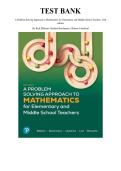
TEST BANK
A Problem-Solving Approach to Mathematics for Elementary and Middle School Teachers, 14th
edition
By Rick Billstein | Barbara Boschmans | Shlomo Libeskind
SC
O
R
EG
U
ID
ES
, Table of Content
1. Problem Solving
1-1 Mathematics and Problem Solving
1-2 Explorations with Patterns
Chapter 1 Review
2. Introduction to Logic and Sets
2-1 Reasoning and Logic: An Introduction
2-2 Describing Sets 2-3 Other Set Operations
Chapter 2 Review
SC
3. Numeration Systems and Whole Number Operations
3-1 Numeration Systems
3-2 Addition of Whole Numbers
3-3 Subtraction of Whole Numbers
3-4 Multiplication of Whole Numbers
3-5 Division of Whole Numbers
O
Chapter 3 Review
4. Number Theory
4-1 Divisibility
R
4-2 Prime and Composite Numbers
4-3 Greatest Common Divisor and Least Common Multiple
Chapter 4 Review
EG
5. Integers
5-1 Addition and Subtraction of Integers
5-2 Multiplication and Division of Integers
Chapter 5 Review
6. Rational Numbers and Proportional Reasoning
6-1 The Set of Rational Numbers
U
6-2 Addition, Subtraction, and Estimation with Rational Numbers
6-3 Multiplication, Division, and Estimation with Rational Numbers
6-4 Proportional Reasoning
ID
Chapter 6 Review
7. Decimals, Percents, and Real Numbers
7-1 Terminating Decimals
7-2 Operations on Decimals
ES
7-3 Repeating Decimals
7-4 Percents
7-5 Real Numbers
Chapter 7 Review
8. Algebraic Thinking
8-1 Expressions and Equations
8-2 Solving Equations and Inequalities with One Variable
8-3 Functions and Graphing Equations
8-4 Solving Systems of Equations and Inequalities with Two Variables
Chapter 8 Review
9. Introductory Geometry
,9-1 Basic Notions
9-2 Curves, Polygons, and Symmetry
9-3 More About Angles
9-4 Geometry in Three Dimensions
Chapter 11 Review
10. Congruence and Similarity
10-1 Congruency Through Constructions
10-2 Additional Congruence Theorems
10-3 Additional Constructions
10-4 Similarity
SC
Chapter 10 Review
11. Measurement
11-1 Linear Measure
11-2 Concept of Area and the Pythagorean Theorem
11-3 Areas of Polygons and Circles
O
11-4 Surface Areas
11-5 Volume and Mass
Chapter 11 Review
Technology Modules
R
12. Transformations
12-1 Translations, Rotations, and Tessellations
12-2 Reflections and Glide Reflections
EG
12-3 Dilations 935
Chapter 12 Review
13. Data Science and Statistics
13-1 The Statistical Problem-Solving Process
13-2 Visualizing Univariate Data
13-3 Visualizing Bivariate Data
U
13-4 Measures of Central Tendency and Variation
Chapter 13 Review
ID
14. Probability
14-1 Determining Probabilities
14-2 Multistage Experiments and Modeling Games
14-3 Simulations and Applications in Probability
14-4 Permutations and Combinations in Probability
ES
Chapter 14 Review
, Exam
Name
MULTIPLE CHOICE. Choose the one alternative that best completes the statement or answers the question.
Determine whether the following is a statement. If it is, then also classify the statement as true or false.
1) Why don't you come here? 1)
A) True statement B) Not a statement C) False statement
Answer: B
SC
2) This room is big. 2)
A) False statement B) True statement C) Not a statement
Answer: C
3) 5 - 1 = 4 3)
A) True statement B) Not a statement C) False statement
O
Answer: A
4) 7x + y = 3 4)
A) False statement B) Not a statement C) True statement
R
Answer: B
5) Can you bring the book? 5)
A) False statement B) True statement C) Not a statement
EG
Answer: C
6) x + y = x - y, where y = 0 6)
A) Not a statement B) True statement C) False statement
Answer: B
7) 12 = 3y 7)
U
A) False statement B) True statement C) Not a statement
Answer: C
ID
8) 2.4 = 5.2 8)
A) Not a statement B) False statement C) True statement
Answer: B
9) The state of California is in North America. 9)
ES
A) Not a statement B) True statement C) False statement
Answer: B
10) Brazil is in Asia. 10)
A) True statement B) Not a statement C) False statement
Answer: C
1
A Problem-Solving Approach to Mathematics for Elementary and Middle School Teachers, 14th
edition
By Rick Billstein | Barbara Boschmans | Shlomo Libeskind
SC
O
R
EG
U
ID
ES
, Table of Content
1. Problem Solving
1-1 Mathematics and Problem Solving
1-2 Explorations with Patterns
Chapter 1 Review
2. Introduction to Logic and Sets
2-1 Reasoning and Logic: An Introduction
2-2 Describing Sets 2-3 Other Set Operations
Chapter 2 Review
SC
3. Numeration Systems and Whole Number Operations
3-1 Numeration Systems
3-2 Addition of Whole Numbers
3-3 Subtraction of Whole Numbers
3-4 Multiplication of Whole Numbers
3-5 Division of Whole Numbers
O
Chapter 3 Review
4. Number Theory
4-1 Divisibility
R
4-2 Prime and Composite Numbers
4-3 Greatest Common Divisor and Least Common Multiple
Chapter 4 Review
EG
5. Integers
5-1 Addition and Subtraction of Integers
5-2 Multiplication and Division of Integers
Chapter 5 Review
6. Rational Numbers and Proportional Reasoning
6-1 The Set of Rational Numbers
U
6-2 Addition, Subtraction, and Estimation with Rational Numbers
6-3 Multiplication, Division, and Estimation with Rational Numbers
6-4 Proportional Reasoning
ID
Chapter 6 Review
7. Decimals, Percents, and Real Numbers
7-1 Terminating Decimals
7-2 Operations on Decimals
ES
7-3 Repeating Decimals
7-4 Percents
7-5 Real Numbers
Chapter 7 Review
8. Algebraic Thinking
8-1 Expressions and Equations
8-2 Solving Equations and Inequalities with One Variable
8-3 Functions and Graphing Equations
8-4 Solving Systems of Equations and Inequalities with Two Variables
Chapter 8 Review
9. Introductory Geometry
,9-1 Basic Notions
9-2 Curves, Polygons, and Symmetry
9-3 More About Angles
9-4 Geometry in Three Dimensions
Chapter 11 Review
10. Congruence and Similarity
10-1 Congruency Through Constructions
10-2 Additional Congruence Theorems
10-3 Additional Constructions
10-4 Similarity
SC
Chapter 10 Review
11. Measurement
11-1 Linear Measure
11-2 Concept of Area and the Pythagorean Theorem
11-3 Areas of Polygons and Circles
O
11-4 Surface Areas
11-5 Volume and Mass
Chapter 11 Review
Technology Modules
R
12. Transformations
12-1 Translations, Rotations, and Tessellations
12-2 Reflections and Glide Reflections
EG
12-3 Dilations 935
Chapter 12 Review
13. Data Science and Statistics
13-1 The Statistical Problem-Solving Process
13-2 Visualizing Univariate Data
13-3 Visualizing Bivariate Data
U
13-4 Measures of Central Tendency and Variation
Chapter 13 Review
ID
14. Probability
14-1 Determining Probabilities
14-2 Multistage Experiments and Modeling Games
14-3 Simulations and Applications in Probability
14-4 Permutations and Combinations in Probability
ES
Chapter 14 Review
, Exam
Name
MULTIPLE CHOICE. Choose the one alternative that best completes the statement or answers the question.
Determine whether the following is a statement. If it is, then also classify the statement as true or false.
1) Why don't you come here? 1)
A) True statement B) Not a statement C) False statement
Answer: B
SC
2) This room is big. 2)
A) False statement B) True statement C) Not a statement
Answer: C
3) 5 - 1 = 4 3)
A) True statement B) Not a statement C) False statement
O
Answer: A
4) 7x + y = 3 4)
A) False statement B) Not a statement C) True statement
R
Answer: B
5) Can you bring the book? 5)
A) False statement B) True statement C) Not a statement
EG
Answer: C
6) x + y = x - y, where y = 0 6)
A) Not a statement B) True statement C) False statement
Answer: B
7) 12 = 3y 7)
U
A) False statement B) True statement C) Not a statement
Answer: C
ID
8) 2.4 = 5.2 8)
A) Not a statement B) False statement C) True statement
Answer: B
9) The state of California is in North America. 9)
ES
A) Not a statement B) True statement C) False statement
Answer: B
10) Brazil is in Asia. 10)
A) True statement B) Not a statement C) False statement
Answer: C
1


