NURS 6222 HEALTH assessment final exam review
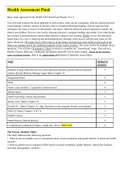
Basic study approach for the NURS 6222 Final Exam Weeks # 8-13 You will want to know the exam approach to each system, what you are examining, what are normal physical exam findings, what are variants of normal, what is considered abnormal finding, what are special exam techniques for when you have an abnormality and what is different about the general approach to adults, the elderly and children. Review your weekly learning objectives, assigned readings and media. Note what faculty have posted in announcements and the Q&A Board to support your learning. Briefly review the discussion board topics as a way of studying and understanding key elements of the history and physical exam for the topics discussed. The major focus of the exam is on the history and physical exam skills as discussed in the Bates text readings and in the media/powerpoints of the weekly sessions. The exam will be 50 multiple choice questions. You will have 60 minutes (1 hour) in which to complete the “closed book” exam. This will be a Remote Proctor (RP)exam. Additional information about RP will be forth coming. Please do the practice exam in remote proctor. Here is the approximate distribution of questions across topics Topic Number of questions Pediatric/Young Adult (Review hx, exam approach and basic growth and development Tanner (Sexual Maturity Ratings) stages Bates Chapter 18 5 Integument/Derm 8 MSK 8 Neuro ( may include 1-2 questions Cranial nerves) 8 Mental Status 3 Health Screening ( breast and prostate) 2 Breast exam (Bates Chapter 10 2 Female GU (Bates Chapter 14 – No Questions on the pregnant female ( powerpoint) 3 Male GU (Bates Chapter 13 & 15) 3 Health Literacy 2 Health History (Sexual history) 2 Constitutional symptoms (Fatigue, weight loss, fever) Dain’s text 4 The Fenway Institute Study: The study addressed the following questions: 1. What are the acceptable ways to ask patients about sexual orientation and gender identity in electronic health records? 2. How do patient survey responses differ based on sexual orientation, gender identity, clinical site location, and other demographic variables? Asked to answer a two-step gender identity and birth sex question that has been endorsed by leading transgender researchers. This question first asks about current gender identity, followed by sex assigned at birth. Session 8: Special populations: Peds and young adults ● Distinguish normal from abnormal findings in the history and physical exam of infants, children, adolescents, and the young adult. ● Recognize common complaints and differential diagnoses in the history and physical exam of infants, children, adolescents and the young adult. ● Demonstrate key techniques used that may be different in the history and physical exam of infants, children, adolescents, and the young adult. ● Provide exemplars of unique documentation in the history and physical exam of infants,children, adolescents and the young adult. Review power points for Peds and Newborn physical assessments Bates - Media: 2, 3, 4 Bates': Ch 18. - pg 799 4 principles of child development: 1. Child development proceeds along a predictable pathway 2. Range of normal is wide 3. various factors affect development(social, environmental, diseases) 4. The developmental conducts how one does the history and physical(hx from a 5 yr old is different than that from some bratty teen) At one minute: Normal=8-10, at 1 minute 5-7= some nervous system depression 0-4=severe depression, requiring immediate resuscitation At 5 minutes: Normal= 8-10 0-7= High risk for subsequent CNS and other organ dysfunction Gestational age Preterm 37 weeks Term 37-42 weeks Postterm 42 weeks Birth weight Classification Extremely low 1000 g very low 1500 g low 2500 g normal = 2500 Newborn Classification Small for gestational age(SGA) 10th percentile Appropriate(AGA) 10-90th percentile Large(LGA) 90th percentile Highest risk for mortality in preterm kids is SGA and LGA lowest is AGA You should not examine the newborn prior to feeding. The baby is most responsive 1-2 hours after feeding and that is the optimal time for the exam. Infants birth weight should triple and height should increase by 50% in one year Health visits should be at Birth, 1st week, then at 1, 2, 4, 6, 9, 12 months. Called the Infant Periodicity Schedule. Failure to Thrive: Inadequate weight gain for age: Growth5th percentile, growth drop of 2 quartiles in 6 months, weight for height 5th percentile Causes of microcephaly: ie: small head circumference= chromosomal, congenital infection, maternal metabolic disorder, neurologic insult. Causes of macrocephaly: 97th percentile= hydrocephalus, subdural hematoma, tumor, familial-benign with normal brain growth Blood pressure norms: Doppler method is the most easily used to get a systolic pressure. in males is should be 70 mmHg at birth, 85 at 1 month, and 90 at 6 months Heart Rates from birth to 1 year: birth to 2 months=140 range=90-190 birth to 6 months=130 range= months=115 range 75-155 Pulse that is too rapid may =Paroxysmal SVT Bradycardia- drug ingestions, hypoxia, intracranial conditions, heart block Respiratory Rate between 30-60 in the newborn. Tachypnea birth to 2months 60/min 2-12 months 50/min Fever can raise rate by 10 for each degree rise in temp. PNA is common cause rapid shallow rates may mean cyanotic cardiac disease, right to left shunt, metabolic acidosis Temperature Average Rectal temp is higher-99,0F until age 3 years Fever 38C or 100F in infants 2-3months Remember, temperature is not well managed in newborns yet so take it seriously Cutis Marmorata: (mottling) Vasomotor abnormality in the dermis due to cooling or chronic exposure to heat. Lattice-like bluish mottled appearance on the trunk, arms, and legs. May last for months. Could also be due to hypothyroidism, Down syndrome. Prominent in premature infants. Acrocyanosis: Blue cast to the hands and feet when exposed to cold. Common in newborns and may occur throughout infancy. If it DOES NOT disappear within 8 hours or with warming r/o cyanotic congenital heart disease Harlequin Dyschromia: Occasionally in newborns there is a transient cyanosis over one half of the body or one extremity, presumably from vascular instability Central Cyanosis: Assessed at the tongue, oral mucosa, NOT the nails. May signify congenital heart disease Cafe Au Lait spots: Pigmented light brown lesions 1-2cm. Isolated= no big deal. Multiple lesions with smooth borders may mean Neurofibromatosis Miliaria Rubra: Scattered vesicles on an erythematous base, usually on the face and trunk, result from obstruction of the sweat ducts; disappears within weeks Erythema Toxicum: May appear at 2-3 days of life. Rash that consists of erythematous macules with central pinpoint vesicles scattered diffusely over the entire body. Look like flea bites. Unknown etiology and should disappear in 1 week Pustular Melanosis: More common in African American infants. Appears at birth. Rash of vesiculopustules over a brown macular base. May last for months. Milia: Pin sized smooth white raised areas without surrounding erythema on the nose, chin, and forehead resulting from retention of sebum in the openings of the sebaceous glands. Appears within the first few weeks and disappears over several weeks. Lanugo: Fine, downy growth of hair that covers the entire body, especially the shoulders and back. Sheds within the first few weeks. More prominent in premature infants Jaundice: You should know what this is. You should also know that if it appears within the first 24 hours it may mean hemolytic disease of the newborn. If it persists beyond 2-3 weeks it may mean biliary obstruction of liver disease Salmon Patch: also called a stork bite or capillary hemangioma. May appear on the nape of the neck, eyelids, forehead, or upper lip. They are distended capillaries and not nevi and should disappear in a week. Anterior Fontanelle: at birth it measures 4-6cm in diameter and usually closes between 4 and 26 months(90% twixt 7-19 months) Bulging fontanelle is increased ICP caused by CNS infection, neoplasm, hydrocephalus. Depressed fontanelle-dehydration
Document information
- Uploaded on
- August 4, 2021
- Number of pages
- 43
- Written in
- 2021/2022
- Type
- Exam (elaborations)
- Contains
- Questions & answers