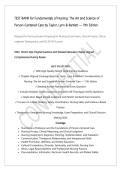
TEST BANK for Fundamentals of Nursing: The Art and Science of
Person-Centered Care by Taylor, Lynn & Bartlett — 11th Edition
Designed for Nursing Students Preparing for Nursing School Exams, Clinical Practice, Clinical
Judgment Development, and NCLEX-RN Success
1000+ NCLEX-Style Original Questions with Detailed Rationales Chapter-Aligned
Comprehensive Nursing Review
KEY FEATURES
✓ 1000 High-Quality NCLEX-Style Practice Questions
✓ Chapter-Aligned Coverage Based on Taylor, Lynn & Bartlett’s Fundamentals of
Nursing: The Art and Science of Person-Centered Care — 11th Edition
✓ Detailed Answer Rationales for Every Question
✓ Includes Multiple-Choice Questions and Select-All-That-Apply (SATA) Questions
✓ Application-Based Clinical Judgment and Patient-Centered Care Scenarios
✓ Focuses on Critical Thinking, Safety, Prioritization, Nursing Skills, and Evidence-Based
Practice
✓ Designed to Strengthen Nursing Knowledge, Exam Preparation, and Clinical Decision-
Making Skills
Coverage
• Nursing as a Profession and the Foundations of Person-Centered Care
• Nursing Process, Clinical Reasoning, and Clinical Judgment
• Nursing Assessment, Diagnosis, Planning, Implementation, and Evaluation
• Communication, Therapeutic Relationships, and Interpersonal Skills
• Health Promotion, Wellness, and Patient Education
• Cultural Competence, Diversity, Spirituality, and Holistic Nursing Care
• Ethics, Legal Responsibilities, and Professional Nursing Practice
• Documentation, Informatics, Electronic Health Records, and Patient Safety
,1. During a professional development seminar, a group of nursing students debate whether
nursing is primarily a scientific discipline or a caring profession. Which statement by the
instructor best explains the contemporary nature of nursing practice?
A. “Nursing is mainly focused on performing technical procedures accurately.”
B. “Nursing combines scientific knowledge, clinical reasoning, and a therapeutic relationship to
meet the unique needs of individuals.”
C. “Nursing is an extension of medicine and primarily involves carrying out provider decisions.”
D. “Nursing focuses mainly on emotional support because scientific knowledge belongs to other
healthcare disciplines.”
Correct Answer:
B. “Nursing combines scientific knowledge, clinical reasoning, and a therapeutic relationship to
meet the unique needs of individuals.”
Rationale:
Modern nursing integrates both the science and art of nursing. The science involves evidence-
based knowledge, assessment, clinical reasoning, and technical competence. The art involves
communication, compassion, cultural awareness, and developing therapeutic relationships that
recognize each person as unique. Nursing is an autonomous profession that collaborates with
other disciplines but is not simply an extension of medicine.
2. A nurse working in a cardiac rehabilitation program notices that many clients struggle
with lifestyle changes after discharge. Instead of focusing only on medication adherence,
the nurse develops individualized plans that consider each client’s beliefs, resources, family
support, and personal goals. Which nursing philosophy is demonstrated?
A. Task-oriented nursing care
B. Disease-centered care
C. Person-centered nursing practice
D. Provider-directed healthcare management
,Correct Answer:
C. Person-centered nursing practice
Rationale:
Person-centered care views individuals as active partners in their healthcare. It considers
physical health, emotional needs, social circumstances, cultural values, personal preferences, and
goals. Disease-centered care focuses mainly on the illness, while person-centered nursing
focuses on the whole person experiencing the illness.
3. A nursing student states, “Technology has replaced the need for nurses because
machines can monitor patients more accurately.” Which response by the clinical instructor
is most appropriate?
A. “Technology has reduced the importance of nursing assessment.”
B. “Technology supports nursing practice, but nurses provide interpretation, judgment,
advocacy, and human connection.”
C. “Technology should only be used by physicians.”
D. “Technology eliminates the need for communication skills.”
Correct Answer:
B. “Technology supports nursing practice, but nurses provide interpretation, judgment,
advocacy, and human connection.”
Rationale:
Healthcare technology enhances nursing practice but does not replace professional nursing
judgment. Nurses interpret data, recognize subtle changes, communicate with patients and
families, make clinical decisions, and provide compassionate care.
4. A nurse in a rural community identifies that residents have increased rates of
uncontrolled hypertension. The nurse partners with community leaders to create blood
, pressure screening events and education programs. Which nursing role is primarily
demonstrated?
A. Disease treatment specialist
B. Community health advocate
C. Medication administrator
D. Hospital-based caregiver
Correct Answer:
B. Community health advocate
Rationale:
Nurses promote health beyond individual patient care. Community health advocacy includes
identifying population needs, reducing health risks, improving access to care, and developing
prevention strategies.
5. A nurse is reviewing factors that have shaped modern nursing practice. Which historical
developments contributed to the professionalization of nursing?
Select all that apply.
A. Development of formal nursing education programs
B. Growth of evidence-based nursing practice
C. Recognition of nursing as an independent profession
D. Increased emphasis on patient advocacy
E. Limiting nursing practice to tasks delegated by physicians
Correct Answers:
A, B, C, D
Rationale:
Professional nursing has evolved through formal education, research, expanded practice roles,
evidence-based care, and advocacy. Modern nurses are independent professionals responsible for
clinical judgment and patient-centered care.
Person-Centered Care by Taylor, Lynn & Bartlett — 11th Edition
Designed for Nursing Students Preparing for Nursing School Exams, Clinical Practice, Clinical
Judgment Development, and NCLEX-RN Success
1000+ NCLEX-Style Original Questions with Detailed Rationales Chapter-Aligned
Comprehensive Nursing Review
KEY FEATURES
✓ 1000 High-Quality NCLEX-Style Practice Questions
✓ Chapter-Aligned Coverage Based on Taylor, Lynn & Bartlett’s Fundamentals of
Nursing: The Art and Science of Person-Centered Care — 11th Edition
✓ Detailed Answer Rationales for Every Question
✓ Includes Multiple-Choice Questions and Select-All-That-Apply (SATA) Questions
✓ Application-Based Clinical Judgment and Patient-Centered Care Scenarios
✓ Focuses on Critical Thinking, Safety, Prioritization, Nursing Skills, and Evidence-Based
Practice
✓ Designed to Strengthen Nursing Knowledge, Exam Preparation, and Clinical Decision-
Making Skills
Coverage
• Nursing as a Profession and the Foundations of Person-Centered Care
• Nursing Process, Clinical Reasoning, and Clinical Judgment
• Nursing Assessment, Diagnosis, Planning, Implementation, and Evaluation
• Communication, Therapeutic Relationships, and Interpersonal Skills
• Health Promotion, Wellness, and Patient Education
• Cultural Competence, Diversity, Spirituality, and Holistic Nursing Care
• Ethics, Legal Responsibilities, and Professional Nursing Practice
• Documentation, Informatics, Electronic Health Records, and Patient Safety
,1. During a professional development seminar, a group of nursing students debate whether
nursing is primarily a scientific discipline or a caring profession. Which statement by the
instructor best explains the contemporary nature of nursing practice?
A. “Nursing is mainly focused on performing technical procedures accurately.”
B. “Nursing combines scientific knowledge, clinical reasoning, and a therapeutic relationship to
meet the unique needs of individuals.”
C. “Nursing is an extension of medicine and primarily involves carrying out provider decisions.”
D. “Nursing focuses mainly on emotional support because scientific knowledge belongs to other
healthcare disciplines.”
Correct Answer:
B. “Nursing combines scientific knowledge, clinical reasoning, and a therapeutic relationship to
meet the unique needs of individuals.”
Rationale:
Modern nursing integrates both the science and art of nursing. The science involves evidence-
based knowledge, assessment, clinical reasoning, and technical competence. The art involves
communication, compassion, cultural awareness, and developing therapeutic relationships that
recognize each person as unique. Nursing is an autonomous profession that collaborates with
other disciplines but is not simply an extension of medicine.
2. A nurse working in a cardiac rehabilitation program notices that many clients struggle
with lifestyle changes after discharge. Instead of focusing only on medication adherence,
the nurse develops individualized plans that consider each client’s beliefs, resources, family
support, and personal goals. Which nursing philosophy is demonstrated?
A. Task-oriented nursing care
B. Disease-centered care
C. Person-centered nursing practice
D. Provider-directed healthcare management
,Correct Answer:
C. Person-centered nursing practice
Rationale:
Person-centered care views individuals as active partners in their healthcare. It considers
physical health, emotional needs, social circumstances, cultural values, personal preferences, and
goals. Disease-centered care focuses mainly on the illness, while person-centered nursing
focuses on the whole person experiencing the illness.
3. A nursing student states, “Technology has replaced the need for nurses because
machines can monitor patients more accurately.” Which response by the clinical instructor
is most appropriate?
A. “Technology has reduced the importance of nursing assessment.”
B. “Technology supports nursing practice, but nurses provide interpretation, judgment,
advocacy, and human connection.”
C. “Technology should only be used by physicians.”
D. “Technology eliminates the need for communication skills.”
Correct Answer:
B. “Technology supports nursing practice, but nurses provide interpretation, judgment,
advocacy, and human connection.”
Rationale:
Healthcare technology enhances nursing practice but does not replace professional nursing
judgment. Nurses interpret data, recognize subtle changes, communicate with patients and
families, make clinical decisions, and provide compassionate care.
4. A nurse in a rural community identifies that residents have increased rates of
uncontrolled hypertension. The nurse partners with community leaders to create blood
, pressure screening events and education programs. Which nursing role is primarily
demonstrated?
A. Disease treatment specialist
B. Community health advocate
C. Medication administrator
D. Hospital-based caregiver
Correct Answer:
B. Community health advocate
Rationale:
Nurses promote health beyond individual patient care. Community health advocacy includes
identifying population needs, reducing health risks, improving access to care, and developing
prevention strategies.
5. A nurse is reviewing factors that have shaped modern nursing practice. Which historical
developments contributed to the professionalization of nursing?
Select all that apply.
A. Development of formal nursing education programs
B. Growth of evidence-based nursing practice
C. Recognition of nursing as an independent profession
D. Increased emphasis on patient advocacy
E. Limiting nursing practice to tasks delegated by physicians
Correct Answers:
A, B, C, D
Rationale:
Professional nursing has evolved through formal education, research, expanded practice roles,
evidence-based care, and advocacy. Modern nurses are independent professionals responsible for
clinical judgment and patient-centered care.