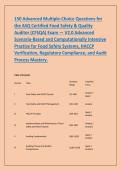
150 Advanced Multiple-Choice Questions for
the ASQ Certified Food Safety & Quality
Auditor (CFSQA) Exam — V2.0 Advanced
Scenario-Based and Computationally Intensive
Practice for Food Safety Systems, HACCP
Verification, Regulatory Compliance, and Audit
Process Mastery.
Table of Contents
Question Cognitive
Domain Topic
Range Focus
Analyze /
I Food Safety and HACCP System Q1–Q30
Apply
II Food Safety and HACCP Management Q31–Q39 Analyze
Apply /
III HACCP Principles Q40–Q61
Analyze
Implementation and Maintenance of Food Analyze /
IV Q62–Q82
Safety and HACCP System Evaluate
Apply /
V Auditing Fundamentals Q83–Q105
Analyze
Auditing Process and Auditor Apply /
VI Q106–Q128
Competencies Evaluate
, Question Cognitive
Domain Topic
Range Focus
Apply /
VII Quality Tools and Techniques Q129–Q150
Analyze
Domain I: Food Safety and HACCP System (Q1–Q30)
Q1. A HACCP team is conducting a hazard analysis for a ready-to-eat (RTE) deli meat product. They
identify Listeria monocytogenes as a significant hazard. Which of the following control measures is most
appropriate for addressing this hazard in the RTE environment?
A. Metal detection at the final packaging stage
B. Environmental monitoring and sanitation program targeting Listeria spp.
C. Cooking to a minimum internal temperature of 71°C
D. Allergen labeling verification
Rationale: For RTE products, Listeria monocytogenes is primarily controlled through environmental
monitoring programs (EMP) that detect and eliminate harbourage sites in the processing environment.
Cooking is a kill step for raw products, but RTE products are typically consumed without further cooking,
making post-process environmental controls critical. Metal detection and allergen labeling address
different hazard categories.
Q2. A facility’s HACCP plan specifies a critical limit of pH ≤ 4.6 for an acidified food. During
verification, the team discovers that the pH meter used for monitoring has not been calibrated in 3
months. According to Codex Alimentarius definitions, this situation primarily represents a failure of:
A. Validation
B. Verification
C. Monitoring
D. Hazard analysis
Rationale: Verification includes equipment calibration as a means of confirming that monitoring data
are accurate and reliable. Calibration is explicitly listed as a verification activity under HACCP Principle 6.
Validation establishes the scientific basis for the control measure; monitoring is the act of measurement
itself.
Q3. A Preventive Controls Qualified Individual (PCQI) is developing a Food Safety Plan under 21 CFR
Part 117. Which of the following activities is NOT a PCQI responsibility?
A. Conducting the hazard analysis
B. Performing the facility’s annual financial audit
C. Validating preventive controls
D. Reviewing records for verification
,Rationale: The PCQI is responsible for developing the Food Safety Plan, conducting hazard analysis,
validating preventive controls, and overseeing record review. Financial auditing falls entirely outside the
scope of food safety responsibilities under FSMA.
Q4. An auditor is reviewing a facility’s food fraud vulnerability assessment. The assessment identifies
that a supplier of high-value olive oil may be diluting product with lower-grade oils. Under the CFSQA
BoK, this scenario is best classified as:
A. Food defense breach
B. Food fraud (dilution)
C. Prerequisite program deviation
D. Crisis management failure
Rationale: Food fraud encompasses intentional acts of substitution, mislabeling, dilution, and
counterfeiting for economic gain. Dilution of high-value products is a classic food fraud vulnerability.
Food defense addresses intentional adulteration intended to cause harm, not economic gain.
Q5. A facility uses a continuous monitoring system for a pasteurization CCP. The system records
temperature every 5 seconds. During a 4-hour production run, the temperature dropped below the
critical limit for 45 seconds. The facility’s corrective action procedure requires that affected product be:
A. Released immediately if the deviation was less than 1 minute
B. Evaluated for safety before disposition
C. Discarded without evaluation
D. Repackaged with a new production code
Rationale: Any deviation from a critical limit requires evaluation of affected product to determine its
safety. There is no automatic release based on duration. Product disposition options include release if
safe, reprocessing, or destruction. The evaluation must be documented.
Q6. An auditor observes that a facility’s environmental monitoring program for Listeria spp. includes
only post-production swabbing. According to FSAI Guidance Note 45, what critical element is likely
missing?
A. Pre-production or mid-production swabbing to detect harbourage sites
B. Finished product testing
C. Supplier verification
D. Allergen testing
Rationale: Effective Listeria environmental monitoring programs should include sampling at multiple
times, including pre-production and mid-production, to detect harbourage sites and growth niches.
Post-production-only sampling may miss contamination that occurs during production. FSAI Guidance
Note 45 emphasizes risk-based location and frequency selection.
Q7. A HACCP team is evaluating the significance of a hazard using a risk matrix. The hazard has a
severity score of 4 (high) and a likelihood score of 2 (low). Based on typical risk matrices, this hazard
would be classified as:
, A. Low risk
B. Medium risk
C. High risk
D. Negligible risk
Rationale: In a typical risk matrix, a high severity score combined with even a low likelihood score
results in a high overall risk classification. Hazards with severe health consequences (e.g., Listeria in RTE
foods) must be controlled even if likelihood is low. The product of severity and likelihood determines
risk priority.
Q8. A facility’s prerequisite program for calibration specifies that all thermometers used for CCP
monitoring must be calibrated quarterly against a reference thermometer traceable to NIST. This
requirement is an example of:
A. Operational limit
B. Verification activity
C. Monitoring procedure
D. Critical limit
Rationale: Calibration of monitoring equipment is a verification activity that confirms the accuracy and
reliability of monitoring data. It is distinct from monitoring (the act of measuring) and from critical limits
(the boundaries of safety).
Q9. An auditor is assessing a facility’s food defense plan. The facility has installed security cameras at
all entry points and requires background checks for all employees. According to the CARVER+Shock
methodology, these measures primarily address which vulnerability dimension?
A. Criticality
B. Accessibility
C. Recoverability
D. Recognizability
Rationale: The CARVER+Shock acronym includes Accessibility (physical access to the target). Security
cameras and background checks reduce accessibility by limiting who can enter the facility and
monitoring access points. Criticality refers to public health and economic impact; recoverability is the
ability to recover from an attack.
Q10. A facility’s HACCP plan includes a CCP at the metal detection step with a critical limit of “no
metal fragments ≥ 2.0 mm.” The facility tests the metal detector at start-up, every 2 hours, and at end of
production using ferrous, non-ferrous, and stainless steel test pieces. This testing frequency is an
example of:
A. Validation
B. Monitoring
C. Verification
D. Corrective action
the ASQ Certified Food Safety & Quality
Auditor (CFSQA) Exam — V2.0 Advanced
Scenario-Based and Computationally Intensive
Practice for Food Safety Systems, HACCP
Verification, Regulatory Compliance, and Audit
Process Mastery.
Table of Contents
Question Cognitive
Domain Topic
Range Focus
Analyze /
I Food Safety and HACCP System Q1–Q30
Apply
II Food Safety and HACCP Management Q31–Q39 Analyze
Apply /
III HACCP Principles Q40–Q61
Analyze
Implementation and Maintenance of Food Analyze /
IV Q62–Q82
Safety and HACCP System Evaluate
Apply /
V Auditing Fundamentals Q83–Q105
Analyze
Auditing Process and Auditor Apply /
VI Q106–Q128
Competencies Evaluate
, Question Cognitive
Domain Topic
Range Focus
Apply /
VII Quality Tools and Techniques Q129–Q150
Analyze
Domain I: Food Safety and HACCP System (Q1–Q30)
Q1. A HACCP team is conducting a hazard analysis for a ready-to-eat (RTE) deli meat product. They
identify Listeria monocytogenes as a significant hazard. Which of the following control measures is most
appropriate for addressing this hazard in the RTE environment?
A. Metal detection at the final packaging stage
B. Environmental monitoring and sanitation program targeting Listeria spp.
C. Cooking to a minimum internal temperature of 71°C
D. Allergen labeling verification
Rationale: For RTE products, Listeria monocytogenes is primarily controlled through environmental
monitoring programs (EMP) that detect and eliminate harbourage sites in the processing environment.
Cooking is a kill step for raw products, but RTE products are typically consumed without further cooking,
making post-process environmental controls critical. Metal detection and allergen labeling address
different hazard categories.
Q2. A facility’s HACCP plan specifies a critical limit of pH ≤ 4.6 for an acidified food. During
verification, the team discovers that the pH meter used for monitoring has not been calibrated in 3
months. According to Codex Alimentarius definitions, this situation primarily represents a failure of:
A. Validation
B. Verification
C. Monitoring
D. Hazard analysis
Rationale: Verification includes equipment calibration as a means of confirming that monitoring data
are accurate and reliable. Calibration is explicitly listed as a verification activity under HACCP Principle 6.
Validation establishes the scientific basis for the control measure; monitoring is the act of measurement
itself.
Q3. A Preventive Controls Qualified Individual (PCQI) is developing a Food Safety Plan under 21 CFR
Part 117. Which of the following activities is NOT a PCQI responsibility?
A. Conducting the hazard analysis
B. Performing the facility’s annual financial audit
C. Validating preventive controls
D. Reviewing records for verification
,Rationale: The PCQI is responsible for developing the Food Safety Plan, conducting hazard analysis,
validating preventive controls, and overseeing record review. Financial auditing falls entirely outside the
scope of food safety responsibilities under FSMA.
Q4. An auditor is reviewing a facility’s food fraud vulnerability assessment. The assessment identifies
that a supplier of high-value olive oil may be diluting product with lower-grade oils. Under the CFSQA
BoK, this scenario is best classified as:
A. Food defense breach
B. Food fraud (dilution)
C. Prerequisite program deviation
D. Crisis management failure
Rationale: Food fraud encompasses intentional acts of substitution, mislabeling, dilution, and
counterfeiting for economic gain. Dilution of high-value products is a classic food fraud vulnerability.
Food defense addresses intentional adulteration intended to cause harm, not economic gain.
Q5. A facility uses a continuous monitoring system for a pasteurization CCP. The system records
temperature every 5 seconds. During a 4-hour production run, the temperature dropped below the
critical limit for 45 seconds. The facility’s corrective action procedure requires that affected product be:
A. Released immediately if the deviation was less than 1 minute
B. Evaluated for safety before disposition
C. Discarded without evaluation
D. Repackaged with a new production code
Rationale: Any deviation from a critical limit requires evaluation of affected product to determine its
safety. There is no automatic release based on duration. Product disposition options include release if
safe, reprocessing, or destruction. The evaluation must be documented.
Q6. An auditor observes that a facility’s environmental monitoring program for Listeria spp. includes
only post-production swabbing. According to FSAI Guidance Note 45, what critical element is likely
missing?
A. Pre-production or mid-production swabbing to detect harbourage sites
B. Finished product testing
C. Supplier verification
D. Allergen testing
Rationale: Effective Listeria environmental monitoring programs should include sampling at multiple
times, including pre-production and mid-production, to detect harbourage sites and growth niches.
Post-production-only sampling may miss contamination that occurs during production. FSAI Guidance
Note 45 emphasizes risk-based location and frequency selection.
Q7. A HACCP team is evaluating the significance of a hazard using a risk matrix. The hazard has a
severity score of 4 (high) and a likelihood score of 2 (low). Based on typical risk matrices, this hazard
would be classified as:
, A. Low risk
B. Medium risk
C. High risk
D. Negligible risk
Rationale: In a typical risk matrix, a high severity score combined with even a low likelihood score
results in a high overall risk classification. Hazards with severe health consequences (e.g., Listeria in RTE
foods) must be controlled even if likelihood is low. The product of severity and likelihood determines
risk priority.
Q8. A facility’s prerequisite program for calibration specifies that all thermometers used for CCP
monitoring must be calibrated quarterly against a reference thermometer traceable to NIST. This
requirement is an example of:
A. Operational limit
B. Verification activity
C. Monitoring procedure
D. Critical limit
Rationale: Calibration of monitoring equipment is a verification activity that confirms the accuracy and
reliability of monitoring data. It is distinct from monitoring (the act of measuring) and from critical limits
(the boundaries of safety).
Q9. An auditor is assessing a facility’s food defense plan. The facility has installed security cameras at
all entry points and requires background checks for all employees. According to the CARVER+Shock
methodology, these measures primarily address which vulnerability dimension?
A. Criticality
B. Accessibility
C. Recoverability
D. Recognizability
Rationale: The CARVER+Shock acronym includes Accessibility (physical access to the target). Security
cameras and background checks reduce accessibility by limiting who can enter the facility and
monitoring access points. Criticality refers to public health and economic impact; recoverability is the
ability to recover from an attack.
Q10. A facility’s HACCP plan includes a CCP at the metal detection step with a critical limit of “no
metal fragments ≥ 2.0 mm.” The facility tests the metal detector at start-up, every 2 hours, and at end of
production using ferrous, non-ferrous, and stainless steel test pieces. This testing frequency is an
example of:
A. Validation
B. Monitoring
C. Verification
D. Corrective action