
STUDY NOTES & REFERENCE GUIDE
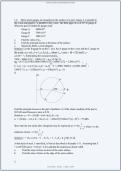
1-6 Three strain gauges are mounted on the surface of a part. Gauge A is parallel to
the x-axis and gauge C is parallel to the y-axis. The third gage, B, is at 30° to gauge A.
When the part is loaded the gauges read
Gauge A 3000x10-6
Gauge B 3500 x10-6
Gauge C 1000 x10-6
a. Find the value of γxy.
b. Find the principal strains in the plane of the surface.
c. Sketch the Mohr’s circle diagram.
Solution: Let the B gauge be on the x’ axis, the A gauge on the x-axis and the C gauge on
2 2
the y-axis. exx= exxℓ xx+ e ℓ xyy+ γxyℓ xxℓ xy , where ℓ xx = cosex = 30 = √3/2 and ℓ xy =
y
cos 60 = ½. Substituting the measured strains,
3500 = 3000(√2/3)2 – 1000(1/2)2 + γxy(√3/2)(1/2)
2 2 -6
γ◻xy = (4/√3/2){3500-[3000–(1000(√3/2) +1000(1/2) ]} = 2,309 (x10 ) 2
1/2
b. e1,e2 = (ex +ey)/2± [(ex-ey)2 + γxy2] /2 = (3000+1000)/2 ± [(3000-1000) +
23092]1/2/2 .e1 = 3530(x10-6), e2 = 470(x10-6), e3 = 0.
c)
γ/2
sx
s2 s1
s
sx’
sy
Find the principal stresses in the part of problem 1-6 if the elastic modulus of the part is
205 GPa and Poissons’s ratio is 0.29.
Solution: e3 = 0 = (1/E)[0 - v (σ1+σ2)], σ1 = σ2
e1 = (1/E)(σ1 - v σ1); σ1 = Ee1/(1-v) = 205x109(3530x10-6)/(1-.292) = 79 MPa
1
Show that the true strain after elongation may be expressed as s = ln( ) where r is the
1– r
1
reduction of area. s = ln( ).
1– r
Solution: r = (Ao-A1)/Ao =1 – A1/Ao = 1 – Lo/L1. s = ln[1/(1-r)]
◻
A thin sheet of steel, 1-mm thick, is bent as described in Example 1-11. Assuming that E
= is 205 GPa and v = 0.29, p = 2.0 m and that the neutral axis doesn’t shift.
a. Find the state of stress on most of the outer surface.
b. Find the state of stress at the edge of the outer surface.
2
Coursesity - Stuvia | Page 1 of 90
, STUDY NOTES & REFERENCE GUIDE
Solution: a. Substituting E = 205x109, t = 0.001, p = 2.0 and v = 0.29
Et vEt
into σx = and σy = , σx = 56 MPa, , σy = 16.2 MPa
2p(1 – v )
2
2p(1 – v 2 )
vEt
b. Now σy = 0, so σy = = 51 MPa
2p
1-10 For an aluminum sheet, under plane stress loading sx = 0.003 and sy = 0.001.
Assuming that E = is 68 GPa and v = 0.30, find sz.
Solution: ey = (1/E)(σy-vσy), ex = (1/E)(σx – vEey – v2σx). Solving for σx,
σx = [E/(1-v2)]ey + vey). Similarly, σy = [E/(1-v2)](ey + vex). Substituting into
ez = (1/E)(-vσy-vσy) = (-v /E)(E/(1-v2)[ey + vey+ ey + vex ) = [-v(1+v)//(1-v2)](ey + ey) =
0.29(-1.29/0.916)(0.004) = -0.00163
1-11 A piece of steel is elastically loaded under principal stresses, σ1 = 300 MPa, σ2 =
250 MPa and σ3 = -200 MPa. Assuming that E = is 205 GPa and v = 0.29 find the stored
elastic energy per volume.
Solution: w = (1/2)(σ1e1 + σ2e2 + σ3e3). Substituting e1 = (1/E)[σ1 - v(σ2 + σ3)],
e2 = (1/E)[σ2 -2 v(σ32+ σ1)]2 and e3 = (1/E)[σ3 - v(σ1 + σ2)],
w = 1/(2E)[σ + σ + σ - 2v(σ σ +σ σ +σ σ )] =
1 2 3 2 3 3 1 1 2
(1/(2x205x10 )[300 +250 + 200 –(2x0.29)(-200x250 – 300x250 + 250+300)]x1012 =
9 2 2 2
400J/m3
1-12 A slab of metal is subjected to plane-strain deformation (e2=0) such that σ1 = 40
ksi and σ3 = 0. Assume that the loading is elastic and
that E = is 205 GPa and v = 0.29 (Note the mixed units.) Find
a. the three normal strains.
b. the strain energy per volume.
Solution: w = (1/2)(σ1e1 + σ2e2 + σ3e3) = (1/2)(σ1e1 + 0 + 0) = σ1e1/2
σ1 = 40ksi(6.89MPa/ksi) = 276 MPa
0 = e2 = (1/E)[σ2 -v σ1], σ2 =v σ1 = 0.29x276 = 80 MPa
e1 = (1/E)(σ1 -v σ2) =(1/205x103)[276-.29(80)] = 0.00121
w = (276x106)(0.00121)/2 = 167 kJ/m3
Chapter 2
a) If the principal stresses on a material with a yield stress in shear of 200 MPa are σ2
= 175 MPa and σ1 = 350 MPa., what is the stress, σ3, at yielding according to the Tresca
criterion?
b) If the stresses in (a) were compressive, what tensile stress σ3 must be applied to cause
yielding according to the Tresca criterion?
Solution: a) σ1 - σ3 = 2k, σ3 = 2k – σ1 = 400 - 350 = 50 MPa.
3
Coursesity - Stuvia | Page 2 of 90
, STUDY NOTES & REFERENCE GUIDE
b) σ3 = 2k – σ1 = 400 – (350) = 50 MPa
Consider a 6-cm diameter tube with 1-mm thick wall with closed ends made from a
metal with a tensile yield strength of 25 MPa. After applying a compressive load of 2000
N to the ends. What internal pressure is required to cause yielding according to a) the
Tresca criterion. b) the von Mises criterion?
Solution: a) The ratio of the tube diameter to wall thickness is very large, so it can be treated as a thin
wall tube. The stress caused by the pressure can be found by x- and y- direction force balances.
From pressure, σx = Pd/(2t) = 60P and σy = Pd/(4t) = 30P. The stress caused by the axial load is σy =
F/(dt) = -2000N/[π(0.060)(0.001)]= -10.6 MPa, so the total stress, σy = 30P -10.6 MPa
a) σx = 60P = σmax is the largest stress, σy = 30P -10.6 MPa and σz = 0. There are two
possibilities which must be checked.
i. If σz < σy, σz = σmin, yielding will occur when 60P-0 = Y, or P=Y/60 =25/60 = 0.416 MPa
ii. If σy < σz, σy = σmin, and yielding will occur when
60P-(30P-10.6) = Y, or 30P = Y + 10.6, P = (Y+10.6)/30 = 35.6/30 = 1.1187 MPa
Yielding will occur when the smaller of the two values is reached, and therefore the smaller one is
appropriate. P = 0.415 MPa
b) Substituting into eq. 2-7 (in MPa),
2(25) = [60P-(30P -10.6)]2 +[(30P -10.6)-0]2 + [0-60P]2
2
1250 = 5400P2 + 224, p = 0.436 MPa
2-3 Consider a 0.5 m-diameter cylindrical pressure vessel with hemispherical ends
made from a metal for which k = 500 MPa. If no section of the pressure vessel is to yield
under an internal pressure of 35 MPa, what is the minimum wall thickness according to a)
the Tresca criterion? b) the von Mises criterion?
Solution: A force balance in the hemispherical ends gives σx ( =σy) = PD/(4t).
A force balance in the cylindrical section gives σx = PD/(2t). σy = PD/(4t) so this
section has the greatest stress.
a. σmax - σmin = 2k, PD/2t – 0 = 2k, t = PD/(4k) = 35(0.5)/(4x500) = 8.75 mm
b. (σx/2 - 0)2 + (0 - σx)2+ (σx -σx/2)2 = 6k2, (3/2)σ x2 = 6k2, σx = 2k = PD/(2t), t =
PD/(4k) which is identical to part a. t = 8.75 mm
2 2
s = 2(sx + sy /3
)
2-4 A thin-wall tube is subjected to combined tensile and torsional loading. Find the
relationship between the axial stress, σ, the shear stress, τ, and the tensile yield strength,
◻ Y, to cause yielding according to a) the Tresca criterion, b) the von Mises criterion.
Solution: a) σ1,σ 2 = σ /2 (σ /2)2 + τ 2 If σ /2 – (σ /2)2 + τ 2 > 0, σmin = 0, so the
Tresca criterion predicts yielding when σ /2 (σ /2)2 + τ 2 = Y . If σ /2 – (σ /2)2 + τ 2 <
0, σmin = – (σ /2)2 + τ 2 , so the Tresca criterion predicts yielding when 2 (σ /2)2 + τ 2
b) {2[σ /2 – (σ /2)2 + τ 2 ]2 +[ 2 (σ /2)2 + τ 2 ]2}1/2 = √2Y+
◻ ◻
◻ ◻
◻ ◻
4
Coursesity - Stuvia | Page 3 of 90
, STUDY NOTES & REFERENCE GUIDE
Consider a plane-strain compression test with a compressive load, Fy, a strip width,
w, an indenter width, b, and a strip thickness, t. Using the von Mises criterion, find:
a) s as a function of sy.
b) σ as a function of σy.
c) an expression for the work per volume in terms of sy and σy.
◻ d) an expression in the form of σy = f(K,sy,n) assuming σ = Ks n .
◻ Solution: a. If sz = 0, sy = - ex s = 2(s 2 + s 2) /3= = 1.154sy
x y
2
b. σx = 0, σz = -(1/2)σy; σ = (1/2)[(σ y – σ y /2) + (σ y /2 – 0)2 + (0 – σ y )2 ] = σy/1.154
◻
c. w = ∫σydsy
n+1/2
d. σ y = 4 /3σ = 4/3Ks n = 4 /3K( )s y)n = (4/3) ey
◻
2-6 The following yield criterion has been proposed: “Yielding will occur when the sum
of the two largest shear stresses reaches a critical value. “ Stated mathematically
◻ (σ1- σ3) + (σ1- σ2) = C if (σ1 - σ2) > (σ2 - σ3) or (σ2 - σ3) + (σ1 - σ2) = C if (σ1- σ2) ≤
(σ2- σ3) where σ1 > σ2 > σ3, C = 2Y and Y = tensile yield strength.
a) Is this criterion satisfactory for an isotropic solid where Y is insensitive to pressure?
Justify your answer.
b) Plot the σz = 0 yield locus. Sketch the Tresca yield locus on the same plot
c) Where σz = 0, find the values of σx and σy for
i. plane strain, sz = 0, with sx > 0
ii. axisymmetric flow with sy = sz = sx/2 and sx > 0
Solution: a) Yes. The value of the left hand sides are not affected if each principal stress is increased
the same amount.
b) First find the constant C. Consider an x-direction tension test. At yielding, σx = σ1 = Y,
σy = σz = σ2 = σ3 = 0. Therefore (σ1 - σ2)> (σ2 - σ3) so criterion I applies, and C = (σ1 - σ3) +
(σ1 - σ2) = 2Y. Therefore C = 2Y.
We can also think about an x-direction compression test. At yielding, σx = σ3 = -Y, σy = σz = σ2 =
σ3 = . Therefore (σ2 - σ3)>(σ1 - σ2)> so criterion II applies, and C = (σ1 - σ3) + (σ2 - σ3) = -(-
2Y) or again C = 2Y.
Now consider several loading paths:
In region A, σx = σ1, σy = σ2, σz= σ3 = 0 and σx >2σy so (σ1 - σ3) >(σ1 - σ2)
Therefore criterion I, (σx - ) + (σx - σy) = 2Y, or σx = Y + σy/2
In region B, σx = σ1, σy = σ2, σz= σ3 = 0 but σx <2σy so (σ1 - σ3)<(σ1 - σ2)
Therefore criterion II, (σx - ) + (σy - ) = 2Y, or σx = 2Y - σy
In region C, σy = σ1, σx= σ2, σz= σ3 = 0 but σy <2σx so (σ1 - σ3)<(σ1 - σ2)
Therefore criterion II, (σy - ) + (σx - ) = 2Y, or σy = 2Y - σx
In region D, σy = σ1, σx = σ2, σz= σ3 = 0 and σy >2σx so (σ1 - σ2) >(σ2 - σ3)
Therefore criterion I, (σy - ) + (σy - σx) = 2Y, or σy = Y + σx/2
5
Coursesity - Stuvia | Page 4 of 90
1-6 Three strain gauges are mounted on the surface of a part. Gauge A is parallel to
the x-axis and gauge C is parallel to the y-axis. The third gage, B, is at 30° to gauge A.
When the part is loaded the gauges read
Gauge A 3000x10-6
Gauge B 3500 x10-6
Gauge C 1000 x10-6
a. Find the value of γxy.
b. Find the principal strains in the plane of the surface.
c. Sketch the Mohr’s circle diagram.
Solution: Let the B gauge be on the x’ axis, the A gauge on the x-axis and the C gauge on
2 2
the y-axis. exx= exxℓ xx+ e ℓ xyy+ γxyℓ xxℓ xy , where ℓ xx = cosex = 30 = √3/2 and ℓ xy =
y
cos 60 = ½. Substituting the measured strains,
3500 = 3000(√2/3)2 – 1000(1/2)2 + γxy(√3/2)(1/2)
2 2 -6
γ◻xy = (4/√3/2){3500-[3000–(1000(√3/2) +1000(1/2) ]} = 2,309 (x10 ) 2
1/2
b. e1,e2 = (ex +ey)/2± [(ex-ey)2 + γxy2] /2 = (3000+1000)/2 ± [(3000-1000) +
23092]1/2/2 .e1 = 3530(x10-6), e2 = 470(x10-6), e3 = 0.
c)
γ/2
sx
s2 s1
s
sx’
sy
Find the principal stresses in the part of problem 1-6 if the elastic modulus of the part is
205 GPa and Poissons’s ratio is 0.29.
Solution: e3 = 0 = (1/E)[0 - v (σ1+σ2)], σ1 = σ2
e1 = (1/E)(σ1 - v σ1); σ1 = Ee1/(1-v) = 205x109(3530x10-6)/(1-.292) = 79 MPa
1
Show that the true strain after elongation may be expressed as s = ln( ) where r is the
1– r
1
reduction of area. s = ln( ).
1– r
Solution: r = (Ao-A1)/Ao =1 – A1/Ao = 1 – Lo/L1. s = ln[1/(1-r)]
◻
A thin sheet of steel, 1-mm thick, is bent as described in Example 1-11. Assuming that E
= is 205 GPa and v = 0.29, p = 2.0 m and that the neutral axis doesn’t shift.
a. Find the state of stress on most of the outer surface.
b. Find the state of stress at the edge of the outer surface.
2
Coursesity - Stuvia | Page 1 of 90
, STUDY NOTES & REFERENCE GUIDE
Solution: a. Substituting E = 205x109, t = 0.001, p = 2.0 and v = 0.29
Et vEt
into σx = and σy = , σx = 56 MPa, , σy = 16.2 MPa
2p(1 – v )
2
2p(1 – v 2 )
vEt
b. Now σy = 0, so σy = = 51 MPa
2p
1-10 For an aluminum sheet, under plane stress loading sx = 0.003 and sy = 0.001.
Assuming that E = is 68 GPa and v = 0.30, find sz.
Solution: ey = (1/E)(σy-vσy), ex = (1/E)(σx – vEey – v2σx). Solving for σx,
σx = [E/(1-v2)]ey + vey). Similarly, σy = [E/(1-v2)](ey + vex). Substituting into
ez = (1/E)(-vσy-vσy) = (-v /E)(E/(1-v2)[ey + vey+ ey + vex ) = [-v(1+v)//(1-v2)](ey + ey) =
0.29(-1.29/0.916)(0.004) = -0.00163
1-11 A piece of steel is elastically loaded under principal stresses, σ1 = 300 MPa, σ2 =
250 MPa and σ3 = -200 MPa. Assuming that E = is 205 GPa and v = 0.29 find the stored
elastic energy per volume.
Solution: w = (1/2)(σ1e1 + σ2e2 + σ3e3). Substituting e1 = (1/E)[σ1 - v(σ2 + σ3)],
e2 = (1/E)[σ2 -2 v(σ32+ σ1)]2 and e3 = (1/E)[σ3 - v(σ1 + σ2)],
w = 1/(2E)[σ + σ + σ - 2v(σ σ +σ σ +σ σ )] =
1 2 3 2 3 3 1 1 2
(1/(2x205x10 )[300 +250 + 200 –(2x0.29)(-200x250 – 300x250 + 250+300)]x1012 =
9 2 2 2
400J/m3
1-12 A slab of metal is subjected to plane-strain deformation (e2=0) such that σ1 = 40
ksi and σ3 = 0. Assume that the loading is elastic and
that E = is 205 GPa and v = 0.29 (Note the mixed units.) Find
a. the three normal strains.
b. the strain energy per volume.
Solution: w = (1/2)(σ1e1 + σ2e2 + σ3e3) = (1/2)(σ1e1 + 0 + 0) = σ1e1/2
σ1 = 40ksi(6.89MPa/ksi) = 276 MPa
0 = e2 = (1/E)[σ2 -v σ1], σ2 =v σ1 = 0.29x276 = 80 MPa
e1 = (1/E)(σ1 -v σ2) =(1/205x103)[276-.29(80)] = 0.00121
w = (276x106)(0.00121)/2 = 167 kJ/m3
Chapter 2
a) If the principal stresses on a material with a yield stress in shear of 200 MPa are σ2
= 175 MPa and σ1 = 350 MPa., what is the stress, σ3, at yielding according to the Tresca
criterion?
b) If the stresses in (a) were compressive, what tensile stress σ3 must be applied to cause
yielding according to the Tresca criterion?
Solution: a) σ1 - σ3 = 2k, σ3 = 2k – σ1 = 400 - 350 = 50 MPa.
3
Coursesity - Stuvia | Page 2 of 90
, STUDY NOTES & REFERENCE GUIDE
b) σ3 = 2k – σ1 = 400 – (350) = 50 MPa
Consider a 6-cm diameter tube with 1-mm thick wall with closed ends made from a
metal with a tensile yield strength of 25 MPa. After applying a compressive load of 2000
N to the ends. What internal pressure is required to cause yielding according to a) the
Tresca criterion. b) the von Mises criterion?
Solution: a) The ratio of the tube diameter to wall thickness is very large, so it can be treated as a thin
wall tube. The stress caused by the pressure can be found by x- and y- direction force balances.
From pressure, σx = Pd/(2t) = 60P and σy = Pd/(4t) = 30P. The stress caused by the axial load is σy =
F/(dt) = -2000N/[π(0.060)(0.001)]= -10.6 MPa, so the total stress, σy = 30P -10.6 MPa
a) σx = 60P = σmax is the largest stress, σy = 30P -10.6 MPa and σz = 0. There are two
possibilities which must be checked.
i. If σz < σy, σz = σmin, yielding will occur when 60P-0 = Y, or P=Y/60 =25/60 = 0.416 MPa
ii. If σy < σz, σy = σmin, and yielding will occur when
60P-(30P-10.6) = Y, or 30P = Y + 10.6, P = (Y+10.6)/30 = 35.6/30 = 1.1187 MPa
Yielding will occur when the smaller of the two values is reached, and therefore the smaller one is
appropriate. P = 0.415 MPa
b) Substituting into eq. 2-7 (in MPa),
2(25) = [60P-(30P -10.6)]2 +[(30P -10.6)-0]2 + [0-60P]2
2
1250 = 5400P2 + 224, p = 0.436 MPa
2-3 Consider a 0.5 m-diameter cylindrical pressure vessel with hemispherical ends
made from a metal for which k = 500 MPa. If no section of the pressure vessel is to yield
under an internal pressure of 35 MPa, what is the minimum wall thickness according to a)
the Tresca criterion? b) the von Mises criterion?
Solution: A force balance in the hemispherical ends gives σx ( =σy) = PD/(4t).
A force balance in the cylindrical section gives σx = PD/(2t). σy = PD/(4t) so this
section has the greatest stress.
a. σmax - σmin = 2k, PD/2t – 0 = 2k, t = PD/(4k) = 35(0.5)/(4x500) = 8.75 mm
b. (σx/2 - 0)2 + (0 - σx)2+ (σx -σx/2)2 = 6k2, (3/2)σ x2 = 6k2, σx = 2k = PD/(2t), t =
PD/(4k) which is identical to part a. t = 8.75 mm
2 2
s = 2(sx + sy /3
)
2-4 A thin-wall tube is subjected to combined tensile and torsional loading. Find the
relationship between the axial stress, σ, the shear stress, τ, and the tensile yield strength,
◻ Y, to cause yielding according to a) the Tresca criterion, b) the von Mises criterion.
Solution: a) σ1,σ 2 = σ /2 (σ /2)2 + τ 2 If σ /2 – (σ /2)2 + τ 2 > 0, σmin = 0, so the
Tresca criterion predicts yielding when σ /2 (σ /2)2 + τ 2 = Y . If σ /2 – (σ /2)2 + τ 2 <
0, σmin = – (σ /2)2 + τ 2 , so the Tresca criterion predicts yielding when 2 (σ /2)2 + τ 2
b) {2[σ /2 – (σ /2)2 + τ 2 ]2 +[ 2 (σ /2)2 + τ 2 ]2}1/2 = √2Y+
◻ ◻
◻ ◻
◻ ◻
4
Coursesity - Stuvia | Page 3 of 90
, STUDY NOTES & REFERENCE GUIDE
Consider a plane-strain compression test with a compressive load, Fy, a strip width,
w, an indenter width, b, and a strip thickness, t. Using the von Mises criterion, find:
a) s as a function of sy.
b) σ as a function of σy.
c) an expression for the work per volume in terms of sy and σy.
◻ d) an expression in the form of σy = f(K,sy,n) assuming σ = Ks n .
◻ Solution: a. If sz = 0, sy = - ex s = 2(s 2 + s 2) /3= = 1.154sy
x y
2
b. σx = 0, σz = -(1/2)σy; σ = (1/2)[(σ y – σ y /2) + (σ y /2 – 0)2 + (0 – σ y )2 ] = σy/1.154
◻
c. w = ∫σydsy
n+1/2
d. σ y = 4 /3σ = 4/3Ks n = 4 /3K( )s y)n = (4/3) ey
◻
2-6 The following yield criterion has been proposed: “Yielding will occur when the sum
of the two largest shear stresses reaches a critical value. “ Stated mathematically
◻ (σ1- σ3) + (σ1- σ2) = C if (σ1 - σ2) > (σ2 - σ3) or (σ2 - σ3) + (σ1 - σ2) = C if (σ1- σ2) ≤
(σ2- σ3) where σ1 > σ2 > σ3, C = 2Y and Y = tensile yield strength.
a) Is this criterion satisfactory for an isotropic solid where Y is insensitive to pressure?
Justify your answer.
b) Plot the σz = 0 yield locus. Sketch the Tresca yield locus on the same plot
c) Where σz = 0, find the values of σx and σy for
i. plane strain, sz = 0, with sx > 0
ii. axisymmetric flow with sy = sz = sx/2 and sx > 0
Solution: a) Yes. The value of the left hand sides are not affected if each principal stress is increased
the same amount.
b) First find the constant C. Consider an x-direction tension test. At yielding, σx = σ1 = Y,
σy = σz = σ2 = σ3 = 0. Therefore (σ1 - σ2)> (σ2 - σ3) so criterion I applies, and C = (σ1 - σ3) +
(σ1 - σ2) = 2Y. Therefore C = 2Y.
We can also think about an x-direction compression test. At yielding, σx = σ3 = -Y, σy = σz = σ2 =
σ3 = . Therefore (σ2 - σ3)>(σ1 - σ2)> so criterion II applies, and C = (σ1 - σ3) + (σ2 - σ3) = -(-
2Y) or again C = 2Y.
Now consider several loading paths:
In region A, σx = σ1, σy = σ2, σz= σ3 = 0 and σx >2σy so (σ1 - σ3) >(σ1 - σ2)
Therefore criterion I, (σx - ) + (σx - σy) = 2Y, or σx = Y + σy/2
In region B, σx = σ1, σy = σ2, σz= σ3 = 0 but σx <2σy so (σ1 - σ3)<(σ1 - σ2)
Therefore criterion II, (σx - ) + (σy - ) = 2Y, or σx = 2Y - σy
In region C, σy = σ1, σx= σ2, σz= σ3 = 0 but σy <2σx so (σ1 - σ3)<(σ1 - σ2)
Therefore criterion II, (σy - ) + (σx - ) = 2Y, or σy = 2Y - σx
In region D, σy = σ1, σx = σ2, σz= σ3 = 0 and σy >2σx so (σ1 - σ2) >(σ2 - σ3)
Therefore criterion I, (σy - ) + (σy - σx) = 2Y, or σy = Y + σx/2
5
Coursesity - Stuvia | Page 4 of 90


