
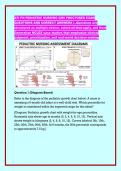
ATI PN PEDIATRIC NURSING CMS PROCTORED EXAM
QUESTIONS AND CORRECT ANSWERS (..Questions are
structured as multiple-choice, select-all-that-apply, and Next
Generation NCLEX case studies that emphasize clinical
judgment, prioritization, and real-world decision-making
Question 1 (Diagram-Based)
Refer to the diagram of the pediatric growth chart below. A nurse is
assessing a 6-month-old infant at a well-child visit. Which percentile for
weight is considered within the expected range for this infant?
[Diagram: Pediatric growth chart with weight-for-age percentiles.
Horizontal axis shows age in months (0, 2, 4, 6, 8, 10, 12). Vertical axis
shows weight in kilograms (2, 4, 6, 8, 10, 12). Curves labeled: 5th, 10th,
25th, 50th, 75th, 90th, 95th. At 6 months, the 50th percentile corresponds
to approximately 7.5 kg.]
,A. Below the 5th percentile
B. Between the 10th and 90th percentiles
C. Above the 95th percentile
D. At the 50th percentile only
B. Between the 10th and 90th percentiles
RATIONALE: A weight between the 10th and 90th percentiles is
considered within the expected range for a 6-month-old infant.
Measurements below the 5th percentile or above the 95th percentile
require further assessment. A single point at the 50th percentile is also
normal, but the range of 10th to 90th is more broadly expected.
Question 2 (Diagram-Based)
Refer to the diagram of the infant's fontanelles below. A nurse is
assessing a 2-month-old infant. Which finding about the fontanelles
,indicates a potential concern?
[Diagram: Infant skull showing anterior fontanelle (labeled A) and
posterior fontanelle (labeled B). Anterior fontanelle is diamond-shaped
and located at the junction of the coronal and sagittal sutures. Posterior
fontanelle is triangular and located at the junction of the sagittal and
lambdoid sutures.]
A. Anterior fontanelle is soft and flat
B. Posterior fontanelle is closed
C. Anterior fontanelle is sunken
D. Anterior fontanelle is bulging
C. Anterior fontanelle is sunken
RATIONALE: A sunken anterior fontanelle indicates dehydration and
requires immediate intervention. A soft, flat anterior fontanelle is
normal. The posterior fontanelle typically closes by 2 to 3 months of age.
A bulging fontanelle indicates increased intracranial pressure.
, Question 3 (Diagram-Based)
Refer to the diagram of the pediatric airway below. A nurse is caring for
a 3-year-old child with croup. Which anatomical difference in the
pediatric airway increases the risk for obstruction?
[Diagram: Comparison of adult and pediatric airways. Pediatric airway
labeled: A (Funnel-shaped larynx), B (Narrowest at the cricoid
cartilage), C (Large tongue relative to oral cavity), D (Short, narrow
trachea).]
A. Funnel-shaped larynx
B. Narrowest at the cricoid cartilage
C. Large tongue relative to oral cavity
D. All of the above
QUESTIONS AND CORRECT ANSWERS (..Questions are
structured as multiple-choice, select-all-that-apply, and Next
Generation NCLEX case studies that emphasize clinical
judgment, prioritization, and real-world decision-making
Question 1 (Diagram-Based)
Refer to the diagram of the pediatric growth chart below. A nurse is
assessing a 6-month-old infant at a well-child visit. Which percentile for
weight is considered within the expected range for this infant?
[Diagram: Pediatric growth chart with weight-for-age percentiles.
Horizontal axis shows age in months (0, 2, 4, 6, 8, 10, 12). Vertical axis
shows weight in kilograms (2, 4, 6, 8, 10, 12). Curves labeled: 5th, 10th,
25th, 50th, 75th, 90th, 95th. At 6 months, the 50th percentile corresponds
to approximately 7.5 kg.]
,A. Below the 5th percentile
B. Between the 10th and 90th percentiles
C. Above the 95th percentile
D. At the 50th percentile only
B. Between the 10th and 90th percentiles
RATIONALE: A weight between the 10th and 90th percentiles is
considered within the expected range for a 6-month-old infant.
Measurements below the 5th percentile or above the 95th percentile
require further assessment. A single point at the 50th percentile is also
normal, but the range of 10th to 90th is more broadly expected.
Question 2 (Diagram-Based)
Refer to the diagram of the infant's fontanelles below. A nurse is
assessing a 2-month-old infant. Which finding about the fontanelles
,indicates a potential concern?
[Diagram: Infant skull showing anterior fontanelle (labeled A) and
posterior fontanelle (labeled B). Anterior fontanelle is diamond-shaped
and located at the junction of the coronal and sagittal sutures. Posterior
fontanelle is triangular and located at the junction of the sagittal and
lambdoid sutures.]
A. Anterior fontanelle is soft and flat
B. Posterior fontanelle is closed
C. Anterior fontanelle is sunken
D. Anterior fontanelle is bulging
C. Anterior fontanelle is sunken
RATIONALE: A sunken anterior fontanelle indicates dehydration and
requires immediate intervention. A soft, flat anterior fontanelle is
normal. The posterior fontanelle typically closes by 2 to 3 months of age.
A bulging fontanelle indicates increased intracranial pressure.
, Question 3 (Diagram-Based)
Refer to the diagram of the pediatric airway below. A nurse is caring for
a 3-year-old child with croup. Which anatomical difference in the
pediatric airway increases the risk for obstruction?
[Diagram: Comparison of adult and pediatric airways. Pediatric airway
labeled: A (Funnel-shaped larynx), B (Narrowest at the cricoid
cartilage), C (Large tongue relative to oral cavity), D (Short, narrow
trachea).]
A. Funnel-shaped larynx
B. Narrowest at the cricoid cartilage
C. Large tongue relative to oral cavity
D. All of the above


