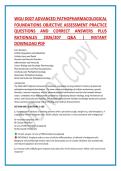
WGU D027 ADVANCED PATHOPHARMACOLOGICAL
FOUNDATIONS OBJECTIVE ASSESSMENT PRACTICE
QUESTIONS AND CORRECT ANSWERS PLUS
RATIONALES 2026/207 Q&A | INSTANT
DOWNLOAD PDF
Core Domains
Cellular Regulation and Adaptation
Cellular Injury and Death
Genetics and Genetic Disorders
Inflammation and Immunity
Cancer Biology and Oncologic Pharmacology
Pharmacokinetics and Pharmacodynamics
Cardiovascular Pathopharmacology
Respiratory Pathopharmacology
Renal and Endocrine Pathopharmacology
Introduction
The WGU D027 Objective Assessment evaluates a graduate nursing student's mastery of advanced
pathopharmacological foundations. The exam assesses knowledge of cellular mechanisms, genetic
disorders, immune responses, and the pharmacological interventions used to treat complex disease
states. Candidates must demonstrate competency in analyzing disease etiology, drug mechanisms of
action, and clinical decision-making. The multiple-choice format includes knowledge-based and scenario-
driven questions emphasizing critical thinking and evidence-based practice.
SECTION ONE: QUESTIONS 1–100
1. A patient with a history of smoking presents with a persistent cough, weight loss, and hemoptysis. A
lung biopsy reveals malignant cells. Which cellular characteristic is most consistent with malignancy?
A) Increased apoptosis rate
B) Contact inhibition
C) Loss of differentiation (anaplasia)
D) Decreased mitotic rate
Correct answer: C) Loss of differentiation (anaplasia)
RATIONALE: Anaplasia refers to loss of cellular differentiation, a hallmark of malignant cells.
Malignant cells exhibit high mitotic rates (not decreased), loss of contact inhibition (not maintained),
and reduced apoptosis (not increased) .
2. A woman with a BRCA1 gene mutation asks about her risk for breast cancer. What is the nurse's best
response?
,A) "BRCA1 mutation is not associated with breast cancer risk."
B) "Women with BRCA1 mutations have a 50-80% lifetime risk of breast cancer."
C) "BRCA1 mutations only increase ovarian cancer risk, not breast cancer."
D) "BRCA1 mutations guarantee that you will develop breast cancer."
Correct answer: B) "Women with BRCA1 mutations have a 50-80% lifetime risk of breast cancer."
RATIONALE: BRCA1 and BRCA2 are tumor suppressor genes. Mutations significantly increase breast
cancer risk (50-80% lifetime) and ovarian cancer risk (20-40%). The mutations do not guarantee cancer
development .
3. During carcinogenesis, the process by which a normal cell acquires genetic mutations leading to
malignant transformation is called:
A) Apoptosis
B) Metastasis
C) Initiation-promotion-progression
D) Angiogenesis
Correct answer: C) Initiation-promotion-progression
RATIONALE: Carcinogenesis involves three stages: initiation (DNA damage by carcinogen),
promotion (proliferation of initiated cells), and progression (acquisition of invasive/metastatic
capabilities) .
4. A patient receiving chemotherapy develops neutropenia. Which assessment finding is most
concerning?
A) Temperature of 38.3°C (101.0°F)
B) Fatigue
C) Nausea
D) Alopecia
Correct answer: A) Temperature of 38.3°C (101.0°F)
RATIONALE: Fever in a neutropenic patient (febrile neutropenia) is a medical emergency indicating
possible sepsis. Neutropenic patients have impaired inflammatory response and may not show typical
signs of infection .
5. A patient with metastatic lung cancer is prescribed bevacizumab (Avastin). Which adverse effect
requires immediate intervention?
A) Hypertension
B) Diarrhea
C) Hemorrhage
D) Fatigue
Correct answer: C) Hemorrhage
RATIONALE: Bevacizumab is an anti-VEGF monoclonal antibody that increases bleeding risk
(hemorrhage), including gastrointestinal bleeding, hemoptysis, and intracranial hemorrhage.
Hemorrhage is life-threatening .
, 6. A patient receiving trastuzumab (Herceptin) for HER2-positive breast cancer should be monitored for
which adverse effect?
A) Cardiotoxicity
B) Nephrotoxicity
C) Ototoxicity
D) Hepatotoxicity
Correct answer: A) Cardiotoxicity
RATIONALE: Trastuzumab is a monoclonal antibody against HER2 that can cause cardiotoxicity
(cardiomyopathy, heart failure), especially when combined with anthracyclines .
7. A patient with metastatic lung cancer reports severe bone pain. The nurse understands this is likely
due to:
A) Tumor compression of spinal cord
B) Osteolytic metastases
C) Neuropathic pain from chemotherapy
D) Muscle strain from coughing
Correct answer: B) Osteolytic metastases
RATIONALE: Bone metastases cause bone destruction, release of cytokines, and severe pain.
Osteolytic lesions weaken bone, increasing fracture risk .
8. Which cellular adaptation is characterized by a decrease in cell size and function?
A) Hyperplasia
B) Hypertrophy
C) Atrophy
D) Metaplasia
Correct answer: C) Atrophy
RATIONALE: Atrophy occurs when cells shrink due to decreased workload, aging, reduced blood
supply, or loss of hormonal stimulation .
9. Hypertrophy is best defined as:
A) Increase in cell number
B) Increase in cell size
C) Cell death
D) Genetic mutation
Correct answer: B) Increase in cell size
RATIONALE: Hypertrophy occurs when existing cells enlarge, leading to increased tissue or organ
size, such as left ventricular hypertrophy in hypertension .
10. Which cellular adaptation involves replacement of one mature cell type with another?
FOUNDATIONS OBJECTIVE ASSESSMENT PRACTICE
QUESTIONS AND CORRECT ANSWERS PLUS
RATIONALES 2026/207 Q&A | INSTANT
DOWNLOAD PDF
Core Domains
Cellular Regulation and Adaptation
Cellular Injury and Death
Genetics and Genetic Disorders
Inflammation and Immunity
Cancer Biology and Oncologic Pharmacology
Pharmacokinetics and Pharmacodynamics
Cardiovascular Pathopharmacology
Respiratory Pathopharmacology
Renal and Endocrine Pathopharmacology
Introduction
The WGU D027 Objective Assessment evaluates a graduate nursing student's mastery of advanced
pathopharmacological foundations. The exam assesses knowledge of cellular mechanisms, genetic
disorders, immune responses, and the pharmacological interventions used to treat complex disease
states. Candidates must demonstrate competency in analyzing disease etiology, drug mechanisms of
action, and clinical decision-making. The multiple-choice format includes knowledge-based and scenario-
driven questions emphasizing critical thinking and evidence-based practice.
SECTION ONE: QUESTIONS 1–100
1. A patient with a history of smoking presents with a persistent cough, weight loss, and hemoptysis. A
lung biopsy reveals malignant cells. Which cellular characteristic is most consistent with malignancy?
A) Increased apoptosis rate
B) Contact inhibition
C) Loss of differentiation (anaplasia)
D) Decreased mitotic rate
Correct answer: C) Loss of differentiation (anaplasia)
RATIONALE: Anaplasia refers to loss of cellular differentiation, a hallmark of malignant cells.
Malignant cells exhibit high mitotic rates (not decreased), loss of contact inhibition (not maintained),
and reduced apoptosis (not increased) .
2. A woman with a BRCA1 gene mutation asks about her risk for breast cancer. What is the nurse's best
response?
,A) "BRCA1 mutation is not associated with breast cancer risk."
B) "Women with BRCA1 mutations have a 50-80% lifetime risk of breast cancer."
C) "BRCA1 mutations only increase ovarian cancer risk, not breast cancer."
D) "BRCA1 mutations guarantee that you will develop breast cancer."
Correct answer: B) "Women with BRCA1 mutations have a 50-80% lifetime risk of breast cancer."
RATIONALE: BRCA1 and BRCA2 are tumor suppressor genes. Mutations significantly increase breast
cancer risk (50-80% lifetime) and ovarian cancer risk (20-40%). The mutations do not guarantee cancer
development .
3. During carcinogenesis, the process by which a normal cell acquires genetic mutations leading to
malignant transformation is called:
A) Apoptosis
B) Metastasis
C) Initiation-promotion-progression
D) Angiogenesis
Correct answer: C) Initiation-promotion-progression
RATIONALE: Carcinogenesis involves three stages: initiation (DNA damage by carcinogen),
promotion (proliferation of initiated cells), and progression (acquisition of invasive/metastatic
capabilities) .
4. A patient receiving chemotherapy develops neutropenia. Which assessment finding is most
concerning?
A) Temperature of 38.3°C (101.0°F)
B) Fatigue
C) Nausea
D) Alopecia
Correct answer: A) Temperature of 38.3°C (101.0°F)
RATIONALE: Fever in a neutropenic patient (febrile neutropenia) is a medical emergency indicating
possible sepsis. Neutropenic patients have impaired inflammatory response and may not show typical
signs of infection .
5. A patient with metastatic lung cancer is prescribed bevacizumab (Avastin). Which adverse effect
requires immediate intervention?
A) Hypertension
B) Diarrhea
C) Hemorrhage
D) Fatigue
Correct answer: C) Hemorrhage
RATIONALE: Bevacizumab is an anti-VEGF monoclonal antibody that increases bleeding risk
(hemorrhage), including gastrointestinal bleeding, hemoptysis, and intracranial hemorrhage.
Hemorrhage is life-threatening .
, 6. A patient receiving trastuzumab (Herceptin) for HER2-positive breast cancer should be monitored for
which adverse effect?
A) Cardiotoxicity
B) Nephrotoxicity
C) Ototoxicity
D) Hepatotoxicity
Correct answer: A) Cardiotoxicity
RATIONALE: Trastuzumab is a monoclonal antibody against HER2 that can cause cardiotoxicity
(cardiomyopathy, heart failure), especially when combined with anthracyclines .
7. A patient with metastatic lung cancer reports severe bone pain. The nurse understands this is likely
due to:
A) Tumor compression of spinal cord
B) Osteolytic metastases
C) Neuropathic pain from chemotherapy
D) Muscle strain from coughing
Correct answer: B) Osteolytic metastases
RATIONALE: Bone metastases cause bone destruction, release of cytokines, and severe pain.
Osteolytic lesions weaken bone, increasing fracture risk .
8. Which cellular adaptation is characterized by a decrease in cell size and function?
A) Hyperplasia
B) Hypertrophy
C) Atrophy
D) Metaplasia
Correct answer: C) Atrophy
RATIONALE: Atrophy occurs when cells shrink due to decreased workload, aging, reduced blood
supply, or loss of hormonal stimulation .
9. Hypertrophy is best defined as:
A) Increase in cell number
B) Increase in cell size
C) Cell death
D) Genetic mutation
Correct answer: B) Increase in cell size
RATIONALE: Hypertrophy occurs when existing cells enlarge, leading to increased tissue or organ
size, such as left ventricular hypertrophy in hypertension .
10. Which cellular adaptation involves replacement of one mature cell type with another?