
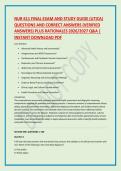
NUR 611 FINAL EXAM AND STUDY GUIDE (UTICA)
QUESTIONS AND CORRECT ANSWERS (VERIFIED
ANSWERS) PLUS RATIONALES 2026/2027 Q&A |
INSTANT DOWNLOAD PDF
Core Domains
• Advanced Health History and Interviewing*
• Integumentary and HEENT Assessment*
• Cardiovascular and Peripheral Vascular Assessment*
• Respiratory and Thoracic Assessment*
• Abdominal and Gastrointestinal Assessment*
• Neurological and Musculoskeletal Assessment*
• Diagnostic Reasoning and Clinical Decision-Making*
• Evidence-Based Practice and Clinical Guidelines*
• Ethical, Legal, and Cultural Considerations*
• Health Promotion and Disease Prevention*
Introduction
This comprehensive assessment evaluates advanced health assessment and diagnostic reasoning
competencies required for graduate-level nursing practice. It measures mastery of comprehensive history
taking, physical examination techniques, differential diagnosis formulation, and evidence-based clinical
decision-making. The examination uses multiple-choice and scenario-based items reflecting realistic
patient encounters across the lifespan. Emphasis is placed on clinical judgment, prioritization, cultural
competence, and the integration of subjective and objective data to formulate appropriate plans of care.
Candidates must demonstrate the ability to apply advanced assessment skills to identify health problems
and guide clinical management.
SECTION ONE: QUESTIONS 1–100
Question 1
A 58-year-old male presents with exertional chest pressure that radiates to his left jaw and resolves with
rest. Which of the following is the most likely diagnosis?
A. Pericarditis
B. Stable angina
,C. Unstable angina
D. Gastroesophageal reflux disease
B. Stable angina
RATIONALE: Stable angina is characterized by predictable chest pain that occurs with exertion and
resolves with rest or nitroglycerin. The pain is typically substernal and may radiate to the jaw, neck, or
left arm. Unstable angina occurs at rest or with minimal exertion and is unpredictable.
Question 2
A nurse is assessing a patient with suspected heart failure. Which finding is most consistent with left-
sided heart failure?
A. Peripheral edema
B. Jugular venous distention
C. Crackles in the lung bases
D. Hepatomegaly
C. Crackles in the lung bases
RATIONALE: Left-sided heart failure causes pulmonary congestion, leading to crackles, dyspnea,
orthopnea, and paroxysmal nocturnal dyspnea. Right-sided heart failure causes peripheral edema,
jugular venous distention, and hepatomegaly.
Question 3
A patient presents with sudden onset of severe abdominal pain, rigidity, and absent bowel sounds.
Which of the following is the most likely diagnosis?
A. Gastroenteritis
B. Bowel obstruction
C. Peritonitis
D. Appendicitis
C. Peritonitis
RATIONALE: Peritonitis is characterized by sudden, severe abdominal pain, abdominal rigidity
(board-like abdomen), rebound tenderness, and absent bowel sounds. It is a surgical emergency.
Question 4
A patient presents with a headache, fever, and neck stiffness. Which of the following is the most
appropriate next step?
,A. Administer acetaminophen and discharge
B. Perform a lumbar puncture
C. Obtain a CT scan of the head
D. Prescribe antibiotics and send home
B. Perform a lumbar puncture
RATIONALE: The triad of headache, fever, and neck stiffness suggests meningitis. A lumbar puncture
is the definitive diagnostic procedure to analyze cerebrospinal fluid. However, a CT scan may be
performed first if increased intracranial pressure is suspected.
Question 5
A patient presents with unilateral facial droop, arm weakness, and slurred speech. What is the most
appropriate initial action?
A. Administer aspirin immediately
B. Activate emergency stroke protocol
C. Obtain a detailed history
D. Schedule an outpatient MRI
B. Activate emergency stroke protocol
RATIONALE: The findings suggest an acute stroke. Time is critical for thrombolytic therapy.
Emergency stroke protocol should be activated immediately for rapid assessment and intervention.
Question 6
A 45-year-old female presents with fatigue, weight gain, cold intolerance, and constipation. Which of
the following is the most likely diagnosis?
A. Hyperthyroidism
B. Hypothyroidism
C. Diabetes mellitus
D. Anemia
B. Hypothyroidism
RATIONALE: Hypothyroidism presents with fatigue, weight gain, cold intolerance, constipation, dry
skin, and bradycardia. Hyperthyroidism presents with weight loss, heat intolerance, and tachycardia.
Question 7
A patient presents with polyuria, polydipsia, and polyphagia. Which of the following is the most likely
diagnosis?
, A. Diabetes insipidus
B. Diabetes mellitus
C. Hyperthyroidism
D. Chronic kidney disease
B. Diabetes mellitus
RATIONALE: The classic triad of polyuria, polydipsia, and polyphagia suggests diabetes mellitus.
Hyperglycemia causes osmotic diuresis (polyuria), dehydration (polydipsia), and cellular starvation
(polyphagia).
Question 8
A patient presents with a sudden onset of severe flank pain radiating to the groin, hematuria, and
nausea. Which of the following is the most likely diagnosis?
A. Pyelonephritis
B. Renal calculi
C. Appendicitis
D. Diverticulitis
B. Renal calculi
RATIONALE: Renal calculi (kidney stones) present with severe, colicky flank pain radiating to the
groin, hematuria, nausea, and vomiting. Pyelonephritis presents with fever, chills, and costovertebral
angle tenderness.
Question 9
A patient presents with a painless, firm, movable mass in the breast. Which of the following is the most
appropriate next step?
A. Reassure the patient and schedule a follow-up in 6 months
B. Order a diagnostic mammogram and ultrasound
C. Prescribe antibiotics
D. Perform a fine needle aspiration without imaging
B. Order a diagnostic mammogram and ultrasound
RATIONALE: A painless, firm, movable breast mass requires evaluation to rule out malignancy.
Diagnostic mammography and ultrasound are the appropriate initial imaging studies. Fine needle
aspiration or biopsy may follow based on imaging results.
Question 10
QUESTIONS AND CORRECT ANSWERS (VERIFIED
ANSWERS) PLUS RATIONALES 2026/2027 Q&A |
INSTANT DOWNLOAD PDF
Core Domains
• Advanced Health History and Interviewing*
• Integumentary and HEENT Assessment*
• Cardiovascular and Peripheral Vascular Assessment*
• Respiratory and Thoracic Assessment*
• Abdominal and Gastrointestinal Assessment*
• Neurological and Musculoskeletal Assessment*
• Diagnostic Reasoning and Clinical Decision-Making*
• Evidence-Based Practice and Clinical Guidelines*
• Ethical, Legal, and Cultural Considerations*
• Health Promotion and Disease Prevention*
Introduction
This comprehensive assessment evaluates advanced health assessment and diagnostic reasoning
competencies required for graduate-level nursing practice. It measures mastery of comprehensive history
taking, physical examination techniques, differential diagnosis formulation, and evidence-based clinical
decision-making. The examination uses multiple-choice and scenario-based items reflecting realistic
patient encounters across the lifespan. Emphasis is placed on clinical judgment, prioritization, cultural
competence, and the integration of subjective and objective data to formulate appropriate plans of care.
Candidates must demonstrate the ability to apply advanced assessment skills to identify health problems
and guide clinical management.
SECTION ONE: QUESTIONS 1–100
Question 1
A 58-year-old male presents with exertional chest pressure that radiates to his left jaw and resolves with
rest. Which of the following is the most likely diagnosis?
A. Pericarditis
B. Stable angina
,C. Unstable angina
D. Gastroesophageal reflux disease
B. Stable angina
RATIONALE: Stable angina is characterized by predictable chest pain that occurs with exertion and
resolves with rest or nitroglycerin. The pain is typically substernal and may radiate to the jaw, neck, or
left arm. Unstable angina occurs at rest or with minimal exertion and is unpredictable.
Question 2
A nurse is assessing a patient with suspected heart failure. Which finding is most consistent with left-
sided heart failure?
A. Peripheral edema
B. Jugular venous distention
C. Crackles in the lung bases
D. Hepatomegaly
C. Crackles in the lung bases
RATIONALE: Left-sided heart failure causes pulmonary congestion, leading to crackles, dyspnea,
orthopnea, and paroxysmal nocturnal dyspnea. Right-sided heart failure causes peripheral edema,
jugular venous distention, and hepatomegaly.
Question 3
A patient presents with sudden onset of severe abdominal pain, rigidity, and absent bowel sounds.
Which of the following is the most likely diagnosis?
A. Gastroenteritis
B. Bowel obstruction
C. Peritonitis
D. Appendicitis
C. Peritonitis
RATIONALE: Peritonitis is characterized by sudden, severe abdominal pain, abdominal rigidity
(board-like abdomen), rebound tenderness, and absent bowel sounds. It is a surgical emergency.
Question 4
A patient presents with a headache, fever, and neck stiffness. Which of the following is the most
appropriate next step?
,A. Administer acetaminophen and discharge
B. Perform a lumbar puncture
C. Obtain a CT scan of the head
D. Prescribe antibiotics and send home
B. Perform a lumbar puncture
RATIONALE: The triad of headache, fever, and neck stiffness suggests meningitis. A lumbar puncture
is the definitive diagnostic procedure to analyze cerebrospinal fluid. However, a CT scan may be
performed first if increased intracranial pressure is suspected.
Question 5
A patient presents with unilateral facial droop, arm weakness, and slurred speech. What is the most
appropriate initial action?
A. Administer aspirin immediately
B. Activate emergency stroke protocol
C. Obtain a detailed history
D. Schedule an outpatient MRI
B. Activate emergency stroke protocol
RATIONALE: The findings suggest an acute stroke. Time is critical for thrombolytic therapy.
Emergency stroke protocol should be activated immediately for rapid assessment and intervention.
Question 6
A 45-year-old female presents with fatigue, weight gain, cold intolerance, and constipation. Which of
the following is the most likely diagnosis?
A. Hyperthyroidism
B. Hypothyroidism
C. Diabetes mellitus
D. Anemia
B. Hypothyroidism
RATIONALE: Hypothyroidism presents with fatigue, weight gain, cold intolerance, constipation, dry
skin, and bradycardia. Hyperthyroidism presents with weight loss, heat intolerance, and tachycardia.
Question 7
A patient presents with polyuria, polydipsia, and polyphagia. Which of the following is the most likely
diagnosis?
, A. Diabetes insipidus
B. Diabetes mellitus
C. Hyperthyroidism
D. Chronic kidney disease
B. Diabetes mellitus
RATIONALE: The classic triad of polyuria, polydipsia, and polyphagia suggests diabetes mellitus.
Hyperglycemia causes osmotic diuresis (polyuria), dehydration (polydipsia), and cellular starvation
(polyphagia).
Question 8
A patient presents with a sudden onset of severe flank pain radiating to the groin, hematuria, and
nausea. Which of the following is the most likely diagnosis?
A. Pyelonephritis
B. Renal calculi
C. Appendicitis
D. Diverticulitis
B. Renal calculi
RATIONALE: Renal calculi (kidney stones) present with severe, colicky flank pain radiating to the
groin, hematuria, nausea, and vomiting. Pyelonephritis presents with fever, chills, and costovertebral
angle tenderness.
Question 9
A patient presents with a painless, firm, movable mass in the breast. Which of the following is the most
appropriate next step?
A. Reassure the patient and schedule a follow-up in 6 months
B. Order a diagnostic mammogram and ultrasound
C. Prescribe antibiotics
D. Perform a fine needle aspiration without imaging
B. Order a diagnostic mammogram and ultrasound
RATIONALE: A painless, firm, movable breast mass requires evaluation to rule out malignancy.
Diagnostic mammography and ultrasound are the appropriate initial imaging studies. Fine needle
aspiration or biopsy may follow based on imaging results.
Question 10


