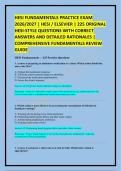
HESI FUNDAMENTALS PRACTICE EXAM
2026/2027 | HESI / ELSEVIER | 225 ORIGINAL
HESI-STYLE QUESTIONS WITH CORRECT
ANSWERS AND DETAILED RATIONALES |
COMPREHENSIVE FUNDAMENTALS REVIEW
GUIDE
HESI Fundamentals — 225 Practice Questions
1. A nurse is preparing to administer medication to a client. Which action should the
nurse take first?
A. Explain the medication's purpose
B. Verify the client's identity using two identifiers
C. Document the medication administration
D. Assess the client's response
Answer: B. Verify the client's identity using two identifiers.
Rationale: Using two identifiers helps ensure that medications are administered to the
correct client and is a fundamental medication-safety practice.
2. Which action is most effective for preventing the transmission of infection in
healthcare settings?
A. Wearing gloves during every client interaction
B. Performing hand hygiene before and after client contact
C. Administering prophylactic antibiotics
D. Keeping client rooms closed
Answer: B. Performing hand hygiene before and after client contact.
Rationale: Proper hand hygiene is one of the most effective methods for reducing
transmission of microorganisms.
3. A nurse is caring for a client who is at risk for falls. Which intervention is
appropriate?
,A. Keep the bed in the highest position
B. Place frequently used items within reach
C. Keep all four side rails raised
D. Encourage the client to walk independently
Answer: B. Place frequently used items within reach.
Rationale: Keeping necessary items accessible reduces the need for the client to reach,
stretch, or get out of bed unnecessarily.
4. Which assessment finding should the nurse report immediately?
A. Respiratory rate of 16/min
B. Oxygen saturation of 97%
C. New onset of confusion
D. Temperature of 37°C (98.6°F)
Answer: C. New onset of confusion.
Rationale: Acute confusion can indicate hypoxia, infection, metabolic disturbance,
medication effects, or another serious condition and requires prompt evaluation.
5. A nurse is preparing to perform a sterile procedure. Which action is appropriate?
A. Keep sterile supplies below waist level
B. Touch the inside of the sterile package
C. Consider the outer 2.5 cm (1 inch) of a sterile field contaminated
D. Reach across the sterile field
Answer: C. Consider the outer 2.5 cm (1 inch) of a sterile field contaminated.
Rationale: The outer edge of a sterile field is considered contaminated and should not be
used for sterile items.
6. Which position is generally appropriate for administering an oral medication to a
client who can swallow safely?
A. Supine
B. Prone
C. Upright or semi-Fowler's
D. Trendelenburg
Answer: C. Upright or semi-Fowler's.
,Rationale: Upright positioning facilitates swallowing and reduces the risk of aspiration.
7. A nurse needs to measure a client's respiratory rate. Which action is best?
A. Tell the client to breathe normally while being observed
B. Count respirations immediately after measuring the pulse without announcing the
assessment
C. Ask the client to take several deep breaths
D. Count for 5 seconds and multiply by 12
Answer: B. Count respirations immediately after measuring the pulse without announcing the
assessment.
Rationale: Clients may alter their breathing if they know respirations are being counted.
Counting immediately after the pulse provides a more accurate resting respiratory rate.
8. Which finding is most concerning in a postoperative client?
A. Mild incisional pain
B. Temperature of 37.2°C (99°F)
C. Sudden shortness of breath
D. Slight fatigue
Answer: C. Sudden shortness of breath.
Rationale: Sudden dyspnea may indicate a serious complication such as pulmonary embolism
and requires immediate assessment.
9. Which nursing action promotes effective communication with a hearing-impaired
client?
A. Shout directly into the client's ear
B. Face the client while speaking
C. Speak rapidly
D. Avoid using gestures
Answer: B. Face the client while speaking.
Rationale: Facing the client allows the person to observe facial expressions and lip
movements and improves communication.
10. Which statement demonstrates therapeutic communication?
, A. "You shouldn't feel that way."
B. "Everything will be fine."
C. "Tell me more about what concerns you."
D. "I know exactly how you feel."
Answer: C. "Tell me more about what concerns you."
Rationale: Open-ended statements encourage the client to express concerns and provide
additional information.
11. Which intervention is appropriate when caring for a client with impaired mobility?
A. Encourage prolonged bed rest
B. Perform range-of-motion exercises as prescribed
C. Avoid repositioning
D. Restrict fluids
Answer: B. Perform range-of-motion exercises as prescribed.
Rationale: Range-of-motion exercises help maintain joint mobility and reduce complications
associated with immobility.
12. Which client should the nurse assess first?
A. Client requesting assistance with bathing
B. Client reporting new chest pressure
C. Client requesting a snack
D. Client awaiting discharge instructions
Answer: B. Client reporting new chest pressure.
Rationale: New chest pressure may indicate a life-threatening cardiovascular problem and
takes priority according to airway, breathing, circulation, and acute-change principles.
13. What is the primary purpose of using an incentive spirometer after surgery?
A. Increase muscle strength
B. Prevent atelectasis
C. Reduce nausea
D. Improve digestion
Answer: B. Prevent atelectasis.
2026/2027 | HESI / ELSEVIER | 225 ORIGINAL
HESI-STYLE QUESTIONS WITH CORRECT
ANSWERS AND DETAILED RATIONALES |
COMPREHENSIVE FUNDAMENTALS REVIEW
GUIDE
HESI Fundamentals — 225 Practice Questions
1. A nurse is preparing to administer medication to a client. Which action should the
nurse take first?
A. Explain the medication's purpose
B. Verify the client's identity using two identifiers
C. Document the medication administration
D. Assess the client's response
Answer: B. Verify the client's identity using two identifiers.
Rationale: Using two identifiers helps ensure that medications are administered to the
correct client and is a fundamental medication-safety practice.
2. Which action is most effective for preventing the transmission of infection in
healthcare settings?
A. Wearing gloves during every client interaction
B. Performing hand hygiene before and after client contact
C. Administering prophylactic antibiotics
D. Keeping client rooms closed
Answer: B. Performing hand hygiene before and after client contact.
Rationale: Proper hand hygiene is one of the most effective methods for reducing
transmission of microorganisms.
3. A nurse is caring for a client who is at risk for falls. Which intervention is
appropriate?
,A. Keep the bed in the highest position
B. Place frequently used items within reach
C. Keep all four side rails raised
D. Encourage the client to walk independently
Answer: B. Place frequently used items within reach.
Rationale: Keeping necessary items accessible reduces the need for the client to reach,
stretch, or get out of bed unnecessarily.
4. Which assessment finding should the nurse report immediately?
A. Respiratory rate of 16/min
B. Oxygen saturation of 97%
C. New onset of confusion
D. Temperature of 37°C (98.6°F)
Answer: C. New onset of confusion.
Rationale: Acute confusion can indicate hypoxia, infection, metabolic disturbance,
medication effects, or another serious condition and requires prompt evaluation.
5. A nurse is preparing to perform a sterile procedure. Which action is appropriate?
A. Keep sterile supplies below waist level
B. Touch the inside of the sterile package
C. Consider the outer 2.5 cm (1 inch) of a sterile field contaminated
D. Reach across the sterile field
Answer: C. Consider the outer 2.5 cm (1 inch) of a sterile field contaminated.
Rationale: The outer edge of a sterile field is considered contaminated and should not be
used for sterile items.
6. Which position is generally appropriate for administering an oral medication to a
client who can swallow safely?
A. Supine
B. Prone
C. Upright or semi-Fowler's
D. Trendelenburg
Answer: C. Upright or semi-Fowler's.
,Rationale: Upright positioning facilitates swallowing and reduces the risk of aspiration.
7. A nurse needs to measure a client's respiratory rate. Which action is best?
A. Tell the client to breathe normally while being observed
B. Count respirations immediately after measuring the pulse without announcing the
assessment
C. Ask the client to take several deep breaths
D. Count for 5 seconds and multiply by 12
Answer: B. Count respirations immediately after measuring the pulse without announcing the
assessment.
Rationale: Clients may alter their breathing if they know respirations are being counted.
Counting immediately after the pulse provides a more accurate resting respiratory rate.
8. Which finding is most concerning in a postoperative client?
A. Mild incisional pain
B. Temperature of 37.2°C (99°F)
C. Sudden shortness of breath
D. Slight fatigue
Answer: C. Sudden shortness of breath.
Rationale: Sudden dyspnea may indicate a serious complication such as pulmonary embolism
and requires immediate assessment.
9. Which nursing action promotes effective communication with a hearing-impaired
client?
A. Shout directly into the client's ear
B. Face the client while speaking
C. Speak rapidly
D. Avoid using gestures
Answer: B. Face the client while speaking.
Rationale: Facing the client allows the person to observe facial expressions and lip
movements and improves communication.
10. Which statement demonstrates therapeutic communication?
, A. "You shouldn't feel that way."
B. "Everything will be fine."
C. "Tell me more about what concerns you."
D. "I know exactly how you feel."
Answer: C. "Tell me more about what concerns you."
Rationale: Open-ended statements encourage the client to express concerns and provide
additional information.
11. Which intervention is appropriate when caring for a client with impaired mobility?
A. Encourage prolonged bed rest
B. Perform range-of-motion exercises as prescribed
C. Avoid repositioning
D. Restrict fluids
Answer: B. Perform range-of-motion exercises as prescribed.
Rationale: Range-of-motion exercises help maintain joint mobility and reduce complications
associated with immobility.
12. Which client should the nurse assess first?
A. Client requesting assistance with bathing
B. Client reporting new chest pressure
C. Client requesting a snack
D. Client awaiting discharge instructions
Answer: B. Client reporting new chest pressure.
Rationale: New chest pressure may indicate a life-threatening cardiovascular problem and
takes priority according to airway, breathing, circulation, and acute-change principles.
13. What is the primary purpose of using an incentive spirometer after surgery?
A. Increase muscle strength
B. Prevent atelectasis
C. Reduce nausea
D. Improve digestion
Answer: B. Prevent atelectasis.