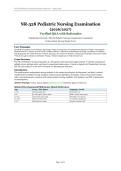
NR-328 Pediatric Nursing Examination 2026/2027 – Study Guide
NR-328 Pediatric Nursing Examination
(2026/2027)
Verified Q&A with Rationales
Chamberlain University | NR-328 Pediatric Nursing Comprehensive Assessment
Undergraduate Nursing Student Focus
Core Domains
Growth & Development Across Pediatric Age Groups • Family-Centered Care & Communication Strategies • Pediatric Assessment &
Health Promotion • Common Acute & Chronic Childhood Illnesses • Medication Administration & Dosage Calculations for Children •
Pain Management & Comfort Measures • Pediatric Emergency & Critical Care Priorities • Immunization Schedules & Preventive Health
• Ethical & Legal Considerations in Pediatric Nursing • Cultural Competency in Child & Family Care
Exam Structure
The NR-328 Pediatric Nursing Examination is a 50-question timed assessment (approximately 75 minutes) consisting of
multiple-choice, multiple-select, and clinical scenario/prioritization items. Content is aligned with Chamberlain University
NR-328 course objectives and AACN Essentials for Baccalaureate Education.
Introduction
This guide prepares undergraduate nursing students for the unique physiological, developmental, and family-centered
considerations in pediatric nursing. Emphasis is placed on age-appropriate assessment, evidence-based interventions,
safety, and communication consistent with current pediatric nursing standards, AAP guidance, and CDC immunization
recommendations.
Answer Format: Correct answers appear in bold green text. Rationales appear in italic text.
Selected Developmental Milestones (Quick Reference)
Age Gross / Fine Motor Language / Social
2–3 mo Lifts head; grasps rattle Social smile; coos
6 mo Sits with support; transfers objects Babbles; stranger anxiety begins
9–12 mo Crawls/cruises; pincer grasp Mama/dada; waves bye-bye
18–24 mo Walks well; stacks blocks 2-word phrases; parallel play
3–5 yr Hops/skips; draws shapes Sentences; cooperative play
Page 1 of 12
, NR-328 Pediatric Nursing Examination 2026/2027 – Study Guide
1. Growth & Development Across Pediatric Age
Groups
1. According to Erikson, the primary psychosocial developmental task of the toddler (1–3 years)
is:
A. Trust vs. Mistrust
B. Autonomy vs. Shame and Doubt
C. Initiative vs. Guilt
D. Industry vs. Inferiority
Correct Answer: B. Autonomy vs. Shame and Doubt
Rationale: Erikson’s stage for toddlers is Autonomy vs. Shame and Doubt, characterized by the drive for
independence (e.g., “me do it”). Trust vs. Mistrust is infancy; Initiative vs. Guilt is preschool; Industry vs.
Inferiority is school-age.
2. A 9-month-old infant who does not yet sit without support and shows no pincer grasp is most
concerning for:
A. Normal variation
B. Possible developmental delay requiring further evaluation
C. Advanced motor skills
D. Only a language delay
Correct Answer: B. Possible developmental delay requiring further evaluation
Rationale: By 9 months most infants sit independently and begin a pincer grasp. Failure to meet these
milestones warrants developmental screening and possible referral.
3. Which play type is most characteristic of a 2-year-old?
A. Cooperative play with shared goals
B. Parallel play (playing alongside but not with others)
C. Solitary play only
D. Competitive team sports
Correct Answer: B. Parallel play (playing alongside but not with others)
Rationale: Toddlers typically engage in parallel play. Cooperative play emerges in the preschool years.
4. The nurse teaches parents that the anterior fontanelle typically closes by:
A. 2–3 months
B. 6–8 months
C. 12–18 months
D. 24–36 months
Correct Answer: C. 12–18 months
Rationale: The anterior fontanelle usually closes between 12 and 18 months. The posterior fontanelle
closes earlier (by 2–3 months).
5. A school-age child (6–12 years) according to Piaget is typically in which cognitive stage?
A. Sensorimotor
B. Preoperational
C. Concrete operational
D. Formal operational
Correct Answer: C. Concrete operational
Rationale: School-age children are in the concrete operational stage (logical thought about concrete
events). Formal operational thinking develops in adolescence.
Page 2 of 12
NR-328 Pediatric Nursing Examination
(2026/2027)
Verified Q&A with Rationales
Chamberlain University | NR-328 Pediatric Nursing Comprehensive Assessment
Undergraduate Nursing Student Focus
Core Domains
Growth & Development Across Pediatric Age Groups • Family-Centered Care & Communication Strategies • Pediatric Assessment &
Health Promotion • Common Acute & Chronic Childhood Illnesses • Medication Administration & Dosage Calculations for Children •
Pain Management & Comfort Measures • Pediatric Emergency & Critical Care Priorities • Immunization Schedules & Preventive Health
• Ethical & Legal Considerations in Pediatric Nursing • Cultural Competency in Child & Family Care
Exam Structure
The NR-328 Pediatric Nursing Examination is a 50-question timed assessment (approximately 75 minutes) consisting of
multiple-choice, multiple-select, and clinical scenario/prioritization items. Content is aligned with Chamberlain University
NR-328 course objectives and AACN Essentials for Baccalaureate Education.
Introduction
This guide prepares undergraduate nursing students for the unique physiological, developmental, and family-centered
considerations in pediatric nursing. Emphasis is placed on age-appropriate assessment, evidence-based interventions,
safety, and communication consistent with current pediatric nursing standards, AAP guidance, and CDC immunization
recommendations.
Answer Format: Correct answers appear in bold green text. Rationales appear in italic text.
Selected Developmental Milestones (Quick Reference)
Age Gross / Fine Motor Language / Social
2–3 mo Lifts head; grasps rattle Social smile; coos
6 mo Sits with support; transfers objects Babbles; stranger anxiety begins
9–12 mo Crawls/cruises; pincer grasp Mama/dada; waves bye-bye
18–24 mo Walks well; stacks blocks 2-word phrases; parallel play
3–5 yr Hops/skips; draws shapes Sentences; cooperative play
Page 1 of 12
, NR-328 Pediatric Nursing Examination 2026/2027 – Study Guide
1. Growth & Development Across Pediatric Age
Groups
1. According to Erikson, the primary psychosocial developmental task of the toddler (1–3 years)
is:
A. Trust vs. Mistrust
B. Autonomy vs. Shame and Doubt
C. Initiative vs. Guilt
D. Industry vs. Inferiority
Correct Answer: B. Autonomy vs. Shame and Doubt
Rationale: Erikson’s stage for toddlers is Autonomy vs. Shame and Doubt, characterized by the drive for
independence (e.g., “me do it”). Trust vs. Mistrust is infancy; Initiative vs. Guilt is preschool; Industry vs.
Inferiority is school-age.
2. A 9-month-old infant who does not yet sit without support and shows no pincer grasp is most
concerning for:
A. Normal variation
B. Possible developmental delay requiring further evaluation
C. Advanced motor skills
D. Only a language delay
Correct Answer: B. Possible developmental delay requiring further evaluation
Rationale: By 9 months most infants sit independently and begin a pincer grasp. Failure to meet these
milestones warrants developmental screening and possible referral.
3. Which play type is most characteristic of a 2-year-old?
A. Cooperative play with shared goals
B. Parallel play (playing alongside but not with others)
C. Solitary play only
D. Competitive team sports
Correct Answer: B. Parallel play (playing alongside but not with others)
Rationale: Toddlers typically engage in parallel play. Cooperative play emerges in the preschool years.
4. The nurse teaches parents that the anterior fontanelle typically closes by:
A. 2–3 months
B. 6–8 months
C. 12–18 months
D. 24–36 months
Correct Answer: C. 12–18 months
Rationale: The anterior fontanelle usually closes between 12 and 18 months. The posterior fontanelle
closes earlier (by 2–3 months).
5. A school-age child (6–12 years) according to Piaget is typically in which cognitive stage?
A. Sensorimotor
B. Preoperational
C. Concrete operational
D. Formal operational
Correct Answer: C. Concrete operational
Rationale: School-age children are in the concrete operational stage (logical thought about concrete
events). Formal operational thinking develops in adolescence.
Page 2 of 12