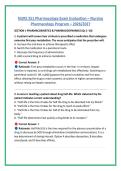
NURS 251 Pharmacology Exam Evaluation – Nursing
Pharmacology Program – 2026/2027
SECTION I: PHARMACOKINETICS & PHARMACODYNAMICS (Qs 1–10)
1. A patient with severe liver cirrhosis is prescribed a medication that undergoes
extensive first-pass metabolism. The nurse anticipates that the prescriber will:
A. Increase the oral dose to achieve therapeutic effect
B. Switch the medication to a parenteral route
C. Decrease the frequency of administration
D. Add a second drug to enhance metabolism
Correct Answer: B
Rationale: First-pass metabolism occurs in the liver. In cirrhosis, hepatic
function is impaired, so oral drugs are metabolized less effectively. Switching to a
parenteral route (IV, IM, subQ) bypasses the portal circulation and first-pass
effect, allowing the drug to reach systemic circulation in higher concentrations
without relying on hepatic extraction.
2. A nurse is teaching a patient about drug half-life. Which statement by the
patient indicates correct understanding?
A. "Half-life is the time it takes for half the drug to be absorbed into my blood."
B. "Half-life is the time it takes for the drug to reach its peak effect."
C. "Half-life is the time it takes for half of the drug to be eliminated from my
body."
D. "Half-life determines how quickly a drug binds to its receptor."
Correct Answer: C
Rationale: Half-life (t½) is the time required for the plasma concentration of a
drug to decrease by 50% through elimination (metabolism and excretion). It is a
key determinant of dosing interval. Option A describes absorption, B describes
onset/peak, and D describes affinity.
,3. A patient is receiving a drug that has a narrow therapeutic index. The nurse
prioritizes which action?
A. Administering the drug with food to enhance absorption
B. Monitoring serum drug levels regularly
C. Encouraging the patient to increase fluid intake
D. Rotating the injection site daily
Correct Answer: B
Rationale: A narrow therapeutic index means the difference between the
minimum effective concentration and the toxic concentration is small (e.g.,
digoxin, lithium, warfarin). Therapeutic drug monitoring (TDM) is essential to
maintain levels within the safe window and prevent toxicity.
4. A patient reports that a newly prescribed drug "does not work as well as it
used to." The nurse suspects tolerance. Which mechanism best explains
tolerance?
A. Increased drug excretion by the kidneys
B. Down-regulation of receptors
C. Decreased gastrointestinal absorption
D. Increased protein binding
Correct Answer: B
Rationale: Tolerance occurs when the body adapts to a drug over time, often
due to receptor down-regulation (decreased number or sensitivity of receptors).
This requires higher doses to achieve the same effect. Option A would affect
duration, not necessarily tolerance; C and D are less likely primary mechanisms.
5. A nurse is reviewing a patient's medication list and notes a drug that acts as a
competitive antagonist. The nurse understands this means the drug:
A. Binds to the receptor and activates it
B. Binds to the receptor and prevents activation by the agonist
C. Binds to a different site and changes receptor shape
D. Enhances the effect of the agonist
, Correct Answer: B
Rationale: A competitive antagonist reversibly binds to the same receptor site
as the agonist, blocking the agonist from binding and activating the receptor.
Increasing the agonist concentration can overcome this blockade. Option A
describes an agonist; C describes allosteric modulation; D describes potentiation.
6. A drug with a high volume of distribution (Vd) is most likely to:
A. Remain primarily in the bloodstream
B. Concentrate in tissues and have a long duration of action
C. Be rapidly excreted by the kidneys
D. Have a high first-pass effect
Correct Answer: B
Rationale: High Vd indicates that the drug extensively distributes into tissues
(fat, muscle, organs) rather than staying in plasma. This leads to a longer duration
of action as the drug is slowly released back into circulation. Option A describes
low Vd.
7. The nurse administers a loading dose of a medication. The primary purpose of
a loading dose is to:
A. Maintain the drug at a steady state over a long period
B. Rapidly achieve a therapeutic serum level
C. Reduce the risk of adverse effects
D. Allow for once-daily dosing
Correct Answer: B
Rationale: A loading dose is a larger initial dose given to quickly reach a
therapeutic concentration in the blood. It is followed by smaller maintenance
doses to keep the level within the therapeutic range. It does not reduce side
effects or necessarily allow once-daily dosing.
8. A patient with renal impairment is prescribed a drug that is primarily excreted
unchanged in the urine. The nurse expects the prescriber to:
, A. Increase the dose
B. Decrease the dose or prolong the dosing interval
C. Administer the drug via the oral route
D. Discontinue the drug immediately
Correct Answer: B
Rationale: Renal impairment reduces glomerular filtration and active tubular
secretion, leading to drug accumulation. To prevent toxicity, the dose must be
reduced or the interval extended. Increasing the dose would be dangerous.
9. Which parenteral route provides the fastest onset of action?
A. Intramuscular (IM)
B. Subcutaneous (SubQ)
C. Intravenous (IV)
D. Intradermal (ID)
Correct Answer: C
Rationale: IV administration delivers the drug directly into the bloodstream,
achieving 100% bioavailability and the most rapid onset of action. IM and SubQ
require absorption from the injection site, which delays onset.
10. A nurse is evaluating a patient for a potential adverse drug reaction. Which
finding is a classic sign of a type I hypersensitivity reaction?
A. Stevens-Johnson syndrome
B. Anaphylaxis with bronchospasm and hypotension
C. Hemolytic anemia
D. Contact dermatitis
Correct Answer: B
Rationale: Type I hypersensitivity is IgE-mediated and occurs rapidly (minutes
to hours). It manifests as anaphylaxis, urticaria, angioedema, bronchospasm, and
hypotension. Stevens-Johnson is type IV (delayed cell-mediated). Hemolytic
anemia is type II (cytotoxic). Contact dermatitis is type IV.
Pharmacology Program – 2026/2027
SECTION I: PHARMACOKINETICS & PHARMACODYNAMICS (Qs 1–10)
1. A patient with severe liver cirrhosis is prescribed a medication that undergoes
extensive first-pass metabolism. The nurse anticipates that the prescriber will:
A. Increase the oral dose to achieve therapeutic effect
B. Switch the medication to a parenteral route
C. Decrease the frequency of administration
D. Add a second drug to enhance metabolism
Correct Answer: B
Rationale: First-pass metabolism occurs in the liver. In cirrhosis, hepatic
function is impaired, so oral drugs are metabolized less effectively. Switching to a
parenteral route (IV, IM, subQ) bypasses the portal circulation and first-pass
effect, allowing the drug to reach systemic circulation in higher concentrations
without relying on hepatic extraction.
2. A nurse is teaching a patient about drug half-life. Which statement by the
patient indicates correct understanding?
A. "Half-life is the time it takes for half the drug to be absorbed into my blood."
B. "Half-life is the time it takes for the drug to reach its peak effect."
C. "Half-life is the time it takes for half of the drug to be eliminated from my
body."
D. "Half-life determines how quickly a drug binds to its receptor."
Correct Answer: C
Rationale: Half-life (t½) is the time required for the plasma concentration of a
drug to decrease by 50% through elimination (metabolism and excretion). It is a
key determinant of dosing interval. Option A describes absorption, B describes
onset/peak, and D describes affinity.
,3. A patient is receiving a drug that has a narrow therapeutic index. The nurse
prioritizes which action?
A. Administering the drug with food to enhance absorption
B. Monitoring serum drug levels regularly
C. Encouraging the patient to increase fluid intake
D. Rotating the injection site daily
Correct Answer: B
Rationale: A narrow therapeutic index means the difference between the
minimum effective concentration and the toxic concentration is small (e.g.,
digoxin, lithium, warfarin). Therapeutic drug monitoring (TDM) is essential to
maintain levels within the safe window and prevent toxicity.
4. A patient reports that a newly prescribed drug "does not work as well as it
used to." The nurse suspects tolerance. Which mechanism best explains
tolerance?
A. Increased drug excretion by the kidneys
B. Down-regulation of receptors
C. Decreased gastrointestinal absorption
D. Increased protein binding
Correct Answer: B
Rationale: Tolerance occurs when the body adapts to a drug over time, often
due to receptor down-regulation (decreased number or sensitivity of receptors).
This requires higher doses to achieve the same effect. Option A would affect
duration, not necessarily tolerance; C and D are less likely primary mechanisms.
5. A nurse is reviewing a patient's medication list and notes a drug that acts as a
competitive antagonist. The nurse understands this means the drug:
A. Binds to the receptor and activates it
B. Binds to the receptor and prevents activation by the agonist
C. Binds to a different site and changes receptor shape
D. Enhances the effect of the agonist
, Correct Answer: B
Rationale: A competitive antagonist reversibly binds to the same receptor site
as the agonist, blocking the agonist from binding and activating the receptor.
Increasing the agonist concentration can overcome this blockade. Option A
describes an agonist; C describes allosteric modulation; D describes potentiation.
6. A drug with a high volume of distribution (Vd) is most likely to:
A. Remain primarily in the bloodstream
B. Concentrate in tissues and have a long duration of action
C. Be rapidly excreted by the kidneys
D. Have a high first-pass effect
Correct Answer: B
Rationale: High Vd indicates that the drug extensively distributes into tissues
(fat, muscle, organs) rather than staying in plasma. This leads to a longer duration
of action as the drug is slowly released back into circulation. Option A describes
low Vd.
7. The nurse administers a loading dose of a medication. The primary purpose of
a loading dose is to:
A. Maintain the drug at a steady state over a long period
B. Rapidly achieve a therapeutic serum level
C. Reduce the risk of adverse effects
D. Allow for once-daily dosing
Correct Answer: B
Rationale: A loading dose is a larger initial dose given to quickly reach a
therapeutic concentration in the blood. It is followed by smaller maintenance
doses to keep the level within the therapeutic range. It does not reduce side
effects or necessarily allow once-daily dosing.
8. A patient with renal impairment is prescribed a drug that is primarily excreted
unchanged in the urine. The nurse expects the prescriber to:
, A. Increase the dose
B. Decrease the dose or prolong the dosing interval
C. Administer the drug via the oral route
D. Discontinue the drug immediately
Correct Answer: B
Rationale: Renal impairment reduces glomerular filtration and active tubular
secretion, leading to drug accumulation. To prevent toxicity, the dose must be
reduced or the interval extended. Increasing the dose would be dangerous.
9. Which parenteral route provides the fastest onset of action?
A. Intramuscular (IM)
B. Subcutaneous (SubQ)
C. Intravenous (IV)
D. Intradermal (ID)
Correct Answer: C
Rationale: IV administration delivers the drug directly into the bloodstream,
achieving 100% bioavailability and the most rapid onset of action. IM and SubQ
require absorption from the injection site, which delays onset.
10. A nurse is evaluating a patient for a potential adverse drug reaction. Which
finding is a classic sign of a type I hypersensitivity reaction?
A. Stevens-Johnson syndrome
B. Anaphylaxis with bronchospasm and hypotension
C. Hemolytic anemia
D. Contact dermatitis
Correct Answer: B
Rationale: Type I hypersensitivity is IgE-mediated and occurs rapidly (minutes
to hours). It manifests as anaphylaxis, urticaria, angioedema, bronchospasm, and
hypotension. Stevens-Johnson is type IV (delayed cell-mediated). Hemolytic
anemia is type II (cytotoxic). Contact dermatitis is type IV.