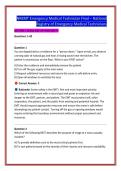
NREMT Emergency Medical Technician Final – National
Registry of Emergency Medical Technicians
SECTION I: SCENE SIZE-UP AND SAFETY
Questions 1–20
Question 1
You are dispatched to a residence for a "person down." Upon arrival, you observe
a strong odor of natural gas and hear a hissing sound near the kitchen. The
patient is unconscious on the floor. What is your FIRST action?
A) Enter the residence and immediately remove the patient
B) Turn off the gas supply at the main valve
C) Request additional resources and ensure the scene is safe before entry
D) Open all windows to ventilate the area
Correct Answer: C
Rationale: Scene safety is the EMT's first and most important priority.
Entering an environment with a natural gas leak poses an explosion risk and
danger to the EMT, partner, and patient. The EMT must protect self, other
responders, the patient, and the public from existing and potential hazards. The
EMT should request appropriate resources and ensure the scene is safe before
attempting any patient contact. Turning off the gas or opening windows would
require entering the hazardous environment without proper assessment and
resources.
Question 2
Which of the following BEST describes the purpose of triage at a mass casualty
incident?
A) To provide definitive care to the most critical patients first
B) To sort patients based on the severity of their injuries and resource availability
,C) To transport patients to the nearest hospital regardless of condition
D) To identify patients who are deceased and leave them in place
Correct Answer: B
Rationale: Triage is the process of sorting patients based on the severity of
their injuries and the availability of resources to ensure optimal care for the
greatest number of patients. At a mass casualty incident, resources are limited,
and triage helps prioritize care and transport. The goal is to do the greatest good
for the greatest number of patients, not to provide definitive care on scene.
Question 3
You are responding to a motor vehicle collision on a highway. Which of the
following actions represents the MOST appropriate scene size-up?
A) Park the ambulance directly behind the collision to block traffic
B) Position the ambulance uphill and upwind from the scene
C) Position the ambulance at a 45-degree angle to shield the scene from
oncoming traffic
D) Park the ambulance as close to the vehicles as possible for rapid extrication
Correct Answer: C
Rationale: The ambulance should be positioned at a 45-degree angle (also
called "fend-off" position) with the wheels turned away from the scene to provide
a protective barrier between the scene and oncoming traffic. This positioning uses
the ambulance as a shield and maximizes scene safety. Parking behind the
collision does not provide adequate protection, and parking uphill/upwind is
relevant for hazardous materials incidents, not general MVCs.
Question 4
A 45-year-old male is found unresponsive in a confined space with a suspicious
odor. Bystanders state he was working with pesticides. What PPE should the EMT
don FIRST?
,A) N95 mask and gloves
B) Surgical mask and eye protection
C) Full turnout gear with SCBA
D) Level B or C hazmat suit with appropriate respiratory protection
Correct Answer: D
Rationale: When a hazardous materials incident is suspected (pesticides in a
confined space), the EMT must don appropriate personal protective equipment
based on known hazards. Pesticides can be absorbed through the skin and
inhaled; therefore, a hazmat suit with appropriate respiratory protection is
required. The EMT should not enter the scene without proper protection. N95
masks and surgical masks do not provide adequate protection against chemical
hazards.
Question 5
You arrive at a scene where a patient is actively being assaulted by a family
member. The family member is still present and armed with a knife. What is your
IMMEDIATE action?
A) Attempt to calm the family member down verbally
B) Retreat to a safe location and contact law enforcement
C) Enter the scene and remove the patient from danger
D) Use your radio to call for backup while remaining on scene
Correct Answer: B
Rationale: An active violent scene with an armed assailant is an immediate
danger to the EMT. The priority is to protect self and other responders. The EMT
should retreat to a safe location and contact law enforcement. The EMT should
never enter an unsafe scene or attempt to intervene in an active violent situation.
Personal safety is paramount.
, Question 6
Which of the following is an example of a mechanism of injury that should
increase the EMT's index of suspicion for significant trauma?
A) A 3-foot fall from a chair
B) A 70-year-old female who tripped on a rug
C) A motor vehicle collision at 15 mph with airbag deployment
D) A pedestrian struck by a vehicle at 25 mph
Correct Answer: D
Rationale: A pedestrian struck by a vehicle at 25 mph represents a significant
mechanism of injury. High-risk mechanisms include falls greater than 15 feet (or 3
times the patient's height), high-speed MVCs, pedestrian vs. vehicle impacts, and
motorcycle crashes. A 3-foot fall is generally low-risk, though geriatric patients
may have increased risk from low-mechanism falls. A 15 mph MVC with airbag
deployment is moderate risk.
Question 7
You are on scene with a patient who was found in a garage with a running car.
The patient is unconscious but breathing. What is your FIRST priority?
A) Administer high-flow oxygen
B) Remove the patient from the garage
C) Check the patient's pulse
D) Turn off the vehicle
Correct Answer: B
Rationale: The patient is in an environment with carbon monoxide (CO)
poisoning risk from the running vehicle. The immediate priority is to remove the
patient from the hazardous environment to prevent ongoing exposure to both the
EMT and the patient. Scene safety and patient removal take precedence over
specific interventions like oxygen administration, though oxygen will be needed
shortly after removal.
Registry of Emergency Medical Technicians
SECTION I: SCENE SIZE-UP AND SAFETY
Questions 1–20
Question 1
You are dispatched to a residence for a "person down." Upon arrival, you observe
a strong odor of natural gas and hear a hissing sound near the kitchen. The
patient is unconscious on the floor. What is your FIRST action?
A) Enter the residence and immediately remove the patient
B) Turn off the gas supply at the main valve
C) Request additional resources and ensure the scene is safe before entry
D) Open all windows to ventilate the area
Correct Answer: C
Rationale: Scene safety is the EMT's first and most important priority.
Entering an environment with a natural gas leak poses an explosion risk and
danger to the EMT, partner, and patient. The EMT must protect self, other
responders, the patient, and the public from existing and potential hazards. The
EMT should request appropriate resources and ensure the scene is safe before
attempting any patient contact. Turning off the gas or opening windows would
require entering the hazardous environment without proper assessment and
resources.
Question 2
Which of the following BEST describes the purpose of triage at a mass casualty
incident?
A) To provide definitive care to the most critical patients first
B) To sort patients based on the severity of their injuries and resource availability
,C) To transport patients to the nearest hospital regardless of condition
D) To identify patients who are deceased and leave them in place
Correct Answer: B
Rationale: Triage is the process of sorting patients based on the severity of
their injuries and the availability of resources to ensure optimal care for the
greatest number of patients. At a mass casualty incident, resources are limited,
and triage helps prioritize care and transport. The goal is to do the greatest good
for the greatest number of patients, not to provide definitive care on scene.
Question 3
You are responding to a motor vehicle collision on a highway. Which of the
following actions represents the MOST appropriate scene size-up?
A) Park the ambulance directly behind the collision to block traffic
B) Position the ambulance uphill and upwind from the scene
C) Position the ambulance at a 45-degree angle to shield the scene from
oncoming traffic
D) Park the ambulance as close to the vehicles as possible for rapid extrication
Correct Answer: C
Rationale: The ambulance should be positioned at a 45-degree angle (also
called "fend-off" position) with the wheels turned away from the scene to provide
a protective barrier between the scene and oncoming traffic. This positioning uses
the ambulance as a shield and maximizes scene safety. Parking behind the
collision does not provide adequate protection, and parking uphill/upwind is
relevant for hazardous materials incidents, not general MVCs.
Question 4
A 45-year-old male is found unresponsive in a confined space with a suspicious
odor. Bystanders state he was working with pesticides. What PPE should the EMT
don FIRST?
,A) N95 mask and gloves
B) Surgical mask and eye protection
C) Full turnout gear with SCBA
D) Level B or C hazmat suit with appropriate respiratory protection
Correct Answer: D
Rationale: When a hazardous materials incident is suspected (pesticides in a
confined space), the EMT must don appropriate personal protective equipment
based on known hazards. Pesticides can be absorbed through the skin and
inhaled; therefore, a hazmat suit with appropriate respiratory protection is
required. The EMT should not enter the scene without proper protection. N95
masks and surgical masks do not provide adequate protection against chemical
hazards.
Question 5
You arrive at a scene where a patient is actively being assaulted by a family
member. The family member is still present and armed with a knife. What is your
IMMEDIATE action?
A) Attempt to calm the family member down verbally
B) Retreat to a safe location and contact law enforcement
C) Enter the scene and remove the patient from danger
D) Use your radio to call for backup while remaining on scene
Correct Answer: B
Rationale: An active violent scene with an armed assailant is an immediate
danger to the EMT. The priority is to protect self and other responders. The EMT
should retreat to a safe location and contact law enforcement. The EMT should
never enter an unsafe scene or attempt to intervene in an active violent situation.
Personal safety is paramount.
, Question 6
Which of the following is an example of a mechanism of injury that should
increase the EMT's index of suspicion for significant trauma?
A) A 3-foot fall from a chair
B) A 70-year-old female who tripped on a rug
C) A motor vehicle collision at 15 mph with airbag deployment
D) A pedestrian struck by a vehicle at 25 mph
Correct Answer: D
Rationale: A pedestrian struck by a vehicle at 25 mph represents a significant
mechanism of injury. High-risk mechanisms include falls greater than 15 feet (or 3
times the patient's height), high-speed MVCs, pedestrian vs. vehicle impacts, and
motorcycle crashes. A 3-foot fall is generally low-risk, though geriatric patients
may have increased risk from low-mechanism falls. A 15 mph MVC with airbag
deployment is moderate risk.
Question 7
You are on scene with a patient who was found in a garage with a running car.
The patient is unconscious but breathing. What is your FIRST priority?
A) Administer high-flow oxygen
B) Remove the patient from the garage
C) Check the patient's pulse
D) Turn off the vehicle
Correct Answer: B
Rationale: The patient is in an environment with carbon monoxide (CO)
poisoning risk from the running vehicle. The immediate priority is to remove the
patient from the hazardous environment to prevent ongoing exposure to both the
EMT and the patient. Scene safety and patient removal take precedence over
specific interventions like oxygen administration, though oxygen will be needed
shortly after removal.