
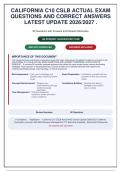
CALIFORNIA C10 CSLB ACTUAL EXAM
QUESTIONS AND CORRECT ANSWERS
LATEST UPDATE 2026/2027 .
80 Questions with Answers and Detailed Rationales
100 PERCENT GUARANTEED PASS
INSTANT DOWNLOAD ANSWERS INCLUDED
IMPORTANCE OF THIS DOCUMENT
This comprehensive examination preparation guide has been meticulously developed to help you succeed in the
CALIFORNIA C10 CSLB ACTUAL EXAM QUESTIONS AND CORRECT ANSWERS LATEST UPDATE
2026/2027 .. It contains 80 carefully selected questions that reflect the most current exam content and testing
strategies. Each question is accompanied by a correct answer and a detailed rationale that explains the
underlying pathophysiology, pharmacology, or clinical reasoning.
Self-Assessment – Test your knowledge and Exam Preparation – Familiarize yourself with the
identify areas requiring further question format and content
study areas
Concept Reinforcement – Deepen your Confidence Building – Develop test-taking
understanding through strategies and reduce
evidence-based exam anxiety
rationales
Time Management – Practice answering
questions under simulated
exam conditions
Review Summary 80 Questions
Foundations - Application - California C10 CSLB Actual AND Correct Update 2026/2027 California
Contractors License LAW AND Business Management C10 Electrical Graduate / Advanced Professional
All answers with rationales
,Table of Contents
Content Area Questions Key Topics
General Administration AND 1-14 Contractor, Electrical, Required, Project, Building
Business Management
Safety AND LOSS Prevention 15-28 Contractor, FIRE Alarm, Certificate, System, Requires
Planning AND Estimating 29-42 Contractor, Electrical, California, Project, Service
Earthwork AND Grading 43-56 Contractor, Service, Installing, Requirement, System
Concrete AND Foundation 57-70 System, Contractor, Installing, Circuit, Building
Framing AND Rough 71-80 Sprinkler, Contractor, System, Required, Installing
Carpentry
TOTAL 80 All questions include answers and detailed rationales
,Section A - General Administration AND Business
Management
Q1.
A C10 contractor enters into a contract with a homeowner for a service panel upgrade.
The contractor fails to provide the required notice of cancellation. Which of the following
is the most severe legal consequence?
A. A fine of up to $5,000 B. The contract is voidable at the
homeowner's option
C. The contractor's license is automatically D. The contractor may not file a mechanics
suspended lien
Correct: D - The contractor may not file a mechanics lien
Rationale:Under California law, failure to provide the required notice of cancellation in a
home improvement contract makes the contract unenforceable, and the contractor loses lien
rights. This is a severe consequence because it undermines the contractor's ability to collect
payment.
Why the other answers are wrong:
A. While fines may apply, they are not the most severe consequence compared to loss of lien
rights.
B. The contract is not merely voidable; it is unenforceable, and the contractor loses lien rights.
C. License suspension is not automatic for this violation.
Reference: California Business and Professions Code §7159 and §7159.5
Q2.
In a construction project, the prime contractor has a contractual right to stop work if the
owner fails to pay. However, the owner disputes the amount and withholds payment.
Which doctrine best protects the prime contractor's right to suspend performance without
breaching the contract?
A. Substantial performance B. Quantum meruit
C. Anticipatory repudiation D. Condition concurrent
Correct: D - Condition concurrent
Rationale:A condition concurrent is a condition that must be performed at the same time as
another condition. In construction contracts, the owner's payment and the contractor's
performance are concurrent conditions, so if the owner fails to pay, the contractor may
suspend work without being in breach.
Why the other answers are wrong:
Page 3
, Section A - General Administration AND Business Management
A. Substantial performance relates to completing nearly all work, not the right to suspend.
B. Quantum meruit is a remedy for unjust enrichment, not a basis for suspension.
C. Anticipatory repudiation involves a party indicating they will not perform in the future, not the owner's failure to pay.
Reference: Sweet, J. & Schneier, M. (2019). Legal Aspects of Architecture, Engineering, and the
Construction Process, 9th Ed., Ch. 4
Q3.
A C10 contractor is preparing a bid for a commercial project. The plans specify a 400A
service with a calculated load of 380A. The contractor intends to use a 400A panel. Which
NEC requirement is most critical to verify to ensure the panel is suitable?
A. The panel must be listed for the available B. The panel must have a main breaker
fault current. rated at least 400A.
C. The panel must be rated for at least D. The panel must have a short-circuit
125% of the calculated load. current rating equal to the available fault
current.
Correct: D - The panel must have a short-circuit current rating equal to the available fault
current.
Rationale:NEC 408.6 requires the short-circuit current rating of the panelboard to be at least
the available fault current at its line terminals. This is critical for safety and code compliance,
and the contractor must verify this rating.
Why the other answers are wrong:
A. Listing is necessary but does not guarantee adequate short-circuit rating.
B. The main breaker rating may be less than the bus rating, but the short-circuit rating is the
critical factor.
C. The panel rating is based on the bus ampacity, not 125% of load; that applies to conductor
sizing.
Reference: NFPA 70: National Electrical Code (2023), Article 408.6
Q4.
A C10 contractor is managing a project where an employee is exposed to electrical
hazards. According to Cal/OSHA regulations, which of the following is required to be
included in the employer's written Electrical Safety Program?
A. A list of all employees authorized to work B. The specific hazard assessment for each
on energized equipment job site
C. Procedures for lockout/tagout and D. The minimum approach distances for all
energized work permits voltage levels
Correct: C - Procedures for lockout/tagout and energized work permits
Page 4
QUESTIONS AND CORRECT ANSWERS
LATEST UPDATE 2026/2027 .
80 Questions with Answers and Detailed Rationales
100 PERCENT GUARANTEED PASS
INSTANT DOWNLOAD ANSWERS INCLUDED
IMPORTANCE OF THIS DOCUMENT
This comprehensive examination preparation guide has been meticulously developed to help you succeed in the
CALIFORNIA C10 CSLB ACTUAL EXAM QUESTIONS AND CORRECT ANSWERS LATEST UPDATE
2026/2027 .. It contains 80 carefully selected questions that reflect the most current exam content and testing
strategies. Each question is accompanied by a correct answer and a detailed rationale that explains the
underlying pathophysiology, pharmacology, or clinical reasoning.
Self-Assessment – Test your knowledge and Exam Preparation – Familiarize yourself with the
identify areas requiring further question format and content
study areas
Concept Reinforcement – Deepen your Confidence Building – Develop test-taking
understanding through strategies and reduce
evidence-based exam anxiety
rationales
Time Management – Practice answering
questions under simulated
exam conditions
Review Summary 80 Questions
Foundations - Application - California C10 CSLB Actual AND Correct Update 2026/2027 California
Contractors License LAW AND Business Management C10 Electrical Graduate / Advanced Professional
All answers with rationales
,Table of Contents
Content Area Questions Key Topics
General Administration AND 1-14 Contractor, Electrical, Required, Project, Building
Business Management
Safety AND LOSS Prevention 15-28 Contractor, FIRE Alarm, Certificate, System, Requires
Planning AND Estimating 29-42 Contractor, Electrical, California, Project, Service
Earthwork AND Grading 43-56 Contractor, Service, Installing, Requirement, System
Concrete AND Foundation 57-70 System, Contractor, Installing, Circuit, Building
Framing AND Rough 71-80 Sprinkler, Contractor, System, Required, Installing
Carpentry
TOTAL 80 All questions include answers and detailed rationales
,Section A - General Administration AND Business
Management
Q1.
A C10 contractor enters into a contract with a homeowner for a service panel upgrade.
The contractor fails to provide the required notice of cancellation. Which of the following
is the most severe legal consequence?
A. A fine of up to $5,000 B. The contract is voidable at the
homeowner's option
C. The contractor's license is automatically D. The contractor may not file a mechanics
suspended lien
Correct: D - The contractor may not file a mechanics lien
Rationale:Under California law, failure to provide the required notice of cancellation in a
home improvement contract makes the contract unenforceable, and the contractor loses lien
rights. This is a severe consequence because it undermines the contractor's ability to collect
payment.
Why the other answers are wrong:
A. While fines may apply, they are not the most severe consequence compared to loss of lien
rights.
B. The contract is not merely voidable; it is unenforceable, and the contractor loses lien rights.
C. License suspension is not automatic for this violation.
Reference: California Business and Professions Code §7159 and §7159.5
Q2.
In a construction project, the prime contractor has a contractual right to stop work if the
owner fails to pay. However, the owner disputes the amount and withholds payment.
Which doctrine best protects the prime contractor's right to suspend performance without
breaching the contract?
A. Substantial performance B. Quantum meruit
C. Anticipatory repudiation D. Condition concurrent
Correct: D - Condition concurrent
Rationale:A condition concurrent is a condition that must be performed at the same time as
another condition. In construction contracts, the owner's payment and the contractor's
performance are concurrent conditions, so if the owner fails to pay, the contractor may
suspend work without being in breach.
Why the other answers are wrong:
Page 3
, Section A - General Administration AND Business Management
A. Substantial performance relates to completing nearly all work, not the right to suspend.
B. Quantum meruit is a remedy for unjust enrichment, not a basis for suspension.
C. Anticipatory repudiation involves a party indicating they will not perform in the future, not the owner's failure to pay.
Reference: Sweet, J. & Schneier, M. (2019). Legal Aspects of Architecture, Engineering, and the
Construction Process, 9th Ed., Ch. 4
Q3.
A C10 contractor is preparing a bid for a commercial project. The plans specify a 400A
service with a calculated load of 380A. The contractor intends to use a 400A panel. Which
NEC requirement is most critical to verify to ensure the panel is suitable?
A. The panel must be listed for the available B. The panel must have a main breaker
fault current. rated at least 400A.
C. The panel must be rated for at least D. The panel must have a short-circuit
125% of the calculated load. current rating equal to the available fault
current.
Correct: D - The panel must have a short-circuit current rating equal to the available fault
current.
Rationale:NEC 408.6 requires the short-circuit current rating of the panelboard to be at least
the available fault current at its line terminals. This is critical for safety and code compliance,
and the contractor must verify this rating.
Why the other answers are wrong:
A. Listing is necessary but does not guarantee adequate short-circuit rating.
B. The main breaker rating may be less than the bus rating, but the short-circuit rating is the
critical factor.
C. The panel rating is based on the bus ampacity, not 125% of load; that applies to conductor
sizing.
Reference: NFPA 70: National Electrical Code (2023), Article 408.6
Q4.
A C10 contractor is managing a project where an employee is exposed to electrical
hazards. According to Cal/OSHA regulations, which of the following is required to be
included in the employer's written Electrical Safety Program?
A. A list of all employees authorized to work B. The specific hazard assessment for each
on energized equipment job site
C. Procedures for lockout/tagout and D. The minimum approach distances for all
energized work permits voltage levels
Correct: C - Procedures for lockout/tagout and energized work permits
Page 4


