
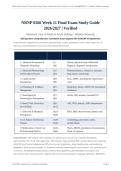
NRNP 6566 Week 11 Final Exam Study Guide - Advanced Care of Adults in Acute Settings
2026/2027 | Verified | Walden University
NRNP 6566 Week 11 Final Exam Study Guide
2026/2027 | Verified
Advanced Care of Adults in Acute Settings - Walden University
160-Question Comprehensive Cumulative Exam aligned with AGACNP Competencies
Comprehensive integration of assessment, pharmacology, cardiac, pulmonary, neuro, renal, endocrine, GI,
infectious, and multisystem critical care with professional practice
Section Q Topic Focus
Range
1. Advanced Assessment & Q1 - History, physical exam, differential
Diagnostic Reasoning Q16 diagnosis, diagnostic interpretation
2. Advanced Pharmacology Q17 - Pharmacokinetics, vasoactive, inotropes,
& Prescriptive Practice Q34 drug classes, monitoring
3. Cardiovascular Q35 - ACS, ADHF, dysrhythmias, hypertensive
Emergencies Q56 crisis
4. Pulmonary & Ventilator Q57 - Respiratory failure, ARDS, PE, mechanical
Management Q76 ventilation
5. Neurological & Q77 - Stroke, TBI, seizures, increased ICP
Neurosurgical Emergencies Q94
6. Renal, Fluid, Electrolyte Q95 - AKI, CKD, dialysis, ABG interpretation
& Acid-Base Q112
7. Endocrine & Metabolic Q113 - DKA, HHS, thyroid storm, adrenal crisis
Emergencies Q128
8. GI, Hepatic & Infectious Q129 - GI bleeding, pancreatitis, sepsis,
Disease Q144 antimicrobials
9. Multisystem, Critical Care Q145 - Shock, MODS, procedures, documentation,
& Professional Practice Q160 Week 11 capstone
Exam structure: 160 multiple-choice questions (4 options each, one correct). Cognitive distribution
approximately 25% recall, 55% application, 20% analysis. Approximately 80% scenario-based items requiring
AGACNP-level clinical judgment and 20% direct recall of guidelines, drug classifications, and monitoring
parameters. Each question includes a 2-4 sentence rationale explaining the correct answer, why each distractor
is incorrect, the pathophysiological basis, evidence-based guidelines, pharmacological principles, and
time-sensitive intervention priorities. Aligned with current Surviving Sepsis Campaign, AHA/ACC, IDSA/ATS,
AGACNP Comprehensive Capstone Integration Page 1
,NRNP 6566 Week 11 Final Exam Study Guide - Advanced Care of Adults in Acute Settings
2026/2027 | Verified | Walden University
and AGACNP certification standards.
Section 1: Advanced Assessment and Diagnostic Reasoning in Acute Care
(History, Physical Exam, & Differential Diagnosis)
Q1: A 68-year-old is admitted with acute dyspnea. The AGACNP's focused history prioritizes which
element as the highest-yield discriminator between cardiogenic and non-cardiogenic dyspnea?
A. Onset, positional variation, associated orthopnea/PND, and presence of chest pain or fever -
distinguishing heart failure from pulmonary/infectious etiologies [CORRECT]
B. Dietary history of fiber intake
C. History of remote childhood immunizations
D. Travel history for leisure only
Correct Answer: A
Rationale: Discriminating cardiogenic from non-cardiogenic dyspnea hinges on positional/orthopnea/PND (heart
failure) vs infectious/fever or sudden-onset pleuritic features. Diet/immunizations/travel are lower yield. The AGACNP
uses pattern recognition to drive the differential, labs (BNP, troponin), and imaging.
Q2: On physical exam of a patient with suspected acute decompensated heart failure, which finding
has the highest positive likelihood ratio for diagnosing ADHF?
A. S3 gallop and jugular venous distension with bilateral crackles (LR+ high for ADHF)
[CORRECT]
B. Bilateral lower extremity edema 1+ pitting
C. Bibasilar crackles alone
D. Tachycardia alone
Correct Answer: A
Rationale: The S3 gallop has the highest LR+ (~24) for ADHF; JVD with crackles strengthens the diagnosis. Edema
alone, crackles alone, and tachycardia have lower LRs and are non-specific. The AGACNP integrates high-LR findings
to confirm ADHF and guide diuresis.
AGACNP Comprehensive Capstone Integration Page 2
,NRNP 6566 Week 11 Final Exam Study Guide - Advanced Care of Adults in Acute Settings
2026/2027 | Verified | Walden University
Q3: A patient presents with acute delirium. Which assessment approach is most appropriate to
identify the underlying etiology?
A. Structured CAM-ICU assessment plus review of medications, metabolic panel, infection
evaluation, oxygenation, and neurologic exam - a systematic search for reversible causes
(DELIRIUMS) [CORRECT]
B. Assume it is baseline dementia and do not work up further
C. Administer haloperidol immediately and observe
D. Order CT head only without labs
Correct Answer: A
Rationale: Acute delirium requires systematic workup: CAM-ICU, med review, metabolic panel, infection workup,
oxygenation, and neurologic exam to identify reversible causes. Assuming dementia (B) misses treatable causes.
Haloperidol first (C) treats symptoms without diagnosis. CT alone (D) misses metabolic/infectious etiologies. The
AGACNP applies the DELIRIUMS framework.
Q4: When formulating a differential diagnosis for acute syncope, which etiology requires immediate
escalation due to highest mortality risk?
A. Cardiac syncope (arrhythmia, structural heart disease, ACS) due to higher associated
mortality [CORRECT]
B. Vasovagal syncope in a young healthy patient
C. Situational syncope after venipuncture
D. Orthostatic syncope from dehydration in a young adult
Correct Answer: A
Rationale: Cardiac syncope carries the highest mortality and requires immediate escalation (ECG, monitoring,
echocardiogram). Vasovagal (B), situational (C), and benign orthostatic (D) have low mortality. The AGACNP triages
syncope by risk stratification to identify cardiac etiologies requiring admission.
Q5: Which laboratory pattern most strongly suggests acute kidney injury (AKI) rather than chronic
kidney disease (CKD)?
A. BUN/Cr ratio >20:1, fractional excretion of sodium (FENa) <1%, recent rise in creatinine,
and normal-sized kidneys - suggesting prerenal AKI [CORRECT]
B. Small echogenic kidneys, prolonged anemia, and stable creatinine for months
C. Creatinine 1.2 mg/dL stable over 12 months with GFR 55
D. Normal BUN/Cr ratio with stable eGFR over years
Correct Answer: A
Rationale: Prerenal AKI shows BUN/Cr >20:1, FENa <1%, recent creatinine rise, and normal-sized kidneys. Small
echogenic kidneys with chronic anemia (B) suggest CKD. Stable creatinine (C, D) is not AKI. The AGACNP
distinguishes AKI from CKD to guide fluid vs. nephrology management.
AGACNP Comprehensive Capstone Integration Page 3
, NRNP 6566 Week 11 Final Exam Study Guide - Advanced Care of Adults in Acute Settings
2026/2027 | Verified | Walden University
Q6: In the acute setting, which physical exam finding is most consistent with massive pulmonary
embolism causing right heart strain?
A. Tachycardia, hypoxemia, S2 split with accentuated P2, JVD, and right ventricular heave
[CORRECT]
B. Bilateral wheezing with prolonged expiration
C. Diffuse rhonchi and fever
D. Decreased breath sounds at bases with dullness to percussion
Correct Answer: A
Rationale: Massive PE causes right heart strain signs: tachycardia, hypoxemia, loud P2, JVD, RV heave. Wheezing
(B) is asthma/COPD. Rhonchi/fever (C) suggests pneumonia. Dullness (D) suggests effusion. The AGACNP
recognizes PE severity to guide thrombolytic vs. anticoagulation decisions.
Q7: When evaluating a patient with acute abdominal pain, which finding is a surgical emergency
requiring immediate surgical consultation?
A. Rebound tenderness, involuntary guarding, and rigidity - peritonitis requiring emergency
surgery [CORRECT]
B. Mild nausea without localized tenderness
C. Crampy pain relieved by defecation
D. Diffuse discomfort with normal vital signs
Correct Answer: A
Rationale: Rebound, guarding, and rigidity indicate peritonitis requiring emergency surgery. Mild nausea (B), crampy
relieved pain (C), and stable discomfort (D) do not require emergency surgery. The AGACNP identifies surgical
abdomen signs to activate immediate surgical consultation.
Q8: Which diagnostic finding is most consistent with acute pancreatitis?
A. Lipase >3 times the upper limit of normal with epigastric pain radiating to the back
[CORRECT]
B. Normal lipase with epigastric pain
C. ALT >1000 with right upper quadrant pain
D. Lipase 1.5 times normal with chest pain
Correct Answer: A
Rationale: Lipase >3x ULN with epigastric pain radiating to the back is diagnostic of acute pancreatitis. Normal lipase
(B) rules out pancreatitis if >48h from symptom onset. ALT >1000 with RUQ pain (C) suggests hepatitis/biliary
disease. Lipase 1.5x normal with chest pain (D) is not diagnostic. AGACNP uses lipase >3x ULN as the diagnostic
standard.
AGACNP Comprehensive Capstone Integration Page 4
2026/2027 | Verified | Walden University
NRNP 6566 Week 11 Final Exam Study Guide
2026/2027 | Verified
Advanced Care of Adults in Acute Settings - Walden University
160-Question Comprehensive Cumulative Exam aligned with AGACNP Competencies
Comprehensive integration of assessment, pharmacology, cardiac, pulmonary, neuro, renal, endocrine, GI,
infectious, and multisystem critical care with professional practice
Section Q Topic Focus
Range
1. Advanced Assessment & Q1 - History, physical exam, differential
Diagnostic Reasoning Q16 diagnosis, diagnostic interpretation
2. Advanced Pharmacology Q17 - Pharmacokinetics, vasoactive, inotropes,
& Prescriptive Practice Q34 drug classes, monitoring
3. Cardiovascular Q35 - ACS, ADHF, dysrhythmias, hypertensive
Emergencies Q56 crisis
4. Pulmonary & Ventilator Q57 - Respiratory failure, ARDS, PE, mechanical
Management Q76 ventilation
5. Neurological & Q77 - Stroke, TBI, seizures, increased ICP
Neurosurgical Emergencies Q94
6. Renal, Fluid, Electrolyte Q95 - AKI, CKD, dialysis, ABG interpretation
& Acid-Base Q112
7. Endocrine & Metabolic Q113 - DKA, HHS, thyroid storm, adrenal crisis
Emergencies Q128
8. GI, Hepatic & Infectious Q129 - GI bleeding, pancreatitis, sepsis,
Disease Q144 antimicrobials
9. Multisystem, Critical Care Q145 - Shock, MODS, procedures, documentation,
& Professional Practice Q160 Week 11 capstone
Exam structure: 160 multiple-choice questions (4 options each, one correct). Cognitive distribution
approximately 25% recall, 55% application, 20% analysis. Approximately 80% scenario-based items requiring
AGACNP-level clinical judgment and 20% direct recall of guidelines, drug classifications, and monitoring
parameters. Each question includes a 2-4 sentence rationale explaining the correct answer, why each distractor
is incorrect, the pathophysiological basis, evidence-based guidelines, pharmacological principles, and
time-sensitive intervention priorities. Aligned with current Surviving Sepsis Campaign, AHA/ACC, IDSA/ATS,
AGACNP Comprehensive Capstone Integration Page 1
,NRNP 6566 Week 11 Final Exam Study Guide - Advanced Care of Adults in Acute Settings
2026/2027 | Verified | Walden University
and AGACNP certification standards.
Section 1: Advanced Assessment and Diagnostic Reasoning in Acute Care
(History, Physical Exam, & Differential Diagnosis)
Q1: A 68-year-old is admitted with acute dyspnea. The AGACNP's focused history prioritizes which
element as the highest-yield discriminator between cardiogenic and non-cardiogenic dyspnea?
A. Onset, positional variation, associated orthopnea/PND, and presence of chest pain or fever -
distinguishing heart failure from pulmonary/infectious etiologies [CORRECT]
B. Dietary history of fiber intake
C. History of remote childhood immunizations
D. Travel history for leisure only
Correct Answer: A
Rationale: Discriminating cardiogenic from non-cardiogenic dyspnea hinges on positional/orthopnea/PND (heart
failure) vs infectious/fever or sudden-onset pleuritic features. Diet/immunizations/travel are lower yield. The AGACNP
uses pattern recognition to drive the differential, labs (BNP, troponin), and imaging.
Q2: On physical exam of a patient with suspected acute decompensated heart failure, which finding
has the highest positive likelihood ratio for diagnosing ADHF?
A. S3 gallop and jugular venous distension with bilateral crackles (LR+ high for ADHF)
[CORRECT]
B. Bilateral lower extremity edema 1+ pitting
C. Bibasilar crackles alone
D. Tachycardia alone
Correct Answer: A
Rationale: The S3 gallop has the highest LR+ (~24) for ADHF; JVD with crackles strengthens the diagnosis. Edema
alone, crackles alone, and tachycardia have lower LRs and are non-specific. The AGACNP integrates high-LR findings
to confirm ADHF and guide diuresis.
AGACNP Comprehensive Capstone Integration Page 2
,NRNP 6566 Week 11 Final Exam Study Guide - Advanced Care of Adults in Acute Settings
2026/2027 | Verified | Walden University
Q3: A patient presents with acute delirium. Which assessment approach is most appropriate to
identify the underlying etiology?
A. Structured CAM-ICU assessment plus review of medications, metabolic panel, infection
evaluation, oxygenation, and neurologic exam - a systematic search for reversible causes
(DELIRIUMS) [CORRECT]
B. Assume it is baseline dementia and do not work up further
C. Administer haloperidol immediately and observe
D. Order CT head only without labs
Correct Answer: A
Rationale: Acute delirium requires systematic workup: CAM-ICU, med review, metabolic panel, infection workup,
oxygenation, and neurologic exam to identify reversible causes. Assuming dementia (B) misses treatable causes.
Haloperidol first (C) treats symptoms without diagnosis. CT alone (D) misses metabolic/infectious etiologies. The
AGACNP applies the DELIRIUMS framework.
Q4: When formulating a differential diagnosis for acute syncope, which etiology requires immediate
escalation due to highest mortality risk?
A. Cardiac syncope (arrhythmia, structural heart disease, ACS) due to higher associated
mortality [CORRECT]
B. Vasovagal syncope in a young healthy patient
C. Situational syncope after venipuncture
D. Orthostatic syncope from dehydration in a young adult
Correct Answer: A
Rationale: Cardiac syncope carries the highest mortality and requires immediate escalation (ECG, monitoring,
echocardiogram). Vasovagal (B), situational (C), and benign orthostatic (D) have low mortality. The AGACNP triages
syncope by risk stratification to identify cardiac etiologies requiring admission.
Q5: Which laboratory pattern most strongly suggests acute kidney injury (AKI) rather than chronic
kidney disease (CKD)?
A. BUN/Cr ratio >20:1, fractional excretion of sodium (FENa) <1%, recent rise in creatinine,
and normal-sized kidneys - suggesting prerenal AKI [CORRECT]
B. Small echogenic kidneys, prolonged anemia, and stable creatinine for months
C. Creatinine 1.2 mg/dL stable over 12 months with GFR 55
D. Normal BUN/Cr ratio with stable eGFR over years
Correct Answer: A
Rationale: Prerenal AKI shows BUN/Cr >20:1, FENa <1%, recent creatinine rise, and normal-sized kidneys. Small
echogenic kidneys with chronic anemia (B) suggest CKD. Stable creatinine (C, D) is not AKI. The AGACNP
distinguishes AKI from CKD to guide fluid vs. nephrology management.
AGACNP Comprehensive Capstone Integration Page 3
, NRNP 6566 Week 11 Final Exam Study Guide - Advanced Care of Adults in Acute Settings
2026/2027 | Verified | Walden University
Q6: In the acute setting, which physical exam finding is most consistent with massive pulmonary
embolism causing right heart strain?
A. Tachycardia, hypoxemia, S2 split with accentuated P2, JVD, and right ventricular heave
[CORRECT]
B. Bilateral wheezing with prolonged expiration
C. Diffuse rhonchi and fever
D. Decreased breath sounds at bases with dullness to percussion
Correct Answer: A
Rationale: Massive PE causes right heart strain signs: tachycardia, hypoxemia, loud P2, JVD, RV heave. Wheezing
(B) is asthma/COPD. Rhonchi/fever (C) suggests pneumonia. Dullness (D) suggests effusion. The AGACNP
recognizes PE severity to guide thrombolytic vs. anticoagulation decisions.
Q7: When evaluating a patient with acute abdominal pain, which finding is a surgical emergency
requiring immediate surgical consultation?
A. Rebound tenderness, involuntary guarding, and rigidity - peritonitis requiring emergency
surgery [CORRECT]
B. Mild nausea without localized tenderness
C. Crampy pain relieved by defecation
D. Diffuse discomfort with normal vital signs
Correct Answer: A
Rationale: Rebound, guarding, and rigidity indicate peritonitis requiring emergency surgery. Mild nausea (B), crampy
relieved pain (C), and stable discomfort (D) do not require emergency surgery. The AGACNP identifies surgical
abdomen signs to activate immediate surgical consultation.
Q8: Which diagnostic finding is most consistent with acute pancreatitis?
A. Lipase >3 times the upper limit of normal with epigastric pain radiating to the back
[CORRECT]
B. Normal lipase with epigastric pain
C. ALT >1000 with right upper quadrant pain
D. Lipase 1.5 times normal with chest pain
Correct Answer: A
Rationale: Lipase >3x ULN with epigastric pain radiating to the back is diagnostic of acute pancreatitis. Normal lipase
(B) rules out pancreatitis if >48h from symptom onset. ALT >1000 with RUQ pain (C) suggests hepatitis/biliary
disease. Lipase 1.5x normal with chest pain (D) is not diagnostic. AGACNP uses lipase >3x ULN as the diagnostic
standard.
AGACNP Comprehensive Capstone Integration Page 4


