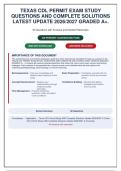
TEXAS CDL PERMIT EXAM STUDY
QUESTIONS AND COMPLETE SOLUTIONS
LATEST UPDATE 2026/2027 GRADED A+.
60 Questions with Answers and Detailed Rationales
100 PERCENT GUARANTEED PASS
INSTANT DOWNLOAD ANSWERS INCLUDED
IMPORTANCE OF THIS DOCUMENT
This comprehensive examination preparation guide has been meticulously developed to help you succeed in the
TEXAS CDL PERMIT EXAM STUDY QUESTIONS AND COMPLETE SOLUTIONS LATEST UPDATE 2026/2027
GRADED A+.. It contains 60 carefully selected questions that reflect the most current exam content and testing
strategies. Each question is accompanied by a correct answer and a detailed rationale that explains the
underlying pathophysiology, pharmacology, or clinical reasoning.
Self-Assessment – Test your knowledge and Exam Preparation – Familiarize yourself with the
identify areas requiring further question format and content
study areas
Concept Reinforcement – Deepen your Confidence Building – Develop test-taking
understanding through strategies and reduce
evidence-based exam anxiety
rationales
Time Management – Practice answering
questions under simulated
exam conditions
Review Summary 60 Questions
Foundations - Application - Texas CDL Permit Study AND Complete Solutions Update 2026/2027 A Texas
CDL Permit Study AND Complete Solutions Update 2026/2027 A University
All answers with rationales
,Table of Contents
Content Area Questions Key Topics
General Knowledge 1-10 Driver, Vehicle, Appropriate, Pressure, Hours
AIR Brakes 11-20 Driver, Trailer, Pressure, Driving, Vehicle
Combination Vehicles 21-30 Driver, Vehicle, Combination, Hazardous, Driving
TANK Vehicles 31-40 Driver, Trailer, Texas, Vehicle, Traffic
Hazardous Materials 41-50 Driver, Required, Transporting, Disqualification, Texas
Doubles AND Triples 51-60 Driver, Vehicle, Commercial, Loaded, Brake
TOTAL 60 All questions include answers and detailed rationales
,Section A - General Knowledge
Q1.
A commercial vehicle's air brake system has a pushrod stroke that exceeds the
adjustment limit on three of ten brakes. During the pre-trip inspection, the driver notes the
low air pressure warning light activates at 55 psi. What is the most appropriate action
before operating the vehicle?
A. Proceed, since the warning threshold is B. Adjust all brakes to within limits and verify
above the legal minimum and the brakes will the warning light activates between 55 and
still apply. 75 psi before driving.
C. Bypass the warning light and continue to D. Operate the vehicle only during daylight
the nearest repair facility if within 50 miles. hours and at reduced speed to minimize
brake heat.
Correct: B - Adjust all brakes to within limits and verify the warning light activates
between 55 and 75 psi before driving.
Rationale:The low air pressure warning must activate before pressure drops below 60 psi
(typically 55-75 psi). Out-of-adjustment brakes reduce braking efficiency and are a violation.
The driver must correct the defect before operating the vehicle. Proceeding, bypassing, or
limiting operation does not address the safety hazard.
Why the other answers are wrong:
A. The warning threshold is legal, but out-of-adjustment brakes are a safety defect and must be
corrected.
C. Bypassing a required safety device is prohibited and does not fix the brake adjustment
issue.
D. Operating with defective brakes is not permitted regardless of time of day or speed.
Reference: Texas CDL Manual, Section 5: Air Brakes; 49 CFR 393.53
Q2.
A driver is given a 10-hour off-duty period after 14 hours on duty. They drive for 8 hours,
take a 30-minute break, and then drive for 3 more hours. Which violation, if any, has
occurred under the 2026 FMCSA hours-of-service rules?
A. No violation, because the 10-hour break B. Violation of the 11-hour driving limit after
resets the 14-hour clock. the break.
C. Violation of the 14-hour on-duty limit, as D. Violation of the 30-minute break
the break does not extend it. requirement because the break was not
taken after 8 hours of driving.
Correct: C - Violation of the 14-hour on-duty limit, as the break does not extend it.
Page 3
, Section A - General Knowledge
Rationale: The 14-hour on-duty limit is continuous from the start of the workday and cannot
be extended by breaks. The driver accumulated 11 hours of driving (8+3) but also had
on-duty time before driving, so the 14-hour limit is exceeded. The 10-hour off-duty reset is not
applicable here.
Why the other answers are wrong:
A. A 10-hour break resets the 14-hour clock only if it is taken before the 14-hour limit is
reached, not after.
B. The 11-hour driving limit is not exceeded; the issue is the 14-hour on-duty limit.
D. The 30-minute break is required after 8 hours of driving, which was satisfied.
Reference: FMCSA Hours-of-Service Regulations, 49 CFR 395.3
Q3.
A tank vehicle is 30% full of a flammable liquid with a high vapor pressure. The driver
must choose a route through a congested urban area. What is the primary consideration
for safe operation?
A. The vehicle's center of gravity is lower B. Liquid surge is minimized because the
when partially full, so speed can be tank is not full, allowing normal braking.
maintained.
C. The high vapor pressure increases the D. The partial load reduces the vehicle's
risk of vapor explosion; avoid unnecessary gross weight, so it can use roads with lower
stops and sudden maneuvers. weight limits.
Correct: C - The high vapor pressure increases the risk of vapor explosion; avoid
unnecessary stops and sudden maneuvers.
Rationale:High vapor pressure liquids produce flammable vapors even at partial fill,
increasing explosion risk. Liquid surge in a partially filled tank shifts weight, affecting stability
and braking. Safe operation requires smooth maneuvers and avoiding unnecessary stops.
Center of gravity is actually higher, and partial fill increases surge.
Why the other answers are wrong:
A. A partially filled tank has a higher center of gravity, not lower, and surge is worse.
B. Partial fill increases liquid surge, not minimizes it.
D. Weight limits are not the primary concern; the hazardous material properties are.
Reference: Texas CDL Manual, Section 9: Hazardous Materials; FMCSA HM-232
Q4.
A driver is transporting a load that extends 4 feet beyond the rear of the trailer. The load is
not marked with red flags. What is the most appropriate action?
A. Attach red flags to the load only if it B. Use red flags or lights at the extreme rear
extends more than 6 feet. of the load during daylight; at night, use a
red light.
Page 4
QUESTIONS AND COMPLETE SOLUTIONS
LATEST UPDATE 2026/2027 GRADED A+.
60 Questions with Answers and Detailed Rationales
100 PERCENT GUARANTEED PASS
INSTANT DOWNLOAD ANSWERS INCLUDED
IMPORTANCE OF THIS DOCUMENT
This comprehensive examination preparation guide has been meticulously developed to help you succeed in the
TEXAS CDL PERMIT EXAM STUDY QUESTIONS AND COMPLETE SOLUTIONS LATEST UPDATE 2026/2027
GRADED A+.. It contains 60 carefully selected questions that reflect the most current exam content and testing
strategies. Each question is accompanied by a correct answer and a detailed rationale that explains the
underlying pathophysiology, pharmacology, or clinical reasoning.
Self-Assessment – Test your knowledge and Exam Preparation – Familiarize yourself with the
identify areas requiring further question format and content
study areas
Concept Reinforcement – Deepen your Confidence Building – Develop test-taking
understanding through strategies and reduce
evidence-based exam anxiety
rationales
Time Management – Practice answering
questions under simulated
exam conditions
Review Summary 60 Questions
Foundations - Application - Texas CDL Permit Study AND Complete Solutions Update 2026/2027 A Texas
CDL Permit Study AND Complete Solutions Update 2026/2027 A University
All answers with rationales
,Table of Contents
Content Area Questions Key Topics
General Knowledge 1-10 Driver, Vehicle, Appropriate, Pressure, Hours
AIR Brakes 11-20 Driver, Trailer, Pressure, Driving, Vehicle
Combination Vehicles 21-30 Driver, Vehicle, Combination, Hazardous, Driving
TANK Vehicles 31-40 Driver, Trailer, Texas, Vehicle, Traffic
Hazardous Materials 41-50 Driver, Required, Transporting, Disqualification, Texas
Doubles AND Triples 51-60 Driver, Vehicle, Commercial, Loaded, Brake
TOTAL 60 All questions include answers and detailed rationales
,Section A - General Knowledge
Q1.
A commercial vehicle's air brake system has a pushrod stroke that exceeds the
adjustment limit on three of ten brakes. During the pre-trip inspection, the driver notes the
low air pressure warning light activates at 55 psi. What is the most appropriate action
before operating the vehicle?
A. Proceed, since the warning threshold is B. Adjust all brakes to within limits and verify
above the legal minimum and the brakes will the warning light activates between 55 and
still apply. 75 psi before driving.
C. Bypass the warning light and continue to D. Operate the vehicle only during daylight
the nearest repair facility if within 50 miles. hours and at reduced speed to minimize
brake heat.
Correct: B - Adjust all brakes to within limits and verify the warning light activates
between 55 and 75 psi before driving.
Rationale:The low air pressure warning must activate before pressure drops below 60 psi
(typically 55-75 psi). Out-of-adjustment brakes reduce braking efficiency and are a violation.
The driver must correct the defect before operating the vehicle. Proceeding, bypassing, or
limiting operation does not address the safety hazard.
Why the other answers are wrong:
A. The warning threshold is legal, but out-of-adjustment brakes are a safety defect and must be
corrected.
C. Bypassing a required safety device is prohibited and does not fix the brake adjustment
issue.
D. Operating with defective brakes is not permitted regardless of time of day or speed.
Reference: Texas CDL Manual, Section 5: Air Brakes; 49 CFR 393.53
Q2.
A driver is given a 10-hour off-duty period after 14 hours on duty. They drive for 8 hours,
take a 30-minute break, and then drive for 3 more hours. Which violation, if any, has
occurred under the 2026 FMCSA hours-of-service rules?
A. No violation, because the 10-hour break B. Violation of the 11-hour driving limit after
resets the 14-hour clock. the break.
C. Violation of the 14-hour on-duty limit, as D. Violation of the 30-minute break
the break does not extend it. requirement because the break was not
taken after 8 hours of driving.
Correct: C - Violation of the 14-hour on-duty limit, as the break does not extend it.
Page 3
, Section A - General Knowledge
Rationale: The 14-hour on-duty limit is continuous from the start of the workday and cannot
be extended by breaks. The driver accumulated 11 hours of driving (8+3) but also had
on-duty time before driving, so the 14-hour limit is exceeded. The 10-hour off-duty reset is not
applicable here.
Why the other answers are wrong:
A. A 10-hour break resets the 14-hour clock only if it is taken before the 14-hour limit is
reached, not after.
B. The 11-hour driving limit is not exceeded; the issue is the 14-hour on-duty limit.
D. The 30-minute break is required after 8 hours of driving, which was satisfied.
Reference: FMCSA Hours-of-Service Regulations, 49 CFR 395.3
Q3.
A tank vehicle is 30% full of a flammable liquid with a high vapor pressure. The driver
must choose a route through a congested urban area. What is the primary consideration
for safe operation?
A. The vehicle's center of gravity is lower B. Liquid surge is minimized because the
when partially full, so speed can be tank is not full, allowing normal braking.
maintained.
C. The high vapor pressure increases the D. The partial load reduces the vehicle's
risk of vapor explosion; avoid unnecessary gross weight, so it can use roads with lower
stops and sudden maneuvers. weight limits.
Correct: C - The high vapor pressure increases the risk of vapor explosion; avoid
unnecessary stops and sudden maneuvers.
Rationale:High vapor pressure liquids produce flammable vapors even at partial fill,
increasing explosion risk. Liquid surge in a partially filled tank shifts weight, affecting stability
and braking. Safe operation requires smooth maneuvers and avoiding unnecessary stops.
Center of gravity is actually higher, and partial fill increases surge.
Why the other answers are wrong:
A. A partially filled tank has a higher center of gravity, not lower, and surge is worse.
B. Partial fill increases liquid surge, not minimizes it.
D. Weight limits are not the primary concern; the hazardous material properties are.
Reference: Texas CDL Manual, Section 9: Hazardous Materials; FMCSA HM-232
Q4.
A driver is transporting a load that extends 4 feet beyond the rear of the trailer. The load is
not marked with red flags. What is the most appropriate action?
A. Attach red flags to the load only if it B. Use red flags or lights at the extreme rear
extends more than 6 feet. of the load during daylight; at night, use a
red light.
Page 4