
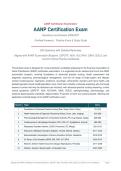
AANP Certification Examination
AANP Certification Exam
Questions and Answers 2026/2027
(Verified Answers) - Practice Exam & Study Guide
200 Questions with Detailed Rationales
Aligned with AANP Examination Blueprint, USPSTF, ADA, ACC/AHA, GINA, GOLD, and
Current Clinical Practice Guidelines
This practice exam is designed for nurse practitioner candidates preparing for the American Association of
Nurse Practitioners (AANP) certification examination. It is organized into ten sections that mirror the AANP
examination blueprint, covering foundations of advanced practice nursing, health assessment and
diagnostic reasoning, pharmacological management, and the full range of body-system and lifespan
content (cardiovascular, respiratory, endocrine, neurologic, GI/renal/GU, women's and men's health, and
pediatric/geriatric/mental health/population care). Each item includes a rationale explaining why the keyed
answer is correct and why the distractors are incorrect, with advanced practice nursing reasoning, current
clinical guidelines (USPSTF, ADA, ACC/AHA, GINA, GOLD), pathophysiology, pharmacology, and
evidence-based practice standards. Approximately 75 percent of items are scenario-based, reflecting the
application-oriented design of the AANP certification exam.
Section Topic Items
1 Foundations of Advanced Practice Nursing (Role, Scope, Ethics, Policy) Q1-Q18
2 Health Assessment & Diagnostic Reasoning (History, Exam, Labs, Imaging) Q19-Q38
3 Pharmacological Management & Prescriptive Authority (PK, Drug Classes, Safety) Q39-Q64
4 Cardiovascular & Hematologic Disorders (HTN, CAD, HF, Dyslipidemia, Anemia) Q65-Q90
5 Respiratory Disorders (Asthma, COPD, Pneumonia, PE, Allergic) Q91-Q110
6 Endocrine & Metabolic Disorders (Diabetes, Thyroid, Adrenal, Obesity) Q111-Q132
7 Musculoskeletal, Neurological, & Sensory Disorders (Arthritis, Headache) Q133-Q152
8 GI, Renal, & GU Disorders (GERD, IBD, CKD, UTI, BPH) Q153-Q170
9 Women's & Men's Health Across the Lifespan (Reproductive, Perinatal) Q171-Q186
10 Pediatric, Geriatric, Mental Health, & Population Care Q187-Q200
Aligned with AANP Certification Examination Blueprint, USPSTF, ADA, ACC/AHA, GINA, GOLD, and Other Current Guidelines Page 1
,AANP Certification Exam Questions and Answers 2026/2027 (Verified Answers) 200 Questions with Rationales
How to use this guide: Work through each section in order. After answering each question, read the
rationale carefully - even for items you answered correctly - because the rationales explicitly address
common AANP exam pitfalls (misapplying clinical guidelines, confusing similar diagnoses, selecting
inappropriate first-line therapy, overlooking contraindications, misinterpreting diagnostic results, failing to
recognize red flags, missing drug interactions, and misunderstanding screening recommendations). Items
span three cognitive levels: approximately 25 percent recall, 55 percent application, and 20 percent
analysis.
Aligned with AANP Certification Examination Blueprint, USPSTF, ADA, ACC/AHA, GINA, GOLD, and Other Current Guidelines Page 2
,AANP Certification Exam Questions and Answers 2026/2027 (Verified Answers) 200 Questions with Rationales
Section 1: Foundations of Advanced Practice Nursing
(Role, Scope, Ethics, Health Policy, & Reimbursement)
Q1. A new NP graduate is preparing to practice in a state that requires a collaborative agreement with a
physician for prescriptive authority. Which term best describes this regulatory model?
A. Full practice authority
B. Reduced practice authority - the NP must have a regulated collaborative agreement for at least one
element of practice (such as prescriptive authority). [CORRECT]
C. Restricted practice authority
D. Independent practice authority
Correct Answer: B
Rationale:
Reduced practice authority requires a regulated collaborative agreement for at least one practice element (often
prescribing). Full practice (A) allows independent evaluation, diagnosis, and prescribing. Restricted (C) requires
career-long supervision/delegation. NPs must verify the specific state's practice environment through the board of
nursing. AANP cue: reduced = collaboration for one element; restricted = career-long supervision.
Q2. A patient refuses a recommended screening colonoscopy despite counseling. The NP documents
the discussion, risks/benefits, and the patient's decision. Which ethical principle is most directly
upheld?
A. Beneficence
B. Autonomy - the patient's right to make an informed decision about their own care is respected, even
when the NP disagrees. [CORRECT]
C. Justice
D. Nonmaleficence
Correct Answer: B
Rationale:
Autonomy is the patient's right to self-determination, including refusal of recommended care after informed consent.
Beneficence (A) is acting in the patient's best interest; nonmaleficence (D) is avoiding harm; justice (C) is fairness
in distribution. Documenting the refusal (informed refusal) is essential. AANP cue: respect for autonomy = informed
refusal documented.
Q3. An NP prescribes a Schedule II controlled substance for a patient with acute severe pain. Which
statement is correct regarding DEA regulations?
A. Schedule II prescriptions can be refilled by phone for up to 6 months.
B. Schedule II prescriptions cannot be refilled; a new prescription is required for each dispensing, and
electronic prescribing of controlled substances (EPCS) is permitted with DEA-compliant software.
[CORRECT]
C. Schedule II drugs cannot be prescribed by NPs under any circumstances.
D. Schedule II prescriptions require only verbal authorization from a physician.
Correct Answer: B
Rationale:
Schedule II controlled substances cannot be refilled; a new prescription is required for each fill. NPs with DEA
registration may prescribe them where state law allows. EPCS is permitted with DEA-compliant software. AANP
cue: Schedule II = no refills; new Rx each time.
Aligned with AANP Certification Examination Blueprint, USPSTF, ADA, ACC/AHA, GINA, GOLD, and Other Current Guidelines Page 3
, AANP Certification Exam Questions and Answers 2026/2027 (Verified Answers) 200 Questions with Rationales
Q4. When billing Medicare for services, an NP uses their own NPI. Which statement is correct regarding
reimbursement?
A. NPs are reimbursed at 100% of the physician fee schedule for all services.
B. NPs are generally reimbursed at 85% of the physician fee schedule for Medicare Part B services when
billing under their own NPI. [CORRECT]
C. NPs cannot bill Medicare directly.
D. NPs are reimbursed at 50% of the physician fee schedule.
Correct Answer: B
Rationale:
NPs billing Medicare Part B under their own NPI are reimbursed at 85% of the physician fee schedule. 'Incident-to'
billing can yield 100% if all requirements are met (established problem, physician physically present in office suite,
etc.). AANP cue: NP direct billing = 85%; incident-to = 100% with strict criteria.
Q5. An NP is considering whether to prescribe a medication off-label. Which statement is accurate?
A. Off-label prescribing is illegal.
B. Off-label prescribing is legal and may be appropriate when supported by evidence (e.g., gabapentin for
neuropathic pain), but requires informed consent and documentation of clinical justification.
[CORRECT]
C. Off-label prescribing requires FDA approval for each specific use.
D. Off-label prescribing is only allowed in hospitals.
Correct Answer: B
Rationale:
Off-label prescribing is legal when evidence-based; the FDA regulates drug approval, not prescribing. Document
the clinical rationale and evidence, obtain informed consent. AANP cue: off-label = legal if evidence supports;
document rationale.
Q6. A 65-year-old patient asks about advance directives. The NP's best response is to:
A. Defer the discussion until the patient is seriously ill.
B. Discuss advance directives now, provide written information, document the discussion, and note
whether the patient has completed one; this is required by federal law for healthcare facilities receiving
Medicare/Medicaid. [CORRECT]
C. Refer the patient to an attorney only.
D. Tell the patient advance directives are not needed.
Correct Answer: B
Rationale:
The Patient Self-Determination Act requires facilities receiving Medicare/Medicaid to ask all adult patients about
advance directives, provide information, and document. NPs should initiate conversations early. AANP cue: PSDA
= ask, inform, document ADs for all adults.
Aligned with AANP Certification Examination Blueprint, USPSTF, ADA, ACC/AHA, GINA, GOLD, and Other Current Guidelines Page 4
AANP Certification Exam
Questions and Answers 2026/2027
(Verified Answers) - Practice Exam & Study Guide
200 Questions with Detailed Rationales
Aligned with AANP Examination Blueprint, USPSTF, ADA, ACC/AHA, GINA, GOLD, and
Current Clinical Practice Guidelines
This practice exam is designed for nurse practitioner candidates preparing for the American Association of
Nurse Practitioners (AANP) certification examination. It is organized into ten sections that mirror the AANP
examination blueprint, covering foundations of advanced practice nursing, health assessment and
diagnostic reasoning, pharmacological management, and the full range of body-system and lifespan
content (cardiovascular, respiratory, endocrine, neurologic, GI/renal/GU, women's and men's health, and
pediatric/geriatric/mental health/population care). Each item includes a rationale explaining why the keyed
answer is correct and why the distractors are incorrect, with advanced practice nursing reasoning, current
clinical guidelines (USPSTF, ADA, ACC/AHA, GINA, GOLD), pathophysiology, pharmacology, and
evidence-based practice standards. Approximately 75 percent of items are scenario-based, reflecting the
application-oriented design of the AANP certification exam.
Section Topic Items
1 Foundations of Advanced Practice Nursing (Role, Scope, Ethics, Policy) Q1-Q18
2 Health Assessment & Diagnostic Reasoning (History, Exam, Labs, Imaging) Q19-Q38
3 Pharmacological Management & Prescriptive Authority (PK, Drug Classes, Safety) Q39-Q64
4 Cardiovascular & Hematologic Disorders (HTN, CAD, HF, Dyslipidemia, Anemia) Q65-Q90
5 Respiratory Disorders (Asthma, COPD, Pneumonia, PE, Allergic) Q91-Q110
6 Endocrine & Metabolic Disorders (Diabetes, Thyroid, Adrenal, Obesity) Q111-Q132
7 Musculoskeletal, Neurological, & Sensory Disorders (Arthritis, Headache) Q133-Q152
8 GI, Renal, & GU Disorders (GERD, IBD, CKD, UTI, BPH) Q153-Q170
9 Women's & Men's Health Across the Lifespan (Reproductive, Perinatal) Q171-Q186
10 Pediatric, Geriatric, Mental Health, & Population Care Q187-Q200
Aligned with AANP Certification Examination Blueprint, USPSTF, ADA, ACC/AHA, GINA, GOLD, and Other Current Guidelines Page 1
,AANP Certification Exam Questions and Answers 2026/2027 (Verified Answers) 200 Questions with Rationales
How to use this guide: Work through each section in order. After answering each question, read the
rationale carefully - even for items you answered correctly - because the rationales explicitly address
common AANP exam pitfalls (misapplying clinical guidelines, confusing similar diagnoses, selecting
inappropriate first-line therapy, overlooking contraindications, misinterpreting diagnostic results, failing to
recognize red flags, missing drug interactions, and misunderstanding screening recommendations). Items
span three cognitive levels: approximately 25 percent recall, 55 percent application, and 20 percent
analysis.
Aligned with AANP Certification Examination Blueprint, USPSTF, ADA, ACC/AHA, GINA, GOLD, and Other Current Guidelines Page 2
,AANP Certification Exam Questions and Answers 2026/2027 (Verified Answers) 200 Questions with Rationales
Section 1: Foundations of Advanced Practice Nursing
(Role, Scope, Ethics, Health Policy, & Reimbursement)
Q1. A new NP graduate is preparing to practice in a state that requires a collaborative agreement with a
physician for prescriptive authority. Which term best describes this regulatory model?
A. Full practice authority
B. Reduced practice authority - the NP must have a regulated collaborative agreement for at least one
element of practice (such as prescriptive authority). [CORRECT]
C. Restricted practice authority
D. Independent practice authority
Correct Answer: B
Rationale:
Reduced practice authority requires a regulated collaborative agreement for at least one practice element (often
prescribing). Full practice (A) allows independent evaluation, diagnosis, and prescribing. Restricted (C) requires
career-long supervision/delegation. NPs must verify the specific state's practice environment through the board of
nursing. AANP cue: reduced = collaboration for one element; restricted = career-long supervision.
Q2. A patient refuses a recommended screening colonoscopy despite counseling. The NP documents
the discussion, risks/benefits, and the patient's decision. Which ethical principle is most directly
upheld?
A. Beneficence
B. Autonomy - the patient's right to make an informed decision about their own care is respected, even
when the NP disagrees. [CORRECT]
C. Justice
D. Nonmaleficence
Correct Answer: B
Rationale:
Autonomy is the patient's right to self-determination, including refusal of recommended care after informed consent.
Beneficence (A) is acting in the patient's best interest; nonmaleficence (D) is avoiding harm; justice (C) is fairness
in distribution. Documenting the refusal (informed refusal) is essential. AANP cue: respect for autonomy = informed
refusal documented.
Q3. An NP prescribes a Schedule II controlled substance for a patient with acute severe pain. Which
statement is correct regarding DEA regulations?
A. Schedule II prescriptions can be refilled by phone for up to 6 months.
B. Schedule II prescriptions cannot be refilled; a new prescription is required for each dispensing, and
electronic prescribing of controlled substances (EPCS) is permitted with DEA-compliant software.
[CORRECT]
C. Schedule II drugs cannot be prescribed by NPs under any circumstances.
D. Schedule II prescriptions require only verbal authorization from a physician.
Correct Answer: B
Rationale:
Schedule II controlled substances cannot be refilled; a new prescription is required for each fill. NPs with DEA
registration may prescribe them where state law allows. EPCS is permitted with DEA-compliant software. AANP
cue: Schedule II = no refills; new Rx each time.
Aligned with AANP Certification Examination Blueprint, USPSTF, ADA, ACC/AHA, GINA, GOLD, and Other Current Guidelines Page 3
, AANP Certification Exam Questions and Answers 2026/2027 (Verified Answers) 200 Questions with Rationales
Q4. When billing Medicare for services, an NP uses their own NPI. Which statement is correct regarding
reimbursement?
A. NPs are reimbursed at 100% of the physician fee schedule for all services.
B. NPs are generally reimbursed at 85% of the physician fee schedule for Medicare Part B services when
billing under their own NPI. [CORRECT]
C. NPs cannot bill Medicare directly.
D. NPs are reimbursed at 50% of the physician fee schedule.
Correct Answer: B
Rationale:
NPs billing Medicare Part B under their own NPI are reimbursed at 85% of the physician fee schedule. 'Incident-to'
billing can yield 100% if all requirements are met (established problem, physician physically present in office suite,
etc.). AANP cue: NP direct billing = 85%; incident-to = 100% with strict criteria.
Q5. An NP is considering whether to prescribe a medication off-label. Which statement is accurate?
A. Off-label prescribing is illegal.
B. Off-label prescribing is legal and may be appropriate when supported by evidence (e.g., gabapentin for
neuropathic pain), but requires informed consent and documentation of clinical justification.
[CORRECT]
C. Off-label prescribing requires FDA approval for each specific use.
D. Off-label prescribing is only allowed in hospitals.
Correct Answer: B
Rationale:
Off-label prescribing is legal when evidence-based; the FDA regulates drug approval, not prescribing. Document
the clinical rationale and evidence, obtain informed consent. AANP cue: off-label = legal if evidence supports;
document rationale.
Q6. A 65-year-old patient asks about advance directives. The NP's best response is to:
A. Defer the discussion until the patient is seriously ill.
B. Discuss advance directives now, provide written information, document the discussion, and note
whether the patient has completed one; this is required by federal law for healthcare facilities receiving
Medicare/Medicaid. [CORRECT]
C. Refer the patient to an attorney only.
D. Tell the patient advance directives are not needed.
Correct Answer: B
Rationale:
The Patient Self-Determination Act requires facilities receiving Medicare/Medicaid to ask all adult patients about
advance directives, provide information, and document. NPs should initiate conversations early. AANP cue: PSDA
= ask, inform, document ADs for all adults.
Aligned with AANP Certification Examination Blueprint, USPSTF, ADA, ACC/AHA, GINA, GOLD, and Other Current Guidelines Page 4


