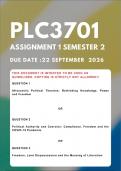
,PLC3701 ASSIGNMENT 1
SEMESTER 2
DUE DATE: 22 SEPTEMBER 2026
QUESTION 1
Afrocentric Political Theories: Rethinking Knowledge, Power and Freedom
Introduction
Political theories have often been developed from particular historical and cultural
experiences and then presented as if they apply universally to all societies. Many dominant
political theories have their origins in European intellectual traditions and have therefore
tended to treat European experiences as the main reference point for understanding
politics, power, freedom and society. Afrocentric political theories challenge this tendency
by placing African histories, cultures, experiences and forms of knowledge at the centre of
political analysis. Rather than treating Africa and Black people as objects of study,
Afrocentric approaches emphasise their ability to produce knowledge about themselves
and their own political realities.
The importance of Afrocentric political frameworks extends beyond simply adding African
perspectives to existing theories. These frameworks question who has the authority to
define knowledge, whose experiences are regarded as politically important and how
concepts such as freedom and liberation should be understood. Africana Womanism
provides a useful example of this approach. Developed by Clenora Hudson-Weems, Africana
Womanism places emphasis on self-naming, self-definition, cultural identity, family,
community and African heritage. It provides a way of understanding Black women's
,experiences without requiring them to fit completely into theoretical categories developed
from different historical and cultural circumstances (Hudson-Weems, 1998).
This essay critically discusses the value of Afrocentric political frameworks as methods of
political analysis. It examines how they influence knowledge production, challenge
dominant understandings of power and provide alternative ways of thinking about freedom.
Africana Womanism is then used to demonstrate how political theory can be developed
from the experiences of Black women and how this can contribute to different
understandings of political community, resistance and liberation.
Understanding Afrocentric Political Analysis
Afrocentric political analysis begins with the recognition that African people have their own
histories, cultures, intellectual traditions and political experiences that should not always be
interpreted through external frameworks. Molefi Kete Asante argues that Afrocentricity
involves placing African people and their experiences at the centre of analysis rather than
treating them as peripheral to European historical and intellectual narratives (Asante, 1998).
This does not mean that everything produced outside Africa must be rejected. Instead,
Afrocentricity questions the assumption that one intellectual tradition should automatically
serve as the universal standard for understanding every society. Mazama (2001) explains
that the Afrocentric paradigm seeks to restore African agency by allowing African
experiences and cultural references to become important sources of knowledge.
This is significant because political theories are never completely separated from history.
Ideas about democracy, citizenship, freedom, authority and political participation are
influenced by the societies in which they develop. An Afrocentric approach therefore asks
whether political concepts developed elsewhere can adequately explain African political
realities. Where they cannot, there is a need to develop or adapt concepts that speak more
directly to African experiences.
, Afrocentric analysis consequently shifts the position of African people from being passive
subjects of political knowledge to active producers of that knowledge. This is one of its
major contributions to political theory.
Knowledge Production and Epistemology
One of the most important contributions of Afrocentric political theory is its challenge to
dominant systems of knowledge. For a long period, African societies were frequently
represented through colonial knowledge systems that described Africans from an external
perspective. Colonial institutions often treated European knowledge as superior while
presenting African cultures and forms of knowledge as backward or less developed.
Afrocentric approaches question this hierarchy. Ndlovu-Gatsheni (2018) argues that
decolonisation requires more than political independence because colonialism also affected
systems of knowledge and ways of understanding the world. Epistemic freedom therefore
involves the ability of African people to participate fully in defining what counts as
knowledge and whose knowledge should be recognised.
This changes the way political analysis can be conducted. Instead of asking only how
established theories explain African societies, researchers can also ask how African
communities understand themselves and their political circumstances. African oral
traditions, cultural practices, historical experiences and collective memories can therefore
become meaningful sources for political knowledge.
Matolino (2023) similarly highlights the importance of recognising African epistemological
traditions within processes of decolonisation. This is not simply an academic exercise.
Knowledge influences power because those who control dominant explanations of society
can also influence how political problems are defined and which solutions are considered
legitimate.
SEMESTER 2
DUE DATE: 22 SEPTEMBER 2026
QUESTION 1
Afrocentric Political Theories: Rethinking Knowledge, Power and Freedom
Introduction
Political theories have often been developed from particular historical and cultural
experiences and then presented as if they apply universally to all societies. Many dominant
political theories have their origins in European intellectual traditions and have therefore
tended to treat European experiences as the main reference point for understanding
politics, power, freedom and society. Afrocentric political theories challenge this tendency
by placing African histories, cultures, experiences and forms of knowledge at the centre of
political analysis. Rather than treating Africa and Black people as objects of study,
Afrocentric approaches emphasise their ability to produce knowledge about themselves
and their own political realities.
The importance of Afrocentric political frameworks extends beyond simply adding African
perspectives to existing theories. These frameworks question who has the authority to
define knowledge, whose experiences are regarded as politically important and how
concepts such as freedom and liberation should be understood. Africana Womanism
provides a useful example of this approach. Developed by Clenora Hudson-Weems, Africana
Womanism places emphasis on self-naming, self-definition, cultural identity, family,
community and African heritage. It provides a way of understanding Black women's
,experiences without requiring them to fit completely into theoretical categories developed
from different historical and cultural circumstances (Hudson-Weems, 1998).
This essay critically discusses the value of Afrocentric political frameworks as methods of
political analysis. It examines how they influence knowledge production, challenge
dominant understandings of power and provide alternative ways of thinking about freedom.
Africana Womanism is then used to demonstrate how political theory can be developed
from the experiences of Black women and how this can contribute to different
understandings of political community, resistance and liberation.
Understanding Afrocentric Political Analysis
Afrocentric political analysis begins with the recognition that African people have their own
histories, cultures, intellectual traditions and political experiences that should not always be
interpreted through external frameworks. Molefi Kete Asante argues that Afrocentricity
involves placing African people and their experiences at the centre of analysis rather than
treating them as peripheral to European historical and intellectual narratives (Asante, 1998).
This does not mean that everything produced outside Africa must be rejected. Instead,
Afrocentricity questions the assumption that one intellectual tradition should automatically
serve as the universal standard for understanding every society. Mazama (2001) explains
that the Afrocentric paradigm seeks to restore African agency by allowing African
experiences and cultural references to become important sources of knowledge.
This is significant because political theories are never completely separated from history.
Ideas about democracy, citizenship, freedom, authority and political participation are
influenced by the societies in which they develop. An Afrocentric approach therefore asks
whether political concepts developed elsewhere can adequately explain African political
realities. Where they cannot, there is a need to develop or adapt concepts that speak more
directly to African experiences.
, Afrocentric analysis consequently shifts the position of African people from being passive
subjects of political knowledge to active producers of that knowledge. This is one of its
major contributions to political theory.
Knowledge Production and Epistemology
One of the most important contributions of Afrocentric political theory is its challenge to
dominant systems of knowledge. For a long period, African societies were frequently
represented through colonial knowledge systems that described Africans from an external
perspective. Colonial institutions often treated European knowledge as superior while
presenting African cultures and forms of knowledge as backward or less developed.
Afrocentric approaches question this hierarchy. Ndlovu-Gatsheni (2018) argues that
decolonisation requires more than political independence because colonialism also affected
systems of knowledge and ways of understanding the world. Epistemic freedom therefore
involves the ability of African people to participate fully in defining what counts as
knowledge and whose knowledge should be recognised.
This changes the way political analysis can be conducted. Instead of asking only how
established theories explain African societies, researchers can also ask how African
communities understand themselves and their political circumstances. African oral
traditions, cultural practices, historical experiences and collective memories can therefore
become meaningful sources for political knowledge.
Matolino (2023) similarly highlights the importance of recognising African epistemological
traditions within processes of decolonisation. This is not simply an academic exercise.
Knowledge influences power because those who control dominant explanations of society
can also influence how political problems are defined and which solutions are considered
legitimate.