
A+ VERIFIED
NURSING · OBJECTIVE ASSESSMENT
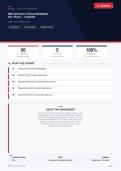
NSG 526 Exam 3 Clinical Modalities
Adv. Psych — Complete
Official Exam
50 Questions Full Rationales Verified Answers
50 5 100%
QUESTIONS SECTIONS RATIONALES
Complete coverage Core exam domains Every answer explained
WHAT THIS COVERS
01 Individual Psychotherapy Modalities
02 Group & Family Therapy Approaches
03 Cognitive, Behavioral & Dialectical Interventions
04 Psychodynamic & Humanistic Approaches
05 Crisis Intervention & Trauma-Informed Care
ABOUT THIS ASSESSMENT
Build mastery in advanced psychiatric clinical modalities — from
individual psychotherapy and group/family therapy to cognitive,
behavioral, dialectical, psychodynamic, humanistic, crisis, and
trauma-informed approaches. This original study bank targets
application and analysis skills for NSG 526 Exam 3, with full
rationales for every answer. For review use only; not an
institutional proctored assessment.
PASSING SCORE LEVEL FORMAT
80% Advanced (Graduate Nursing) Application / Analysis
STUVIA ACTUAL EXAM Page 1
, SECTION 1: Individual Psychotherapy Modalities
Q1. A psychiatric-mental health nurse practitioner is conducting supportive psychotherapy with a client who has recently
experienced a major loss. The primary goal of supportive psychotherapy in this context is to:
A. Focus exclusively on symptom exposure without support.
B. Explore unconscious conflicts from early childhood in depth.
C. Challenge core beliefs through structured cognitive restructuring.
D. Strengthen existing coping skills and reduce anxiety while maintaining the client’s current level of functioning.
Correct Answer: D
Rationale:
Supportive psychotherapy aims to reinforce adaptive defenses and coping, stabilize functioning, and provide a safe therapeutic
relationship rather than deep uncovering of unconscious material.
Q2. During an interpersonal therapy (IPT) session, a client with major depression describes ongoing conflict with a spouse. The
clinician correctly identifies the IPT problem area as:
A. Interpersonal deficits only.
B. Interpersonal role dispute.
C. Grief without any relational component.
D. Role transition unrelated to the spouse.
Correct Answer: B
Rationale:
IPT organizes treatment around four problem areas: grief, role disputes, role transitions, and interpersonal deficits. Ongoing conflict with a
spouse is a classic role dispute.
Q3. A client with borderline personality features is beginning a course of mentalization-based therapy. The clinician explains
that the central focus of this modality is to:
A. Provide only medication management without relational work.
B. Eliminate all emotional expression through strict behavioral control.
C. Improve the capacity to understand one’s own and others’ mental states in the context of attachment relationships.
D. Focus solely on childhood trauma narratives without present-focused skills.
Correct Answer: C
Rationale:
Mentalization-based therapy targets the ability to mentalize—to understand behavior in terms of underlying mental states—particularly
within attachment relationships.
Q4. In a motivational interviewing session, a client expresses ambivalence about reducing alcohol use. The clinician’s most
consistent response is to:
A. Explore the ambivalence collaboratively and elicit the client’s own reasons for change.
B. Confront the client forcefully about the need to quit immediately.
C. Ignore the ambivalence and prescribe a fixed treatment plan.
D. Focus only on the negative consequences without acknowledging mixed feelings.
Correct Answer: A
Rationale:
Motivational interviewing works with ambivalence by eliciting change talk and supporting autonomy rather than arguing for change.
STUVIA ACTUAL EXAM · Page 2
NURSING · OBJECTIVE ASSESSMENT
NSG 526 Exam 3 Clinical Modalities
Adv. Psych — Complete
Official Exam
50 Questions Full Rationales Verified Answers
50 5 100%
QUESTIONS SECTIONS RATIONALES
Complete coverage Core exam domains Every answer explained
WHAT THIS COVERS
01 Individual Psychotherapy Modalities
02 Group & Family Therapy Approaches
03 Cognitive, Behavioral & Dialectical Interventions
04 Psychodynamic & Humanistic Approaches
05 Crisis Intervention & Trauma-Informed Care
ABOUT THIS ASSESSMENT
Build mastery in advanced psychiatric clinical modalities — from
individual psychotherapy and group/family therapy to cognitive,
behavioral, dialectical, psychodynamic, humanistic, crisis, and
trauma-informed approaches. This original study bank targets
application and analysis skills for NSG 526 Exam 3, with full
rationales for every answer. For review use only; not an
institutional proctored assessment.
PASSING SCORE LEVEL FORMAT
80% Advanced (Graduate Nursing) Application / Analysis
STUVIA ACTUAL EXAM Page 1
, SECTION 1: Individual Psychotherapy Modalities
Q1. A psychiatric-mental health nurse practitioner is conducting supportive psychotherapy with a client who has recently
experienced a major loss. The primary goal of supportive psychotherapy in this context is to:
A. Focus exclusively on symptom exposure without support.
B. Explore unconscious conflicts from early childhood in depth.
C. Challenge core beliefs through structured cognitive restructuring.
D. Strengthen existing coping skills and reduce anxiety while maintaining the client’s current level of functioning.
Correct Answer: D
Rationale:
Supportive psychotherapy aims to reinforce adaptive defenses and coping, stabilize functioning, and provide a safe therapeutic
relationship rather than deep uncovering of unconscious material.
Q2. During an interpersonal therapy (IPT) session, a client with major depression describes ongoing conflict with a spouse. The
clinician correctly identifies the IPT problem area as:
A. Interpersonal deficits only.
B. Interpersonal role dispute.
C. Grief without any relational component.
D. Role transition unrelated to the spouse.
Correct Answer: B
Rationale:
IPT organizes treatment around four problem areas: grief, role disputes, role transitions, and interpersonal deficits. Ongoing conflict with a
spouse is a classic role dispute.
Q3. A client with borderline personality features is beginning a course of mentalization-based therapy. The clinician explains
that the central focus of this modality is to:
A. Provide only medication management without relational work.
B. Eliminate all emotional expression through strict behavioral control.
C. Improve the capacity to understand one’s own and others’ mental states in the context of attachment relationships.
D. Focus solely on childhood trauma narratives without present-focused skills.
Correct Answer: C
Rationale:
Mentalization-based therapy targets the ability to mentalize—to understand behavior in terms of underlying mental states—particularly
within attachment relationships.
Q4. In a motivational interviewing session, a client expresses ambivalence about reducing alcohol use. The clinician’s most
consistent response is to:
A. Explore the ambivalence collaboratively and elicit the client’s own reasons for change.
B. Confront the client forcefully about the need to quit immediately.
C. Ignore the ambivalence and prescribe a fixed treatment plan.
D. Focus only on the negative consequences without acknowledging mixed feelings.
Correct Answer: A
Rationale:
Motivational interviewing works with ambivalence by eliciting change talk and supporting autonomy rather than arguing for change.
STUVIA ACTUAL EXAM · Page 2


