
Nur 155 exam 3 (sensory + activity) 2026/2027 (Answered)
Nur 155: exam 3 (sensory + activity)
Study online at https://quizlet.com/_jupipe
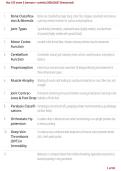
1. Bone Classifica- Bones are classified by shape (long, short, flat, irregular, sesamoid) and serve as
tion & Minerals a primary mineral reservoir for calcium and phosphorus.
2. Joint Types Synarthrodial (immobile), amphiarthrodial (slightly mobile), and diarthrodi-
al/synovial (highly mobile with synovial fluid).
3. Motor Cortex Located in the frontal lobe; initiates voluntary skeletal muscle movements.
Function
4. Cerebellum Coordinates natural gait, voluntary motor actions, overall posture, and physical
Function balance.
5. Proprioception Deep-tissue neuromuscular awareness of body positioning and movement in
three-dimensional space.
6. Muscle Atrophy Wasting of muscle cells leading to a profound reduction in mass, fiber size, and
strength.
7. Joint Contrac- Permanent shortening of muscles/tendons causing locked joints; foot drop is the
tures & Foot Drop inability to lift the foot.
8. Paralysis Classifi- Hemiplegia (one vertical half), paraplegia (lower trunk/extremities), quadriplegia
cations (all four limbs).
9. Orthostatic Hy- A sudden drop in blood pressure when transitioning to an upright position due
potension to venous pooling.
10. Deep Vein Circulatory stasis combined with weakened calf muscle action promotes blood
Thrombosis clots; check pedal pulses.
(DVT) in
Immobility
11. Atelectasis is collapsed alveoli from shallow breathing; hypostatic pneumonia is
bacterial pooling in lung secretions.
1 of 18
, Nur 155 exam 3 (sensory + activity) 2026/2027 (Answered)
Nur 155: exam 3 (sensory + activity)
Study online at https://quizlet.com/_jupipe
Atelectasis & Hy-
postatic Pneu-
monia
12. Negative Nitro- BMR drops and insufficient protein intake causes the body to break down muscle
gen Balance tissue for energy (catabolism).
13. GI Hypomotility Decreased peristalsis from immobility leading to anorexia, nausea, and severe
constipation.
14. Urinary Compli- Gravity-dependent urine pooling causes urinary stasis, leading to renal calculi
cations of Immo- (kidney stones) and UTIs.
bility
15. Tissue Ischemia Unrelieved pressure on bony prominences compresses microvessels, leading to
& Pressure In- local cell death (necrosis).
juries
16. Isotonic vs. Iso- Isotonic involves active movement with muscle shortening (walking); isometric
metric Exercise involves muscle contraction without joint movement (Kegels).
17. Trochanter Rolls Trochanter rolls prevent hip external rotation; footboards/PRAFO boots maintain
& Footboards dorsiflexion to prevent foot drop.
18. Logrolling Proto- Specialized turning method keeping the head, neck, spine, and pelvis aligned in
col a single straight plane.
19. Skin Breakdown Turn patients every 2 hours, use pressure-relieving mattresses, and apply heel/el-
Prevention bow protectors.
20. Cardiopul- Use incentive spirometry (10x/hour), sequential compression devices (SCDs),
monary antiembolism hose, and anticoagulants to prevent DVT.
Prophylaxis
2 of 18
, Nur 155 exam 3 (sensory + activity) 2026/2027 (Answered)
Nur 155: exam 3 (sensory + activity)
Study online at https://quizlet.com/_jupipe
21. Body Mechanics Keep spine aligned, adopt a wide base of support, bend at knees/hips, lift with
for Nurses core, and avoid twisting.
22. Cane Ambulation Hold cane on the stronger (unaffected) side. Move cane forward first, then weaker
Technique leg, then stronger leg.
23. Crutch Safety & Maintain a 2-3 finger-width axillary gap. Stairs: 'Up with the good' (strong leg
Stairs first), 'down with the bad' (crutches/weak leg first).
24. Walker Ambula- Move walker forward, step weak leg into center, then step strong leg forward.
tion Sequence
25. Sensation Path- Stimulus activates receptors, perception interprets signals in the cerebral cortex,
way Components and the RAS modulates cortical arousal.
26. Delirium vs. De- Delirium is an acute, fluctuating, reversible change in mental status; dementia is
mentia a progressive, irreversible cognitive decline.
27. Sundowning in The worsening of confusion, agitation, and anxiety in dementia patients starting
Dementia in the late afternoon or evening.
28. CVA Types & FAST CVAs are ischemic (occlusion) or hemorrhagic (rupture). FAST stands for Face
Assessment drooping, Arm weakness, Speech difficulty, Time to call 911.
29. Wernicke's vs. Wernicke's (receptive) causes fluent nonsensical speech with poor comprehen-
Broca's Aphasia sion; Broca's (expressive) causes trouble speaking despite good comprehension.
30. Hearing Loss Conductive hearing loss is a physical barrier in the outer/middle ear; sensorineur-
Types al involves inner ear or cochlear nerve damage.
31. Visual Deficits Glaucoma increases intraocular pressure causing tunnel vision; cataracts cloud
(Glaucoma vs. the lens causing blurry, dim vision.
Cataracts)
3 of 18
Nur 155: exam 3 (sensory + activity)
Study online at https://quizlet.com/_jupipe
1. Bone Classifica- Bones are classified by shape (long, short, flat, irregular, sesamoid) and serve as
tion & Minerals a primary mineral reservoir for calcium and phosphorus.
2. Joint Types Synarthrodial (immobile), amphiarthrodial (slightly mobile), and diarthrodi-
al/synovial (highly mobile with synovial fluid).
3. Motor Cortex Located in the frontal lobe; initiates voluntary skeletal muscle movements.
Function
4. Cerebellum Coordinates natural gait, voluntary motor actions, overall posture, and physical
Function balance.
5. Proprioception Deep-tissue neuromuscular awareness of body positioning and movement in
three-dimensional space.
6. Muscle Atrophy Wasting of muscle cells leading to a profound reduction in mass, fiber size, and
strength.
7. Joint Contrac- Permanent shortening of muscles/tendons causing locked joints; foot drop is the
tures & Foot Drop inability to lift the foot.
8. Paralysis Classifi- Hemiplegia (one vertical half), paraplegia (lower trunk/extremities), quadriplegia
cations (all four limbs).
9. Orthostatic Hy- A sudden drop in blood pressure when transitioning to an upright position due
potension to venous pooling.
10. Deep Vein Circulatory stasis combined with weakened calf muscle action promotes blood
Thrombosis clots; check pedal pulses.
(DVT) in
Immobility
11. Atelectasis is collapsed alveoli from shallow breathing; hypostatic pneumonia is
bacterial pooling in lung secretions.
1 of 18
, Nur 155 exam 3 (sensory + activity) 2026/2027 (Answered)
Nur 155: exam 3 (sensory + activity)
Study online at https://quizlet.com/_jupipe
Atelectasis & Hy-
postatic Pneu-
monia
12. Negative Nitro- BMR drops and insufficient protein intake causes the body to break down muscle
gen Balance tissue for energy (catabolism).
13. GI Hypomotility Decreased peristalsis from immobility leading to anorexia, nausea, and severe
constipation.
14. Urinary Compli- Gravity-dependent urine pooling causes urinary stasis, leading to renal calculi
cations of Immo- (kidney stones) and UTIs.
bility
15. Tissue Ischemia Unrelieved pressure on bony prominences compresses microvessels, leading to
& Pressure In- local cell death (necrosis).
juries
16. Isotonic vs. Iso- Isotonic involves active movement with muscle shortening (walking); isometric
metric Exercise involves muscle contraction without joint movement (Kegels).
17. Trochanter Rolls Trochanter rolls prevent hip external rotation; footboards/PRAFO boots maintain
& Footboards dorsiflexion to prevent foot drop.
18. Logrolling Proto- Specialized turning method keeping the head, neck, spine, and pelvis aligned in
col a single straight plane.
19. Skin Breakdown Turn patients every 2 hours, use pressure-relieving mattresses, and apply heel/el-
Prevention bow protectors.
20. Cardiopul- Use incentive spirometry (10x/hour), sequential compression devices (SCDs),
monary antiembolism hose, and anticoagulants to prevent DVT.
Prophylaxis
2 of 18
, Nur 155 exam 3 (sensory + activity) 2026/2027 (Answered)
Nur 155: exam 3 (sensory + activity)
Study online at https://quizlet.com/_jupipe
21. Body Mechanics Keep spine aligned, adopt a wide base of support, bend at knees/hips, lift with
for Nurses core, and avoid twisting.
22. Cane Ambulation Hold cane on the stronger (unaffected) side. Move cane forward first, then weaker
Technique leg, then stronger leg.
23. Crutch Safety & Maintain a 2-3 finger-width axillary gap. Stairs: 'Up with the good' (strong leg
Stairs first), 'down with the bad' (crutches/weak leg first).
24. Walker Ambula- Move walker forward, step weak leg into center, then step strong leg forward.
tion Sequence
25. Sensation Path- Stimulus activates receptors, perception interprets signals in the cerebral cortex,
way Components and the RAS modulates cortical arousal.
26. Delirium vs. De- Delirium is an acute, fluctuating, reversible change in mental status; dementia is
mentia a progressive, irreversible cognitive decline.
27. Sundowning in The worsening of confusion, agitation, and anxiety in dementia patients starting
Dementia in the late afternoon or evening.
28. CVA Types & FAST CVAs are ischemic (occlusion) or hemorrhagic (rupture). FAST stands for Face
Assessment drooping, Arm weakness, Speech difficulty, Time to call 911.
29. Wernicke's vs. Wernicke's (receptive) causes fluent nonsensical speech with poor comprehen-
Broca's Aphasia sion; Broca's (expressive) causes trouble speaking despite good comprehension.
30. Hearing Loss Conductive hearing loss is a physical barrier in the outer/middle ear; sensorineur-
Types al involves inner ear or cochlear nerve damage.
31. Visual Deficits Glaucoma increases intraocular pressure causing tunnel vision; cataracts cloud
(Glaucoma vs. the lens causing blurry, dim vision.
Cataracts)
3 of 18


