
Pharmacology Exam 1 Q with complete solutions...
Pharmacology Exam 1
Study online at https://quizlet.com/_1ho5fp
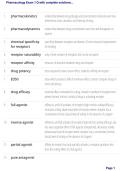
1. pharmacokinetics relationship between drug dosage and concentration in plasma over time,
determines onset, duration, and intensity of drug
2. pharmacodynamics relationship between drug concentration over time and therapeutic re-
sponse
3. chemical specificity specificity between receptors and bonds, EX strict structural requirements
for receptors for binding
4. receptor saturability only a finite number of receptors that can be occupied
5. receptor affinity measure of attraction between drug and receptor
6. drug potency dose required to have certain effect, related to affinity of receptor
7. ED50 dose which produces 50% of maximum effect, used to compare drugs in
terms of potency
8. drug efficacy maximal effect achievable for a drug, related to number of receptor/com-
plexes formed, intrinsic activity of drug in activating receptor
9. full agonist affinity to, and full activator, of receptor (high intrinsic activity/efficacy),
increases activity above basal level of receptor where receptor has a
constitutive (intrinsic basal) level of activity in the absence of a ligand
10. inverse agonist affinity to, and full activator of receptor (high intrinsic activity/efficacy), but
has exact opposite effect of full agonist (metoprolol), decreases activity
below basal level of receptor where receptor has a constitutive (intrinsic
basal) level of activity in the absence of a ligand
11. partial agonist affinity to receptor but only partially activates a receptor, produces less
than the ceiling effect of a full agonist
12. pure antagonist
Page 1
, Pharmacology Exam 1 Q with complete solutions...
Pharmacology Exam 1
Study online at https://quizlet.com/_1ho5fp
affinity to receptor but produces no activation, dose curve is a straight line
across the bottom of an XY graph (EX oraverse vasodilates, overcoming the
vasocontriction of the LA)
13. neutral antgonist has no activity in the absence of an agonist or inverse agonist but can block
either's activity
14. competitive antago- lacks efficacy, competes with agonists for binding sites, inhibitory effect
nist can be overcome by increasing concentration of competing agonist
15. every drug produces a
variety of effects, we
hope we can get sepa-
ration from things we
want and adverse side
effects, this is different
for every patient
16. know the second slide which drugs is most potent, least potenet, most efficient and least efficient
on page 10 of princi-
ples of drugs
17. physiological antago- stimulates competing/opposite physiological responses which counteract
nism the effects of a therapeutic drug, the inhibitory effect can *NOT* be over-
come by increasing the agonist dosage (EX epi is used during anaphylaxis
to produce physiological responses instead of an antihistamine which is
only a competing antagonist)
18. exam will ask you
to explain interactions
between drugs in ref-
erence to physiolog-
ical antagonism that
Page 2
Pharmacology Exam 1
Study online at https://quizlet.com/_1ho5fp
1. pharmacokinetics relationship between drug dosage and concentration in plasma over time,
determines onset, duration, and intensity of drug
2. pharmacodynamics relationship between drug concentration over time and therapeutic re-
sponse
3. chemical specificity specificity between receptors and bonds, EX strict structural requirements
for receptors for binding
4. receptor saturability only a finite number of receptors that can be occupied
5. receptor affinity measure of attraction between drug and receptor
6. drug potency dose required to have certain effect, related to affinity of receptor
7. ED50 dose which produces 50% of maximum effect, used to compare drugs in
terms of potency
8. drug efficacy maximal effect achievable for a drug, related to number of receptor/com-
plexes formed, intrinsic activity of drug in activating receptor
9. full agonist affinity to, and full activator, of receptor (high intrinsic activity/efficacy),
increases activity above basal level of receptor where receptor has a
constitutive (intrinsic basal) level of activity in the absence of a ligand
10. inverse agonist affinity to, and full activator of receptor (high intrinsic activity/efficacy), but
has exact opposite effect of full agonist (metoprolol), decreases activity
below basal level of receptor where receptor has a constitutive (intrinsic
basal) level of activity in the absence of a ligand
11. partial agonist affinity to receptor but only partially activates a receptor, produces less
than the ceiling effect of a full agonist
12. pure antagonist
Page 1
, Pharmacology Exam 1 Q with complete solutions...
Pharmacology Exam 1
Study online at https://quizlet.com/_1ho5fp
affinity to receptor but produces no activation, dose curve is a straight line
across the bottom of an XY graph (EX oraverse vasodilates, overcoming the
vasocontriction of the LA)
13. neutral antgonist has no activity in the absence of an agonist or inverse agonist but can block
either's activity
14. competitive antago- lacks efficacy, competes with agonists for binding sites, inhibitory effect
nist can be overcome by increasing concentration of competing agonist
15. every drug produces a
variety of effects, we
hope we can get sepa-
ration from things we
want and adverse side
effects, this is different
for every patient
16. know the second slide which drugs is most potent, least potenet, most efficient and least efficient
on page 10 of princi-
ples of drugs
17. physiological antago- stimulates competing/opposite physiological responses which counteract
nism the effects of a therapeutic drug, the inhibitory effect can *NOT* be over-
come by increasing the agonist dosage (EX epi is used during anaphylaxis
to produce physiological responses instead of an antihistamine which is
only a competing antagonist)
18. exam will ask you
to explain interactions
between drugs in ref-
erence to physiolog-
ical antagonism that
Page 2


