
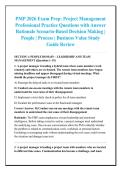
PMP 2026 Exam Prep: Project Management
Professional Practice Questions with Answer
Rationale Scenario-Based Decision Making |
People | Process | Business Value Study
Guide Review
SECTION 1: PEOPLE DOMAIN – LEADERSHIP AND TEAM
MANAGEMENT (Questions 1–35)
1. A project manager is leading a hybrid team where some members work
remotely and others are co-located. The remote team members have begun
missing deadlines and appear disengaged during virtual meetings. What
should the project manager do FIRST?
A) Reassign the delayed tasks to co-located team members
B) Conduct one-on-one meetings with the remote team members to
understand the root cause of their disengagement
C) Implement a strict daily check-in policy for all team members
D) Escalate the performance issue to the functional managers
Correct Answer: B) Conduct one-on-one meetings with the remote team
members to understand the root cause of their disengagement
Rationale: The PMP exam emphasizes servant leadership and emotional
intelligence. Before taking corrective action, a project manager must understand
the underlying issue. One-on-one conversations allow the PM to identify whether
the problem is related to communication, tools, workload, or personal factors.
Escalating or reassigning tasks without understanding the root cause could worsen
the situation and damage team trust.
2. A project manager is leading a project team with members who are located
in different time zones. Communication has become a challenge, and team
,members are complaining about late responses to their queries. What is the
MOST appropriate action?
A) Require all team members to be available during a single core overlap window
B) Establish clear communication protocols and response time expectations
with the team
C) Send daily email summaries to all team members
D) Schedule all meetings during the project manager's working hours
Correct Answer: B) Establish clear communication protocols and response
time expectations with the team
Rationale: In a global or distributed team, establishing clear communication
protocols—including response time expectations, preferred communication
channels, and escalation paths—is essential. This collaborative approach ensures
that all team members understand how and when to communicate, reducing
frustration and improving efficiency. Imposing rigid schedules without team input
can reduce morale and productivity.
3. During a sprint retrospective, a team member expresses frustration that
their ideas are consistently ignored by senior team members. What should the
project manager do?
A) Tell the team member to be more assertive
B) Facilitate a discussion about psychological safety and ensure all voices are
heard in future meetings
C) Ignore the complaint as it is a personal issue
D) Reassign the team member to a different team
Correct Answer: B) Facilitate a discussion about psychological safety and
ensure all voices are heard in future meetings
Rationale: Creating a psychologically safe environment is a key leadership
responsibility. The PM should address the concern by facilitating an open
discussion and implementing practices—such as round-robin idea sharing or
,anonymous feedback—that ensure all team members can contribute. Dismissing
the issue or blaming the individual undermines team cohesion and innovation.
4. A project manager notices that two team members are in constant conflict,
which is affecting team morale and productivity. What is the BEST approach
to resolve this situation?
A) Separate the two team members so they do not work together
B) Meet with both team members together to facilitate a constructive
conversation and identify a resolution
C) Report both team members to HR
D) Ignore the conflict as it will resolve itself over time
Correct Answer: B) Meet with both team members together to facilitate a
constructive conversation and identify a resolution
Rationale: Conflict resolution is a core PMP responsibility. The PM should use a
collaborative approach, meeting with both parties to understand their perspectives
and facilitate a mutually agreeable resolution. Avoiding the conflict or separating
team members may provide temporary relief but does not address the root cause.
5. A project team is experiencing low morale due to a demanding schedule
and constant scope changes. What should the project manager do to improve
team motivation?
A) Increase the team's workload to meet deadlines
B) Recognize and celebrate small wins, and involve the team in decision-
making where possible
C) Remind the team that they should be grateful for their jobs
D) Reduce the number of team meetings
Correct Answer: B) Recognize and celebrate small wins, and involve the team
in decision-making where possible
Rationale: Recognition and empowerment are powerful motivators. Celebrating
achievements—even small ones—and giving team members a voice in decisions
, that affect their work can significantly improve morale and engagement. Increasing
workload or reducing meetings without addressing the underlying issues will not
resolve low morale.
6. A project manager is forming a new project team. What is the MOST
important action to take during the forming stage?
A) Assign tasks immediately to ensure productivity
B) Establish clear roles, responsibilities, and team ground rules
C) Evaluate each team member's performance
D) Begin the project work immediately
Correct Answer: B) Establish clear roles, responsibilities, and team ground
rules
Rationale: During the forming stage, team members are uncertain about their roles
and the team's purpose. The PM should clarify roles and responsibilities, establish
ground rules, and create a shared understanding of the team's goals. This
foundation is essential for the team to progress to the storming and norming stages.
7. A project manager needs to delegate a critical task to a team member.
What should be considered FIRST when selecting the team member?
A) The team member's seniority
B) The team member's skills, experience, and availability
C) The team member's relationship with the project manager
D) The team member's salary
Correct Answer: B) The team member's skills, experience, and availability
Rationale: Effective delegation requires matching the task to the right person
based on their skills, experience, and availability. Seniority alone is not a sufficient
criterion. The PM should also consider the team member's development goals and
provide the necessary support and resources.
Professional Practice Questions with Answer
Rationale Scenario-Based Decision Making |
People | Process | Business Value Study
Guide Review
SECTION 1: PEOPLE DOMAIN – LEADERSHIP AND TEAM
MANAGEMENT (Questions 1–35)
1. A project manager is leading a hybrid team where some members work
remotely and others are co-located. The remote team members have begun
missing deadlines and appear disengaged during virtual meetings. What
should the project manager do FIRST?
A) Reassign the delayed tasks to co-located team members
B) Conduct one-on-one meetings with the remote team members to
understand the root cause of their disengagement
C) Implement a strict daily check-in policy for all team members
D) Escalate the performance issue to the functional managers
Correct Answer: B) Conduct one-on-one meetings with the remote team
members to understand the root cause of their disengagement
Rationale: The PMP exam emphasizes servant leadership and emotional
intelligence. Before taking corrective action, a project manager must understand
the underlying issue. One-on-one conversations allow the PM to identify whether
the problem is related to communication, tools, workload, or personal factors.
Escalating or reassigning tasks without understanding the root cause could worsen
the situation and damage team trust.
2. A project manager is leading a project team with members who are located
in different time zones. Communication has become a challenge, and team
,members are complaining about late responses to their queries. What is the
MOST appropriate action?
A) Require all team members to be available during a single core overlap window
B) Establish clear communication protocols and response time expectations
with the team
C) Send daily email summaries to all team members
D) Schedule all meetings during the project manager's working hours
Correct Answer: B) Establish clear communication protocols and response
time expectations with the team
Rationale: In a global or distributed team, establishing clear communication
protocols—including response time expectations, preferred communication
channels, and escalation paths—is essential. This collaborative approach ensures
that all team members understand how and when to communicate, reducing
frustration and improving efficiency. Imposing rigid schedules without team input
can reduce morale and productivity.
3. During a sprint retrospective, a team member expresses frustration that
their ideas are consistently ignored by senior team members. What should the
project manager do?
A) Tell the team member to be more assertive
B) Facilitate a discussion about psychological safety and ensure all voices are
heard in future meetings
C) Ignore the complaint as it is a personal issue
D) Reassign the team member to a different team
Correct Answer: B) Facilitate a discussion about psychological safety and
ensure all voices are heard in future meetings
Rationale: Creating a psychologically safe environment is a key leadership
responsibility. The PM should address the concern by facilitating an open
discussion and implementing practices—such as round-robin idea sharing or
,anonymous feedback—that ensure all team members can contribute. Dismissing
the issue or blaming the individual undermines team cohesion and innovation.
4. A project manager notices that two team members are in constant conflict,
which is affecting team morale and productivity. What is the BEST approach
to resolve this situation?
A) Separate the two team members so they do not work together
B) Meet with both team members together to facilitate a constructive
conversation and identify a resolution
C) Report both team members to HR
D) Ignore the conflict as it will resolve itself over time
Correct Answer: B) Meet with both team members together to facilitate a
constructive conversation and identify a resolution
Rationale: Conflict resolution is a core PMP responsibility. The PM should use a
collaborative approach, meeting with both parties to understand their perspectives
and facilitate a mutually agreeable resolution. Avoiding the conflict or separating
team members may provide temporary relief but does not address the root cause.
5. A project team is experiencing low morale due to a demanding schedule
and constant scope changes. What should the project manager do to improve
team motivation?
A) Increase the team's workload to meet deadlines
B) Recognize and celebrate small wins, and involve the team in decision-
making where possible
C) Remind the team that they should be grateful for their jobs
D) Reduce the number of team meetings
Correct Answer: B) Recognize and celebrate small wins, and involve the team
in decision-making where possible
Rationale: Recognition and empowerment are powerful motivators. Celebrating
achievements—even small ones—and giving team members a voice in decisions
, that affect their work can significantly improve morale and engagement. Increasing
workload or reducing meetings without addressing the underlying issues will not
resolve low morale.
6. A project manager is forming a new project team. What is the MOST
important action to take during the forming stage?
A) Assign tasks immediately to ensure productivity
B) Establish clear roles, responsibilities, and team ground rules
C) Evaluate each team member's performance
D) Begin the project work immediately
Correct Answer: B) Establish clear roles, responsibilities, and team ground
rules
Rationale: During the forming stage, team members are uncertain about their roles
and the team's purpose. The PM should clarify roles and responsibilities, establish
ground rules, and create a shared understanding of the team's goals. This
foundation is essential for the team to progress to the storming and norming stages.
7. A project manager needs to delegate a critical task to a team member.
What should be considered FIRST when selecting the team member?
A) The team member's seniority
B) The team member's skills, experience, and availability
C) The team member's relationship with the project manager
D) The team member's salary
Correct Answer: B) The team member's skills, experience, and availability
Rationale: Effective delegation requires matching the task to the right person
based on their skills, experience, and availability. Seniority alone is not a sufficient
criterion. The PM should also consider the team member's development goals and
provide the necessary support and resources.


