
STUDY GUIDE
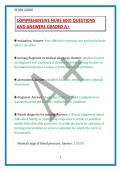
COMPREHENSIVE NURS 6001 QUESTIONS
AND ANSWERS GRADED A+
◉ evaluation. Answer: how effective is nursing care and each phases
affects the other
◉ nursing diagnosis vs medical diagnosis. Answer: medical focuses
on diagnosis and treatment of disease whereas nursing focuses on
the human response to actual or potential health problems
◉ assessment. Answer: establish baseline, review history, physical
assessment
◉ diagnosis. Answer: clustering of data to make a judgement or
statement about the patient's difficulties or condition
◉ Nanda diagnosis for nursing. Answer: a clinical judgement about
individual, family, or community responses to actual or potential
health difficulties/life processes. Provides the basis for selection of
nursing interventions to achieve outcomes for which the nurse is
accountable
Normal range of blood pressure. Answer: 120/80
1
,◉
◉ normal range of pulse. Answer: 60-100 bpm
◉ scale of pulse strength. Answer: 0-4+
◉ scale of 0 pulse. Answer: non palpable or absent
◉ 1+ of pulse. Answer: weak, diminished, and barely palpable
◉ 2+ of pulse. Answer: normal, expected
◉ 3+ of pulse. Answer: Full, increased
◉ 4+ of pulse. Answer: Bounding
◉ normal oral temperature range. Answer: 97.7-99.5 F
◉ normal range for Temporal range. Answer: 98.7-100.5 F
◉ five ways to take temperature. Answer: oral, axillary, rectal,
tympanic, and temporal
◉ normal respirations. Answer: 12-20
2
, STUDY GUIDE
◉ normal O2 saturation. Answer: 95-100%
◉ Pain scale. Answer: 1-10
◉ COLDERR. Answer: characteristic, onset, location, duration,
exacerbation, relief, radiation
◉ 6 stages of infection cycles. Answer: infectious agent, reservoir,
portal of exit, means of transmission, portal of entry, susceptible
host
◉ infectious agent. Answer: bacteria, viruses, and fungi
◉ reservoir. Answer: place for growth and multiplication of
microorganisms is the natural habitat of the organism (other people,
animals, soil, food, water, milk and inanimate objects)
◉ portal of exit. Answer: point of escape for the organism from the
reservoir (respiratory, gastrointestinal, and genitourinary tracts, as
well as breaks in the skin and blood and tissue
means of transmission. Answer: how an organism is transmitted
3
COMPREHENSIVE NURS 6001 QUESTIONS
AND ANSWERS GRADED A+
◉ evaluation. Answer: how effective is nursing care and each phases
affects the other
◉ nursing diagnosis vs medical diagnosis. Answer: medical focuses
on diagnosis and treatment of disease whereas nursing focuses on
the human response to actual or potential health problems
◉ assessment. Answer: establish baseline, review history, physical
assessment
◉ diagnosis. Answer: clustering of data to make a judgement or
statement about the patient's difficulties or condition
◉ Nanda diagnosis for nursing. Answer: a clinical judgement about
individual, family, or community responses to actual or potential
health difficulties/life processes. Provides the basis for selection of
nursing interventions to achieve outcomes for which the nurse is
accountable
Normal range of blood pressure. Answer: 120/80
1
,◉
◉ normal range of pulse. Answer: 60-100 bpm
◉ scale of pulse strength. Answer: 0-4+
◉ scale of 0 pulse. Answer: non palpable or absent
◉ 1+ of pulse. Answer: weak, diminished, and barely palpable
◉ 2+ of pulse. Answer: normal, expected
◉ 3+ of pulse. Answer: Full, increased
◉ 4+ of pulse. Answer: Bounding
◉ normal oral temperature range. Answer: 97.7-99.5 F
◉ normal range for Temporal range. Answer: 98.7-100.5 F
◉ five ways to take temperature. Answer: oral, axillary, rectal,
tympanic, and temporal
◉ normal respirations. Answer: 12-20
2
, STUDY GUIDE
◉ normal O2 saturation. Answer: 95-100%
◉ Pain scale. Answer: 1-10
◉ COLDERR. Answer: characteristic, onset, location, duration,
exacerbation, relief, radiation
◉ 6 stages of infection cycles. Answer: infectious agent, reservoir,
portal of exit, means of transmission, portal of entry, susceptible
host
◉ infectious agent. Answer: bacteria, viruses, and fungi
◉ reservoir. Answer: place for growth and multiplication of
microorganisms is the natural habitat of the organism (other people,
animals, soil, food, water, milk and inanimate objects)
◉ portal of exit. Answer: point of escape for the organism from the
reservoir (respiratory, gastrointestinal, and genitourinary tracts, as
well as breaks in the skin and blood and tissue
means of transmission. Answer: how an organism is transmitted
3


