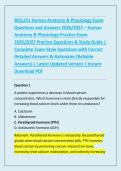
BIOL251 Human Anatomy & Physiology Exam
Questions and Answers 2026/2027 – Human
Anatomy & Physiology Practice Exam
2026/2027 Practice Questions & Study Guide |
Complete Exam-Style Questions with Correct
Detailed Answers & Rationales (Reliable
Answers) | Latest Updated Version | Instant
Download PDf
Question 1
A patient experiences a decrease in blood calcium
concentration. Which hormone is most directly responsible for
increasing blood calcium levels under these circumstances?
A. Calcitonin
B. Aldosterone
C. Parathyroid hormone (PTH)
D. Antidiuretic hormone (ADH)
Rationale: Parathyroid hormone is released by the parathyroid
glands when blood calcium concentration falls. PTH increases
blood calcium by promoting calcium release from bone,
increasing renal calcium reabsorption, and indirectly increasing
,intestinal calcium absorption through stimulation of calcitriol
production in the kidneys. Calcitonin generally acts in the
opposite direction by lowering blood calcium, whereas
aldosterone primarily regulates sodium and potassium balance.
ADH primarily regulates water retention.
Question 2
Which epithelial tissue is best adapted for rapid diffusion of
gases across the alveolar walls of the lungs?
A. Simple cuboidal epithelium
B. Simple squamous epithelium
C. Stratified squamous epithelium
D. Transitional epithelium
Rationale: Simple squamous epithelium consists of a single layer
of thin, flattened cells, creating a minimal diffusion distance.
The alveoli are lined primarily by type I alveolar cells, which
form a simple squamous epithelial surface that facilitates
efficient exchange of oxygen and carbon dioxide. Stratified
epithelia are generally specialized for protection rather than
rapid diffusion.
Question 3
,Which chamber of the heart normally generates the highest
pressure during ventricular contraction?
A. Right atrium
B. Right ventricle
C. Left atrium
D. Left ventricle
Rationale: The left ventricle pumps blood through the systemic
circulation, which has substantially greater resistance than the
pulmonary circulation. Consequently, the left ventricle must
generate much higher pressure than the right ventricle. Its
muscular wall is therefore considerably thicker. The right
ventricle pumps blood only through the pulmonary circuit,
which operates at lower pressure.
Question 4
A patient has damage to the myelin sheath surrounding a
peripheral nerve axon. Which cellular structure is most likely
directly affected?
A. Astrocyte
B. Schwann cell
C. Microglial cell
D. Ependymal cell
, Rationale: Schwann cells produce myelin around axons in the
peripheral nervous system. In contrast, oligodendrocytes
perform the myelinating function in the central nervous system.
Astrocytes support neurons and contribute to the blood-brain
barrier, microglia provide immune functions within the CNS, and
ependymal cells line portions of the ventricular system and
central canal.
Question 5
Which event occurs during ventricular systole?
A. The atrioventricular valves open
B. The ventricles fill rapidly with blood
C. The semilunar valves open when ventricular pressure
exceeds arterial pressure
D. The atria contract to complete ventricular filling
Rationale: During ventricular systole, ventricular pressure rises.
Once ventricular pressure exceeds the pressure in the
pulmonary trunk and aorta, the pulmonary and aortic semilunar
valves open and blood is ejected. The atrioventricular valves are
closed during ventricular contraction to prevent backflow into
the atria.
Question 6
Questions and Answers 2026/2027 – Human
Anatomy & Physiology Practice Exam
2026/2027 Practice Questions & Study Guide |
Complete Exam-Style Questions with Correct
Detailed Answers & Rationales (Reliable
Answers) | Latest Updated Version | Instant
Download PDf
Question 1
A patient experiences a decrease in blood calcium
concentration. Which hormone is most directly responsible for
increasing blood calcium levels under these circumstances?
A. Calcitonin
B. Aldosterone
C. Parathyroid hormone (PTH)
D. Antidiuretic hormone (ADH)
Rationale: Parathyroid hormone is released by the parathyroid
glands when blood calcium concentration falls. PTH increases
blood calcium by promoting calcium release from bone,
increasing renal calcium reabsorption, and indirectly increasing
,intestinal calcium absorption through stimulation of calcitriol
production in the kidneys. Calcitonin generally acts in the
opposite direction by lowering blood calcium, whereas
aldosterone primarily regulates sodium and potassium balance.
ADH primarily regulates water retention.
Question 2
Which epithelial tissue is best adapted for rapid diffusion of
gases across the alveolar walls of the lungs?
A. Simple cuboidal epithelium
B. Simple squamous epithelium
C. Stratified squamous epithelium
D. Transitional epithelium
Rationale: Simple squamous epithelium consists of a single layer
of thin, flattened cells, creating a minimal diffusion distance.
The alveoli are lined primarily by type I alveolar cells, which
form a simple squamous epithelial surface that facilitates
efficient exchange of oxygen and carbon dioxide. Stratified
epithelia are generally specialized for protection rather than
rapid diffusion.
Question 3
,Which chamber of the heart normally generates the highest
pressure during ventricular contraction?
A. Right atrium
B. Right ventricle
C. Left atrium
D. Left ventricle
Rationale: The left ventricle pumps blood through the systemic
circulation, which has substantially greater resistance than the
pulmonary circulation. Consequently, the left ventricle must
generate much higher pressure than the right ventricle. Its
muscular wall is therefore considerably thicker. The right
ventricle pumps blood only through the pulmonary circuit,
which operates at lower pressure.
Question 4
A patient has damage to the myelin sheath surrounding a
peripheral nerve axon. Which cellular structure is most likely
directly affected?
A. Astrocyte
B. Schwann cell
C. Microglial cell
D. Ependymal cell
, Rationale: Schwann cells produce myelin around axons in the
peripheral nervous system. In contrast, oligodendrocytes
perform the myelinating function in the central nervous system.
Astrocytes support neurons and contribute to the blood-brain
barrier, microglia provide immune functions within the CNS, and
ependymal cells line portions of the ventricular system and
central canal.
Question 5
Which event occurs during ventricular systole?
A. The atrioventricular valves open
B. The ventricles fill rapidly with blood
C. The semilunar valves open when ventricular pressure
exceeds arterial pressure
D. The atria contract to complete ventricular filling
Rationale: During ventricular systole, ventricular pressure rises.
Once ventricular pressure exceeds the pressure in the
pulmonary trunk and aorta, the pulmonary and aortic semilunar
valves open and blood is ejected. The atrioventricular valves are
closed during ventricular contraction to prevent backflow into
the atria.
Question 6