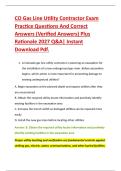
CO Gas Line Utility Contractor Exam
Practice Questions And Correct
Answers (Verified Answers) Plus
Rationale 2027 Q&A| Instant
Download Pdf.
1. A Colorado gas line utility contractor is planning an excavation for
the installation of a new underground gas main. Before excavation
begins, which action is most important for preventing damage to
existing underground utilities?
A. Begin excavation at the planned depth and expose utilities after they
are encountered
B. Obtain the required utility-locate information and positively identify
existing facilities in the excavation area
C. Increase the trench width so damaged utilities can be repaired more
easily
D. Install the new gas main before locating other utilities
Answer: B. Obtain the required utility-locate information and positively
identify existing facilities in the excavation area
Proper utility locating and verification are fundamental controls against
striking gas, electric, water, communications, and other buried facilities.
,Contractors must not rely solely on construction drawings or
assumptions about utility locations.
2. When installing a polyethylene (PE) gas distribution pipe, which
joining method is commonly used to create a permanent pressure-
tight connection?
A. Solvent cementing
B. Mechanical threading
C. Heat fusion
D. Soldering
Answer: C. Heat fusion
PE gas pipe is commonly joined using approved heat-fusion procedures,
such as butt fusion or socket fusion, depending on the pipe and fitting
system. Proper preparation, heating, alignment, and cooling are
essential to joint integrity.
3. What is the primary purpose of a tracer wire installed with a
nonmetallic underground gas pipeline?
A. To increase gas pressure
B. To provide a detectable conductive path for locating the pipeline
C. To prevent condensation inside the pipe
D. To reinforce the polyethylene pipe
Answer: B. To provide a detectable conductive path for locating the
pipeline
,Because polyethylene is nonconductive, a properly installed tracer wire
provides a conductive path that can be detected with locating
equipment, helping future personnel identify the underground gas
pipeline.
4. During trenching for a gas utility installation, an employee discovers
an unstable trench wall showing signs of cracking. What should be
done?
A. Continue working if the trench is less than 6 feet deep
B. Have workers stand against the opposite wall
C. Remove workers from the hazardous area and correct the protective-
system deficiency
D. Increase excavation speed so the pipe can be installed quickly
Answer: C. Remove workers from the hazardous area and correct the
protective-system deficiency
Visible cracking or other indications of instability can signal a cave-in
hazard. Workers must be protected from trench collapse by an
appropriate protective system and must not remain in an unsafe
excavation.
5. Which property of natural gas is most important when evaluating an
accidental release in a confined or poorly ventilated area?
A. Natural gas is heavier than water
B. Natural gas can form a flammable mixture with air
, C. Natural gas immediately freezes when exposed to air
D. Natural gas is noncombustible at atmospheric pressure
Answer: B. Natural gas can form a flammable mixture with air
Natural gas is highly combustible when its concentration in air falls
within its flammable range. A release in a confined area can therefore
create a serious fire or explosion hazard.
6. Why is odorant added to normally odorless natural gas distributed
to consumers?
A. To increase its heating value
B. To reduce pipe corrosion
C. To make gas leaks easier to detect by smell
D. To increase pipeline pressure
Answer: C. To make gas leaks easier to detect by smell
Pipeline-quality natural gas is naturally odorless, so an odorant is added
to help people recognize the presence of escaping gas before
concentrations become more hazardous.
7. Which condition is most likely to cause excessive stress on a newly
installed underground gas pipeline?
A. Properly prepared and compacted bedding
B. Controlled installation temperatures
C. Excessive bending or inadequate support during installation
D. Correctly sized fittings
Answer: C. Excessive bending or inadequate support during installation
Practice Questions And Correct
Answers (Verified Answers) Plus
Rationale 2027 Q&A| Instant
Download Pdf.
1. A Colorado gas line utility contractor is planning an excavation for
the installation of a new underground gas main. Before excavation
begins, which action is most important for preventing damage to
existing underground utilities?
A. Begin excavation at the planned depth and expose utilities after they
are encountered
B. Obtain the required utility-locate information and positively identify
existing facilities in the excavation area
C. Increase the trench width so damaged utilities can be repaired more
easily
D. Install the new gas main before locating other utilities
Answer: B. Obtain the required utility-locate information and positively
identify existing facilities in the excavation area
Proper utility locating and verification are fundamental controls against
striking gas, electric, water, communications, and other buried facilities.
,Contractors must not rely solely on construction drawings or
assumptions about utility locations.
2. When installing a polyethylene (PE) gas distribution pipe, which
joining method is commonly used to create a permanent pressure-
tight connection?
A. Solvent cementing
B. Mechanical threading
C. Heat fusion
D. Soldering
Answer: C. Heat fusion
PE gas pipe is commonly joined using approved heat-fusion procedures,
such as butt fusion or socket fusion, depending on the pipe and fitting
system. Proper preparation, heating, alignment, and cooling are
essential to joint integrity.
3. What is the primary purpose of a tracer wire installed with a
nonmetallic underground gas pipeline?
A. To increase gas pressure
B. To provide a detectable conductive path for locating the pipeline
C. To prevent condensation inside the pipe
D. To reinforce the polyethylene pipe
Answer: B. To provide a detectable conductive path for locating the
pipeline
,Because polyethylene is nonconductive, a properly installed tracer wire
provides a conductive path that can be detected with locating
equipment, helping future personnel identify the underground gas
pipeline.
4. During trenching for a gas utility installation, an employee discovers
an unstable trench wall showing signs of cracking. What should be
done?
A. Continue working if the trench is less than 6 feet deep
B. Have workers stand against the opposite wall
C. Remove workers from the hazardous area and correct the protective-
system deficiency
D. Increase excavation speed so the pipe can be installed quickly
Answer: C. Remove workers from the hazardous area and correct the
protective-system deficiency
Visible cracking or other indications of instability can signal a cave-in
hazard. Workers must be protected from trench collapse by an
appropriate protective system and must not remain in an unsafe
excavation.
5. Which property of natural gas is most important when evaluating an
accidental release in a confined or poorly ventilated area?
A. Natural gas is heavier than water
B. Natural gas can form a flammable mixture with air
, C. Natural gas immediately freezes when exposed to air
D. Natural gas is noncombustible at atmospheric pressure
Answer: B. Natural gas can form a flammable mixture with air
Natural gas is highly combustible when its concentration in air falls
within its flammable range. A release in a confined area can therefore
create a serious fire or explosion hazard.
6. Why is odorant added to normally odorless natural gas distributed
to consumers?
A. To increase its heating value
B. To reduce pipe corrosion
C. To make gas leaks easier to detect by smell
D. To increase pipeline pressure
Answer: C. To make gas leaks easier to detect by smell
Pipeline-quality natural gas is naturally odorless, so an odorant is added
to help people recognize the presence of escaping gas before
concentrations become more hazardous.
7. Which condition is most likely to cause excessive stress on a newly
installed underground gas pipeline?
A. Properly prepared and compacted bedding
B. Controlled installation temperatures
C. Excessive bending or inadequate support during installation
D. Correctly sized fittings
Answer: C. Excessive bending or inadequate support during installation