

Written by students who passed Immediately available after payment Read online or as PDF Wrong document? Swap it for free 4.6 TrustPilot
logo-home
Document preview thumbnail
Preview 3 out of 24 pages
Exam (elaborations)

NSG 3100 Exam 3 Questions & Answers 2026/2027 | 100+ Questions | Urinary & Bowel Elimination, Diagnostic Tests, Medication Administration, Injections & Enemas

Document preview thumbnail
Preview 3 out of 24 pages

This NSG 3100 Exam 3 2026/2027 study guide contains 100+ exam questions and correct answers covering essential nursing concepts in urinary and bowel elimination, specimen collection, diagnostic procedures, medication administration, pharmacology fundamentals, injections, ostomy care, and enemas. The 24-page resource combines exam-style questions with concise answers and detailed review material, making it useful for focused Exam 3 preparation, self-testing, and rapid revision. The uploaded document clearly identifies NSG 3100 and the 2026/2027 academic period, but it does not identify a university, so a university name cannot be accurately added without additional information. A major section focuses on urinary elimination and nursing assessment. Students review normal urine output, urine characteristics, specific gravity and pH, polyuria, oliguria, anuria, frequency, nocturia, urgency, dysuria, enuresis, urinary retention, and urinary incontinence. The resource differentiates urge, stress, mixed, and overflow incontinence and covers clean-catch urine collection, sterile specimen collection from an indwelling catheter, straight catheterization, Foley catheter insertion and drainage-bag positioning, condom catheters, three-way Foley catheters following TURP, CAUTI, UTI prevention, and bladder scanning. The bowel-elimination content addresses constipation, diarrhea, fecal testing, dysphagia, ostomies, and enemas. Students can review causes and management of constipation, appropriate laxative use, diarrhea teaching, fecal occult blood testing, stool-specimen collection, steatorrhea, dietary and bacterial fecal testing, aspiration-prevention interventions, colostomy appliance care, ileostomy skin care, and stoma terminology. The document distinguishes cleansing, hypertonic, isotonic, and oil-retention enemas, including their mechanisms, administration considerations, solution volumes, retention periods, and the Sims position used during administration. Another extensive section reviews laboratory tests, specimen collection, and diagnostic procedures. Topics include CBC, BMP and CMP components, capillary blood glucose specimens, KUB imaging, IV and retrograde pyelography, cystoscopy, anoscopy, proctoscopy, proctosigmoidoscopy, colonoscopy, X-rays, CT scans, MRI, electrocardiography, angiography, echocardiography, V/Q lung scans, lumbar puncture, thoracentesis, and paracentesis. Nursing considerations include NPO status, contrast media, medications, informed consent, test duration, MRI metal screening, patient positioning, specimen requirements, and complications such as hypovolemic shock following excessive fluid removal during paracentesis. The medication section provides focused coverage of pharmacodynamics and pharmacokinetics, including absorption, distribution, biotransformation, and excretion. Students review stat, single, standing, and PRN medication orders; the essential components of a medication order; medication reconciliation at admission, transfer, and discharge; and the document's 10 rights of medication administration—right medication, dose, time, route, client, education, documentation, refusal, assessment, and evaluation. The resource concludes with practical medication-administration concepts involving intradermal, subcutaneous, intramuscular, transdermal, and otic medications. It covers common uses of intradermal injections, subcutaneous administration of insulin and heparin, needle and syringe specifications, subcutaneous and IM injection sites, safe transdermal-patch administration, and age-specific positioning of the ear for otic medication administration. It also reviews drug abuse, drug dependence, physiological and psychological dependence, and drug habituation. This document is particularly relevant for NSG 3100 students, BSN students, pre-licensure nursing students, fundamentals of nursing students, nursing skills students, clinical nursing students, health assessment students, and students preparing for examinations covering elimination, diagnostic testing, specimen collection, medication safety, pharmacology, and medication administration. It can support Exam 3 revision, practice-question review, clinical-skills preparation, and memorization of key nursing procedures and terminology. Students should follow their course instructor's standards where they differ from other clinical references. Referenced academic source: Potter, P. A., Perry, A. G., Stockert, P. A., & Hall, A. M. Fundamentals of Nursing. Elsevier. This established nursing reference is relevant to the document's coverage of urinary and bowel elimination, specimen collection, diagnostic testing, medication administration, patient safety, enteral and parenteral medication techniques, and fundamental nursing procedures. Keywords: NSG 3100 Exam 3, NSG 3100 questions and answers, NSG 3100 Exam , nursing Exam 3 questions, nursing fundamentals exam, urinary elimination nursing, bowel elimination nursing, urinary incontinence, urge incontinence, stress incontinence, overflow incontinence, urinary retention, Foley catheter nursing, indwelling catheter, CAUTI prevention, clean catch urine specimen, urine specimen collection, bowel elimination, constipation nursing, diarrhea nursing, fecal occult blood test, stool specimen collection, ostomy care, colostomy care, ileostomy care, diagnostic procedures nursing, CBC nursing, BMP nursing, CMP nursing, capillary blood glucose, KUB, MRI nursing, CT scan nursing, colonoscopy nursing, thoracentesis, paracentesis, lumbar puncture, angiography, echocardiogram, pharmacodynamics, pharmacokinetics, medication administration, 10 rights of medication administration, medication reconciliation, intradermal injection, subcutaneous injection, intramuscular injection, transdermal medication, otic medication, enema nursing, cleansing enema, oil retention enema, nursing study guide, nursing exam preparation

Content preview

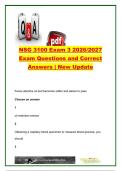
NSG 3100 Exam 3 2026/2027
Exam Questions and Correct
Answers | New Update


Feces absorbs oil and becomes softer and easier to pass

Choose an answer

1

oil retention enema

2

Obtaining a capillary blood specimen to measure blood glucose, you

should

3

,Urge incontinence is due to

4

An x-ray of the abdomen visualizing the kidneys, ureters and bladder is

known as:

ANS 1

Laxatives should only be taken for a few days.

Choose an answer

1

Urge incontinence is due to

2

What indicates a correct understanding of the use of laxatives for

constipation?

3

before fecal occult test eat

4

rules for dietary fecal testing

ANS 2

persons need to take a drug

, Choose an answer

1

A RN instructing a female patient on obtaining a clean catch urine

specimen should stress to:

2

where is needle in lumbar puncture placed?

3

Obtaining a capillary blood specimen to measure blood glucose, you

should

4

drug dependence

ANS 4

True

Choose an answer

1

When giving an enema, you should insert the tube 7-10 cm (3-4 inches).

True or False?

2


COPYRIGHT©PROFFKERRYMARTIN 2026/2027. YEAR PUBLISHED 2026. COMPANY REGISTRATION NUMBER: 619652435. TERMS OF USE.
PRIVACY STATEMENT. ALL RIGHTS RESERVED


Document information

Uploaded on
September 18, 2026
Number of pages
24
Written in
2026/2027
Type
Exam (elaborations)
Contains
Questions & answers
$21.99

Wrong document? Swap it for free Within 14 days of purchase and before downloading, you can choose a different document. You can simply spend the amount again.
Written by students who passed
Immediately available after payment
Read online or as PDF

Seller avatar
Reputation scores are based on the amount of documents a seller has sold for a fee and the reviews they have received for those documents. There are three levels: Bronze, Silver and Gold. The better the reputation, the more your can rely on the quality of the sellers work.
PROFFKERRYMARTIN
3.4
(62)
Sold
306
Followers
9
Items
11507
Last sold
7 hours ago


Why students choose Stuvia

Created by fellow students, verified by reviews

Quality you can trust: written by students who passed their tests and reviewed by others who've used these notes.

Didn't get what you expected? Choose another document

No worries! You can instantly pick a different document that better fits what you're looking for.

Pay as you like, start learning right away

No subscription, no commitments. Pay the way you're used to via credit card and download your PDF document instantly.

Student with book image

“Bought, downloaded, and aced it. It really can be that simple.”

Alisha Student

Working on your references?

Create accurate citations in APA, MLA and Harvard with our free citation generator.

Working on your references?

Frequently asked questions
