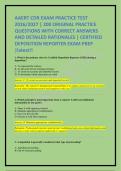
AAERT CDR EXAM PRACTICE TEST
2026/2027 | 200 ORIGINAL PRACTICE
QUESTIONS WITH CORRECT ANSWERS
AND DETAILED RATIONALES | CERTIFIED
DEPOSITION REPORTER EXAM PREP
|latest!!
1. What is the primary role of a Certified Deposition Reporter (CDR) during a
deposition?
A. To represent the witness
B. To advocate for the retaining attorney
C. To create an accurate and impartial record
D. To determine which objections are valid
Answer: C. To create an accurate and impartial record.
Rationale: The reporter's fundamental responsibility is to capture and preserve an accurate
record while remaining neutral and nonparty to the case.
2. Which principle is most important when a reporter is offered confidential
information by one party?
A. Share it with opposing counsel
B. Maintain appropriate confidentiality
C. Post it to the case file
D. Discuss it with other reporters
Answer: B. Maintain appropriate confidentiality.
Rationale: Professional reporters must protect confidential and case-related information and
disclose it only when properly authorized or required.
3. A deposition is generally considered what type of proceeding?
A. Appellate proceeding
B. Out-of-court proceeding
,C. Criminal sentencing proceeding
D. Jury proceeding
Answer: B. Out-of-court proceeding.
Rationale: Depositions are typically conducted outside the courtroom for discovery and
evidentiary purposes.
4. Which person normally administers the oath to a witness during a deposition?
A. The witness
B. The reporter when authorized
C. The opposing attorney
D. The videographer only
Answer: B. The reporter when authorized.
Rationale: Depending on applicable law and authorization, the deposition reporter may
administer the oath or affirmation to the witness.
5. What should a reporter do if two people begin speaking simultaneously?
A. Guess what both said
B. Stop recording
C. Follow established procedures to obtain clarification or repetition
D. Delete the recording
Answer: C. Follow established procedures to obtain clarification or repetition.
Rationale: Overlapping speech can compromise the record. The reporter should address the
problem professionally and obtain a clear statement.
6. What does impartiality require of a digital reporter?
A. Favoring the retaining attorney
B. Remaining neutral toward all parties
C. Helping one side prepare questions
D. Correcting an attorney's legal strategy
Answer: B. Remaining neutral toward all parties.
Rationale: The reporter is a nonparty and should not advocate for either side.
,7. Which action best demonstrates professional preparedness?
A. Arriving after the deposition starts
B. Testing equipment before the proceeding
C. Waiting for equipment problems to occur
D. Using unfamiliar software without testing it
Answer: B. Testing equipment before the proceeding.
Rationale: Equipment preparation and testing reduce the likelihood of interruptions or
recording failures.
8. Why is a backup recording useful?
A. It replaces the official recording automatically
B. It provides redundancy if the primary recording fails
C. It eliminates the need for monitoring
D. It prevents objections
Answer: B. It provides redundancy if the primary recording fails.
Rationale: Redundant recording provides an additional source when the primary recording
is damaged, corrupted, or otherwise unusable.
9. What is confidence monitoring?
A. Monitoring the quality and presence of the recorded audio
B. Monitoring an attorney's legal arguments
C. Monitoring witness credibility
D. Monitoring court rulings
Answer: A. Monitoring the quality and presence of the recorded audio.
Rationale: Confidence monitoring helps the reporter detect problems with audio levels,
channels, microphones, or recording status.
10. What is the best response if the recording equipment stops functioning during
testimony?
A. Continue without telling anyone
B. Immediately address the technical problem according to procedure
C. Delete the existing recording
D. Reconstruct the testimony from memory
, Answer: B. Immediately address the technical problem according to procedure.
Rationale: A recording problem should be identified and corrected promptly so that the
integrity of the record is preserved.
11. Which microphone placement generally helps produce a clear recording?
A. As far away from speakers as possible
B. Positioned appropriately near the speaker while minimizing unwanted noise
C. Behind a closed door
D. Next to a loudspeaker
Answer: B. Positioned appropriately near the speaker while minimizing unwanted noise.
Rationale: Proper microphone placement improves signal quality and reduces interference.
12. What does an audio interface generally do?
A. Converts and routes audio signals between equipment and a computer
B. Creates legal exhibits
C. Determines witness credibility
D. Administers the oath automatically
Answer: A. Converts and routes audio signals between equipment and a computer.
Rationale: An audio interface connects microphones and other audio sources to recording
equipment or a computer.
13. What is an ASIO driver primarily associated with?
A. Legal citation
B. Low-latency professional audio communication
C. Document authentication
D. Witness identification
Answer: B. Low-latency professional audio communication.
Rationale: ASIO is an audio-driver protocol commonly used for professional audio
applications requiring efficient, low-latency communication.
14. What should a reporter do before beginning a remote deposition?
2026/2027 | 200 ORIGINAL PRACTICE
QUESTIONS WITH CORRECT ANSWERS
AND DETAILED RATIONALES | CERTIFIED
DEPOSITION REPORTER EXAM PREP
|latest!!
1. What is the primary role of a Certified Deposition Reporter (CDR) during a
deposition?
A. To represent the witness
B. To advocate for the retaining attorney
C. To create an accurate and impartial record
D. To determine which objections are valid
Answer: C. To create an accurate and impartial record.
Rationale: The reporter's fundamental responsibility is to capture and preserve an accurate
record while remaining neutral and nonparty to the case.
2. Which principle is most important when a reporter is offered confidential
information by one party?
A. Share it with opposing counsel
B. Maintain appropriate confidentiality
C. Post it to the case file
D. Discuss it with other reporters
Answer: B. Maintain appropriate confidentiality.
Rationale: Professional reporters must protect confidential and case-related information and
disclose it only when properly authorized or required.
3. A deposition is generally considered what type of proceeding?
A. Appellate proceeding
B. Out-of-court proceeding
,C. Criminal sentencing proceeding
D. Jury proceeding
Answer: B. Out-of-court proceeding.
Rationale: Depositions are typically conducted outside the courtroom for discovery and
evidentiary purposes.
4. Which person normally administers the oath to a witness during a deposition?
A. The witness
B. The reporter when authorized
C. The opposing attorney
D. The videographer only
Answer: B. The reporter when authorized.
Rationale: Depending on applicable law and authorization, the deposition reporter may
administer the oath or affirmation to the witness.
5. What should a reporter do if two people begin speaking simultaneously?
A. Guess what both said
B. Stop recording
C. Follow established procedures to obtain clarification or repetition
D. Delete the recording
Answer: C. Follow established procedures to obtain clarification or repetition.
Rationale: Overlapping speech can compromise the record. The reporter should address the
problem professionally and obtain a clear statement.
6. What does impartiality require of a digital reporter?
A. Favoring the retaining attorney
B. Remaining neutral toward all parties
C. Helping one side prepare questions
D. Correcting an attorney's legal strategy
Answer: B. Remaining neutral toward all parties.
Rationale: The reporter is a nonparty and should not advocate for either side.
,7. Which action best demonstrates professional preparedness?
A. Arriving after the deposition starts
B. Testing equipment before the proceeding
C. Waiting for equipment problems to occur
D. Using unfamiliar software without testing it
Answer: B. Testing equipment before the proceeding.
Rationale: Equipment preparation and testing reduce the likelihood of interruptions or
recording failures.
8. Why is a backup recording useful?
A. It replaces the official recording automatically
B. It provides redundancy if the primary recording fails
C. It eliminates the need for monitoring
D. It prevents objections
Answer: B. It provides redundancy if the primary recording fails.
Rationale: Redundant recording provides an additional source when the primary recording
is damaged, corrupted, or otherwise unusable.
9. What is confidence monitoring?
A. Monitoring the quality and presence of the recorded audio
B. Monitoring an attorney's legal arguments
C. Monitoring witness credibility
D. Monitoring court rulings
Answer: A. Monitoring the quality and presence of the recorded audio.
Rationale: Confidence monitoring helps the reporter detect problems with audio levels,
channels, microphones, or recording status.
10. What is the best response if the recording equipment stops functioning during
testimony?
A. Continue without telling anyone
B. Immediately address the technical problem according to procedure
C. Delete the existing recording
D. Reconstruct the testimony from memory
, Answer: B. Immediately address the technical problem according to procedure.
Rationale: A recording problem should be identified and corrected promptly so that the
integrity of the record is preserved.
11. Which microphone placement generally helps produce a clear recording?
A. As far away from speakers as possible
B. Positioned appropriately near the speaker while minimizing unwanted noise
C. Behind a closed door
D. Next to a loudspeaker
Answer: B. Positioned appropriately near the speaker while minimizing unwanted noise.
Rationale: Proper microphone placement improves signal quality and reduces interference.
12. What does an audio interface generally do?
A. Converts and routes audio signals between equipment and a computer
B. Creates legal exhibits
C. Determines witness credibility
D. Administers the oath automatically
Answer: A. Converts and routes audio signals between equipment and a computer.
Rationale: An audio interface connects microphones and other audio sources to recording
equipment or a computer.
13. What is an ASIO driver primarily associated with?
A. Legal citation
B. Low-latency professional audio communication
C. Document authentication
D. Witness identification
Answer: B. Low-latency professional audio communication.
Rationale: ASIO is an audio-driver protocol commonly used for professional audio
applications requiring efficient, low-latency communication.
14. What should a reporter do before beginning a remote deposition?