
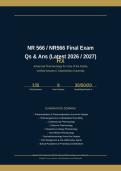
NR 566 / NR566 Final Exam
Qs & Ans (Latest )
Rx
Advanced Pharmacology for Care of the Family
Verified Answers | Chamberlain University
135 9 30/50/20
Total Questions Exam Sections Recall/App/Analysis %
EXAMINATION DOMAINS
Pharmacokinetics & Pharmacodynamics Across the Lifespan
Pharmacogenomics & Individualized Prescribing
Cardiovascular Pharmacology
Endocrine Pharmacology
Respiratory & Allergy Pharmacology
Anti-Infective Pharmacology
Psychopharmacology Across the Lifespan
Pain Management & Anti-Inflammatory Agents
Special Populations & Prescribing Considerations
Aligned with Chamberlain NR 566 Advanced Pharmacology course objectives.
Verified Correct Answers with Mechanism-Level Rationales
,NR 566 Final Exam Qs & Ans | Latest 2026/2027 Advanced Pharmacology for Care of the Family
EXAMINATION OVERVIEW
This comprehensive final examination assesses mastery of advanced pharmacology concepts aligned with the
Chamberlain University NR 566 Advanced Pharmacology for Care of the Family course objectives. The exam consists of
exactly 135 multiple-choice questions distributed across nine content domains spanning pharmacokinetics and
pharmacodynamics through systemic pharmacology of cardiovascular, endocrine, respiratory, anti-infective,
psychotropic, analgesic, and special population agents. Each item is accompanied by a verified correct answer and a
detailed mechanism-level rationale. Content reflects 2026-2027 updated guidelines, FDA approvals, and evidence-based
prescribing standards.
Cognitive level distribution: approximately 30% of items assess direct recall of drug classifications and mechanisms; 50%
require application of pharmacologic principles to clinical scenarios; and 20% demand analysis integrating multiple drug
interactions or discriminating between complex therapeutic choices. Approximately 75% of items are scenario-based,
including family-focused scenarios spanning pediatric, adult, and geriatric populations. Special inclusions: weight-based
pediatric dosing calculations, renal-adjusted dosing, therapeutic drug monitoring (warfarin INR, vancomycin troughs,
digoxin levels, lithium levels), drug-gene interactions, and Beers Criteria applications.
SECTION STRUCTURE
Sec Domain Questions
1 Pharmacokinetics & Pharmacodynamics Q1 - Q13
2 Pharmacogenomics & Individualized Prescribing Q14 - Q25
3 Cardiovascular Pharmacology Q26 - Q43
4 Endocrine Pharmacology Q44 - Q60
5 Respiratory & Allergy Pharmacology Q61 - Q73
6 Anti-Infective Pharmacology Q74 - Q89
7 Psychopharmacology Across the Lifespan Q90 - Q105
8 Pain Management & Anti-Inflammatory Agents Q106 - Q120
9 Special Populations & Prescribing Considerations Q121 - Q135
HOW TO USE THIS EXAMINATION
Each question is presented with four response options (A through D). The verified correct answer is identified by the
[CORRECT] tag in bold green and restated in the "Correct Answer" line. A detailed rationale follows every question
explaining the mechanism-level reasoning for the correct answer and why the distractors are incorrect, integrating
pharmacokinetic principles, pharmacodynamic mechanisms, clinical guideline references, and patient-specific
considerations. Advanced practice nursing students preparing for the NR 566 final examination should review both correct
and incorrect rationales to reinforce mechanism-level understanding across all pharmacologic domains.
NR 566 Advanced Pharmacology | 135 Questions | Verified Answers Page 2
,NR 566 Final Exam Qs & Ans | Latest 2026/2027 Advanced Pharmacology for Care of the Family
SECTION 1: PHARMACOKINETICS AND PHARMACODYNAMICS ACROSS
THE LIFESPAN
Absorption, Distribution, Metabolism, Excretion, Receptors, & Therapeutic Index
Q1: A 62-year-old male is prescribed oral propranolol 40 mg twice daily for hypertension. The provider
explains that a higher oral dose is required compared to the IV dose to achieve the same therapeutic effect.
Which pharmacokinetic principle best explains this dose difference?
A. The first-pass (presystemic) metabolism in the liver reduces the bioavailability of orally administered drugs
before reaching systemic circulation. [CORRECT]
B. Oral propranolol has a larger volume of distribution than IV propranolol.
C. Oral administration prolongs the half-life, requiring dose reduction.
D. IV propranolol undergoes enterohepatic recirculation, increasing its clearance.
Correct Answer: A. The first-pass (presystemic) metabolism in the liver reduces the bioavailability of orally
administered drugs before reaching systemic circulation.
Rationale: The first-pass effect (presystemic metabolism) refers to drug metabolism by the liver and gut wall before reaching systemic
circulation via the portal vein, reducing bioavailability of oral drugs like propranolol, morphine, and lidocaine. IV administration
bypasses the portal circulation, achieving 100% bioavailability. Volume of distribution (B) is a property of drug distribution and not
affected by route. Half-life (C) is not prolonged by oral administration. Enterohepatic recirculation (D) prolongs drug effect, not
relevant here.
Q2: A patient is started on oral metoprolol 50 mg twice daily for atrial fibrillation rate control. The drug has a
half-life of approximately 6 hours. How long will it take to achieve approximately 94% of steady-state plasma
concentration?
A. 6 hours (1 half-life).
B. 12 hours (2 half-lives).
C. 18 hours (3 half-lives).
D. 24 hours (4 half-lives). [CORRECT]
Correct Answer: D. 24 hours (4 half-lives).
Rationale: Steady state is reached in approximately 4-5 half-lives. At 4 half-lives, approximately 94% of steady-state is achieved (1 -
(1/2)^4 = 93.75%). At 5 half-lives, ~97% is achieved. With a 6-hour half-life, 4 half-lives = 24 hours. Six hours (A) corresponds to 50%.
Twelve hours (B) corresponds to 75%. Eighteen hours (C) corresponds to 87.5%.
Q3: A 70-year-old female weighing 60 kg is prescribed digoxin for heart failure with reduced ejection
fraction. Digoxin has a large volume of distribution (Vd ≈ 7 L/kg). Which patient characteristic would most
significantly alter the apparent Vd of digoxin and require dose adjustment?
A. Increased total body water due to ascites. [CORRECT]
B. Decreased serum albumin from 4.0 to 2.5 g/dL.
C. Decline in renal function with elevated serum creatinine.
D. Reduced lean body mass with increased total body fat.
Correct Answer: A. Increased total body water due to ascites.
Rationale: Digoxin distributes extensively into muscle and other tissues, with a Vd of approximately 7 L/kg. Conditions that increase
total body water (ascites, edema, pregnancy) increase the Vd and require dose adjustment (loading dose increase; maintenance dose
may need reduction). Decreased albumin (B) affects protein-bound acidic drugs (phenytoin, warfarin), not digoxin, which is only
20-30% protein-bound. Renal function (C) affects clearance and maintenance dosing, not Vd. Reduced lean body mass (D) decreases
Vd, but the larger effect of ascites is more clinically significant.
Q4: A 78-year-old male with chronic kidney disease (eGFR 28 mL/min) is started on digoxin 0.25 mg daily for
atrial fibrillation. He presents one week later with nausea, vomiting, confusion, and visual disturbances
(yellow-green halos). ECG shows prolonged PR interval. The narrow therapeutic index of digoxin means
NR 566 Advanced Pharmacology | 135 Questions | Verified Answers Page 3
, NR 566 Final Exam Qs & Ans | Latest 2026/2027 Advanced Pharmacology for Care of the Family
that:
A. The drug has a wide margin between therapeutic and toxic doses, requiring no monitoring.
B. The dose producing therapeutic effect is close to the dose producing toxicity, requiring careful serum
concentration monitoring (target 0.5-0.9 ng/mL in HF; <2 ng/mL for AF) and renal function assessment.
[CORRECT]
C. The drug is safe in renal impairment without dose adjustment.
D. Loading doses are not necessary for therapeutic effect.
Correct Answer: B. The dose producing therapeutic effect is close to the dose producing toxicity, requiring
careful serum concentration monitoring (target 0.5-0.9 ng/mL in HF; <2 ng/mL for AF) and renal function
assessment.
Rationale: Digoxin has a narrow therapeutic index: the dose producing therapeutic effect is close to the dose producing toxicity.
Symptoms of digoxin toxicity include GI (nausea, vomiting), neurologic (confusion, visual disturbances, yellow-green halos), and
cardiac (arrhythmias, AV block). The therapeutic range is 0.5-0.9 ng/mL for HFrEF and <2 ng/mL for AF rate control. Renal
impairment prolongs half-life and increases toxicity risk, requiring dose reduction and monitoring. Loading doses (D) are sometimes
used but require caution.
Q5: A 45-year-old female is prescribed propranolol for migraine prophylaxis. The drug competes with
endogenous epinephrine at beta-adrenergic receptors without activating the receptor. Which of the
following best characterizes propranolol's mechanism of action?
A. Full agonist producing maximal receptor activation.
B. Partial agonist producing submaximal receptor activation.
C. Competitive antagonist producing reversible blockade surmountable by increasing agonist concentration.
[CORRECT]
D. Noncompetitive antagonist producing irreversible receptor blockade.
Correct Answer: C. Competitive antagonist producing reversible blockade surmountable by increasing
agonist concentration.
Rationale: Propranolol is a competitive antagonist at beta-adrenergic receptors, binding reversibly without activating the receptor. Its
blockade can be surmounted by increasing concentrations of endogenous agonists (epinephrine, norepinephrine) or exogenous
beta-agonists (isoproterenol). Full agonists (A) produce maximal response. Partial agonists (B) produce submaximal response and can
act as antagonists in the presence of full agonists. Noncompetitive antagonists (D) bind irreversibly or allosterically.
Q6: A clinical trial compares furosemide 40 mg to torsemide 20 mg in patients with heart failure. Both drugs
produce similar maximal diuretic effect when dosed appropriately, but furosemide requires a higher dose to
achieve this effect. Which pharmacologic concept is illustrated?
A. Furosemide has lower efficacy than torsemide.
B. Furosemide has lower potency than torsemide, but both have similar efficacy (maximal effect). [CORRECT]
C. Torsemide has lower efficacy than furosemide.
D. Both drugs have identical potency and efficacy.
Correct Answer: B. Furosemide has lower potency than torsemide, but both have similar efficacy (maximal
effect).
Rationale: Potency refers to the dose required to produce a given effect (lower dose = higher potency); efficacy refers to the maximal
effect achievable. Both furosemide and torsemide are loop diuretics achieving similar maximal diuretic effect (similar efficacy), but
torsemide achieves this effect at a lower dose (higher potency). Efficacy differences (A, C) would require demonstrating different
maximal effects. Identical potency and efficacy (D) is incorrect.
Q7: A 2-week-old neonate requires antibiotic therapy for suspected sepsis. Compared to adults, which of
the following pharmacokinetic differences is most relevant to drug absorption in this age group?
A. Higher gastric pH (less acidic) due to immature acid secretion, increasing bioavailability of acid-labile drugs
(penicillins) and reducing bioavailability of weak acid drugs. [CORRECT]
B. Faster gastric emptying producing enhanced absorption of all drugs.
NR 566 Advanced Pharmacology | 135 Questions | Verified Answers Page 4
Qs & Ans (Latest )
Rx
Advanced Pharmacology for Care of the Family
Verified Answers | Chamberlain University
135 9 30/50/20
Total Questions Exam Sections Recall/App/Analysis %
EXAMINATION DOMAINS
Pharmacokinetics & Pharmacodynamics Across the Lifespan
Pharmacogenomics & Individualized Prescribing
Cardiovascular Pharmacology
Endocrine Pharmacology
Respiratory & Allergy Pharmacology
Anti-Infective Pharmacology
Psychopharmacology Across the Lifespan
Pain Management & Anti-Inflammatory Agents
Special Populations & Prescribing Considerations
Aligned with Chamberlain NR 566 Advanced Pharmacology course objectives.
Verified Correct Answers with Mechanism-Level Rationales
,NR 566 Final Exam Qs & Ans | Latest 2026/2027 Advanced Pharmacology for Care of the Family
EXAMINATION OVERVIEW
This comprehensive final examination assesses mastery of advanced pharmacology concepts aligned with the
Chamberlain University NR 566 Advanced Pharmacology for Care of the Family course objectives. The exam consists of
exactly 135 multiple-choice questions distributed across nine content domains spanning pharmacokinetics and
pharmacodynamics through systemic pharmacology of cardiovascular, endocrine, respiratory, anti-infective,
psychotropic, analgesic, and special population agents. Each item is accompanied by a verified correct answer and a
detailed mechanism-level rationale. Content reflects 2026-2027 updated guidelines, FDA approvals, and evidence-based
prescribing standards.
Cognitive level distribution: approximately 30% of items assess direct recall of drug classifications and mechanisms; 50%
require application of pharmacologic principles to clinical scenarios; and 20% demand analysis integrating multiple drug
interactions or discriminating between complex therapeutic choices. Approximately 75% of items are scenario-based,
including family-focused scenarios spanning pediatric, adult, and geriatric populations. Special inclusions: weight-based
pediatric dosing calculations, renal-adjusted dosing, therapeutic drug monitoring (warfarin INR, vancomycin troughs,
digoxin levels, lithium levels), drug-gene interactions, and Beers Criteria applications.
SECTION STRUCTURE
Sec Domain Questions
1 Pharmacokinetics & Pharmacodynamics Q1 - Q13
2 Pharmacogenomics & Individualized Prescribing Q14 - Q25
3 Cardiovascular Pharmacology Q26 - Q43
4 Endocrine Pharmacology Q44 - Q60
5 Respiratory & Allergy Pharmacology Q61 - Q73
6 Anti-Infective Pharmacology Q74 - Q89
7 Psychopharmacology Across the Lifespan Q90 - Q105
8 Pain Management & Anti-Inflammatory Agents Q106 - Q120
9 Special Populations & Prescribing Considerations Q121 - Q135
HOW TO USE THIS EXAMINATION
Each question is presented with four response options (A through D). The verified correct answer is identified by the
[CORRECT] tag in bold green and restated in the "Correct Answer" line. A detailed rationale follows every question
explaining the mechanism-level reasoning for the correct answer and why the distractors are incorrect, integrating
pharmacokinetic principles, pharmacodynamic mechanisms, clinical guideline references, and patient-specific
considerations. Advanced practice nursing students preparing for the NR 566 final examination should review both correct
and incorrect rationales to reinforce mechanism-level understanding across all pharmacologic domains.
NR 566 Advanced Pharmacology | 135 Questions | Verified Answers Page 2
,NR 566 Final Exam Qs & Ans | Latest 2026/2027 Advanced Pharmacology for Care of the Family
SECTION 1: PHARMACOKINETICS AND PHARMACODYNAMICS ACROSS
THE LIFESPAN
Absorption, Distribution, Metabolism, Excretion, Receptors, & Therapeutic Index
Q1: A 62-year-old male is prescribed oral propranolol 40 mg twice daily for hypertension. The provider
explains that a higher oral dose is required compared to the IV dose to achieve the same therapeutic effect.
Which pharmacokinetic principle best explains this dose difference?
A. The first-pass (presystemic) metabolism in the liver reduces the bioavailability of orally administered drugs
before reaching systemic circulation. [CORRECT]
B. Oral propranolol has a larger volume of distribution than IV propranolol.
C. Oral administration prolongs the half-life, requiring dose reduction.
D. IV propranolol undergoes enterohepatic recirculation, increasing its clearance.
Correct Answer: A. The first-pass (presystemic) metabolism in the liver reduces the bioavailability of orally
administered drugs before reaching systemic circulation.
Rationale: The first-pass effect (presystemic metabolism) refers to drug metabolism by the liver and gut wall before reaching systemic
circulation via the portal vein, reducing bioavailability of oral drugs like propranolol, morphine, and lidocaine. IV administration
bypasses the portal circulation, achieving 100% bioavailability. Volume of distribution (B) is a property of drug distribution and not
affected by route. Half-life (C) is not prolonged by oral administration. Enterohepatic recirculation (D) prolongs drug effect, not
relevant here.
Q2: A patient is started on oral metoprolol 50 mg twice daily for atrial fibrillation rate control. The drug has a
half-life of approximately 6 hours. How long will it take to achieve approximately 94% of steady-state plasma
concentration?
A. 6 hours (1 half-life).
B. 12 hours (2 half-lives).
C. 18 hours (3 half-lives).
D. 24 hours (4 half-lives). [CORRECT]
Correct Answer: D. 24 hours (4 half-lives).
Rationale: Steady state is reached in approximately 4-5 half-lives. At 4 half-lives, approximately 94% of steady-state is achieved (1 -
(1/2)^4 = 93.75%). At 5 half-lives, ~97% is achieved. With a 6-hour half-life, 4 half-lives = 24 hours. Six hours (A) corresponds to 50%.
Twelve hours (B) corresponds to 75%. Eighteen hours (C) corresponds to 87.5%.
Q3: A 70-year-old female weighing 60 kg is prescribed digoxin for heart failure with reduced ejection
fraction. Digoxin has a large volume of distribution (Vd ≈ 7 L/kg). Which patient characteristic would most
significantly alter the apparent Vd of digoxin and require dose adjustment?
A. Increased total body water due to ascites. [CORRECT]
B. Decreased serum albumin from 4.0 to 2.5 g/dL.
C. Decline in renal function with elevated serum creatinine.
D. Reduced lean body mass with increased total body fat.
Correct Answer: A. Increased total body water due to ascites.
Rationale: Digoxin distributes extensively into muscle and other tissues, with a Vd of approximately 7 L/kg. Conditions that increase
total body water (ascites, edema, pregnancy) increase the Vd and require dose adjustment (loading dose increase; maintenance dose
may need reduction). Decreased albumin (B) affects protein-bound acidic drugs (phenytoin, warfarin), not digoxin, which is only
20-30% protein-bound. Renal function (C) affects clearance and maintenance dosing, not Vd. Reduced lean body mass (D) decreases
Vd, but the larger effect of ascites is more clinically significant.
Q4: A 78-year-old male with chronic kidney disease (eGFR 28 mL/min) is started on digoxin 0.25 mg daily for
atrial fibrillation. He presents one week later with nausea, vomiting, confusion, and visual disturbances
(yellow-green halos). ECG shows prolonged PR interval. The narrow therapeutic index of digoxin means
NR 566 Advanced Pharmacology | 135 Questions | Verified Answers Page 3
, NR 566 Final Exam Qs & Ans | Latest 2026/2027 Advanced Pharmacology for Care of the Family
that:
A. The drug has a wide margin between therapeutic and toxic doses, requiring no monitoring.
B. The dose producing therapeutic effect is close to the dose producing toxicity, requiring careful serum
concentration monitoring (target 0.5-0.9 ng/mL in HF; <2 ng/mL for AF) and renal function assessment.
[CORRECT]
C. The drug is safe in renal impairment without dose adjustment.
D. Loading doses are not necessary for therapeutic effect.
Correct Answer: B. The dose producing therapeutic effect is close to the dose producing toxicity, requiring
careful serum concentration monitoring (target 0.5-0.9 ng/mL in HF; <2 ng/mL for AF) and renal function
assessment.
Rationale: Digoxin has a narrow therapeutic index: the dose producing therapeutic effect is close to the dose producing toxicity.
Symptoms of digoxin toxicity include GI (nausea, vomiting), neurologic (confusion, visual disturbances, yellow-green halos), and
cardiac (arrhythmias, AV block). The therapeutic range is 0.5-0.9 ng/mL for HFrEF and <2 ng/mL for AF rate control. Renal
impairment prolongs half-life and increases toxicity risk, requiring dose reduction and monitoring. Loading doses (D) are sometimes
used but require caution.
Q5: A 45-year-old female is prescribed propranolol for migraine prophylaxis. The drug competes with
endogenous epinephrine at beta-adrenergic receptors without activating the receptor. Which of the
following best characterizes propranolol's mechanism of action?
A. Full agonist producing maximal receptor activation.
B. Partial agonist producing submaximal receptor activation.
C. Competitive antagonist producing reversible blockade surmountable by increasing agonist concentration.
[CORRECT]
D. Noncompetitive antagonist producing irreversible receptor blockade.
Correct Answer: C. Competitive antagonist producing reversible blockade surmountable by increasing
agonist concentration.
Rationale: Propranolol is a competitive antagonist at beta-adrenergic receptors, binding reversibly without activating the receptor. Its
blockade can be surmounted by increasing concentrations of endogenous agonists (epinephrine, norepinephrine) or exogenous
beta-agonists (isoproterenol). Full agonists (A) produce maximal response. Partial agonists (B) produce submaximal response and can
act as antagonists in the presence of full agonists. Noncompetitive antagonists (D) bind irreversibly or allosterically.
Q6: A clinical trial compares furosemide 40 mg to torsemide 20 mg in patients with heart failure. Both drugs
produce similar maximal diuretic effect when dosed appropriately, but furosemide requires a higher dose to
achieve this effect. Which pharmacologic concept is illustrated?
A. Furosemide has lower efficacy than torsemide.
B. Furosemide has lower potency than torsemide, but both have similar efficacy (maximal effect). [CORRECT]
C. Torsemide has lower efficacy than furosemide.
D. Both drugs have identical potency and efficacy.
Correct Answer: B. Furosemide has lower potency than torsemide, but both have similar efficacy (maximal
effect).
Rationale: Potency refers to the dose required to produce a given effect (lower dose = higher potency); efficacy refers to the maximal
effect achievable. Both furosemide and torsemide are loop diuretics achieving similar maximal diuretic effect (similar efficacy), but
torsemide achieves this effect at a lower dose (higher potency). Efficacy differences (A, C) would require demonstrating different
maximal effects. Identical potency and efficacy (D) is incorrect.
Q7: A 2-week-old neonate requires antibiotic therapy for suspected sepsis. Compared to adults, which of
the following pharmacokinetic differences is most relevant to drug absorption in this age group?
A. Higher gastric pH (less acidic) due to immature acid secretion, increasing bioavailability of acid-labile drugs
(penicillins) and reducing bioavailability of weak acid drugs. [CORRECT]
B. Faster gastric emptying producing enhanced absorption of all drugs.
NR 566 Advanced Pharmacology | 135 Questions | Verified Answers Page 4


