This NUR 176 Exam 2 2026/2027 study guide provides 19 pages of exam questions, correct answers, and concentrated review material covering neurological nursing, increased intracranial pressure (ICP), stroke, seizures, multiple sclerosis, meningitis, renal and urinary disorders, dialysis, gastrointestinal disorders, isolation precautions, delegation, and IV calculations. The document moves from neurological assessment and emergency priorities into renal, urinary, and GI nursing, making it a broad Exam 2 preparation resource for students reviewing medical-surgical nursing concepts.
The neurological section provides detailed coverage of delirium, increased ICP, Glasgow Coma Scale (GCS), head trauma, stroke, aphasia, dysphagia, seizures, and neurological medications. Students review early versus late manifestations of increased ICP, Cushing’s triad, decorticate and decerebrate posturing, positioning with the head of bed elevated, mannitol therapy, cervical-spine protection after head trauma, basilar skull fracture findings, and cerebrospinal-fluid leakage. The material also identifies the components and scoring range of the Glasgow Coma Scale and connects severe neurological deterioration with changes in consciousness and posturing.
The stroke section distinguishes ischemic from hemorrhagic stroke and reviews CT imaging, hypertension as a modifiable risk factor, the BE FAST recognition framework, left- versus right-sided stroke manifestations, expressive and receptive aphasia, dysphagia, aspiration precautions, swallow evaluation, and thrombolytic therapy. It also discusses neurological and bleeding monitoring following tPA and kidney-function monitoring following contrast-enhanced CT studies.
The seizure and central nervous system material covers status epilepticus, focal seizures, tonic-clonic seizures, absence seizures, atonic seizures, seizure precautions, postictal care, multiple sclerosis, meningitis, and encephalitis. Medication review includes phenytoin, levetiracetam (Keppra), carbamazepine, valproic acid, glatiramer acetate (Copaxone), corticosteroids, mannitol, and benzodiazepines. The document connects these medications with monitoring topics such as gingival hyperplasia, CBC assessment, liver enzymes, injection-site reactions, and serious adverse effects.
Renal and urinary nursing receives substantial attention through UTIs, BPH, TURP, continuous bladder irrigation, urinary retention and incontinence, acute kidney injury, chronic kidney disease, hemodialysis, peritoneal dialysis, and renal dietary restrictions. The guide reviews kidney-failure laboratory patterns involving BUN, creatinine, potassium, and GFR; fistula precautions; dialysis-associated hypotension; and recognition of peritonitis through cloudy peritoneal-dialysis drainage, abdominal pain, and fever.
The gastrointestinal section reviews celiac disease, Crohn’s disease, ulcerative colitis, ostomy assessment, appendicitis, and peritonitis. Students are expected to distinguish skip lesions in Crohn’s disease from continuous colonic involvement in ulcerative colitis, recognize gluten as the trigger addressed in the document's celiac-disease review, identify a healthy ostomy, and recognize findings associated with appendicitis and peritoneal inflammation. The final material reinforces contact, droplet, and airborne precautions; RN, LPN, and UAP responsibilities; IV flow-rate calculations; and the ABC/safety/unstable-before-stable priority framework used in nursing questions.
Relevant students: This document is relevant to NUR 176 students preparing for Exam 2 during the 2026/2027 academic year, particularly students studying medical-surgical and adult-health nursing. It can also support practical nursing and registered nursing students reviewing neurological emergencies, stroke care, seizure management, renal failure, dialysis, urinary disorders, inflammatory bowel disease, infection precautions, nursing delegation, and prioritization. The uploaded document does not identify a university or college, so an institution name has not been added to the title rather than attributing the material to an unsupported school.
Keywords: NUR 176 Exam 2, NUR 176 Exam 2 2026, NUR 176 Exam , NUR 176 questions and answers, NUR 176 study guide, NUR 176 exam review, NUR 176 medical surgical nursing, increased ICP nursing, intracranial pressure nursing, Glasgow Coma Scale, GCS nursing questions, Cushing triad, decorticate posturing, decerebrate posturing, mannitol nursing, head trauma nursing, basilar skull fracture, stroke nursing questions, ischemic stroke nursing, hemorrhagic stroke nursing, BE FAST stroke, aphasia nursing, dysphagia nursing, tPA nursing, seizure nursing questions, status epilepticus, seizure precautions, phenytoin nursing, Keppra nursing, carbamazepine nursing, valproic acid nursing, multiple sclerosis nursing, Copaxone nursing, meningitis nursing, encephalitis nursing, UTI nursing, BPH nursing, TURP nursing, urinary incontinence nursing, AKI nursing, CKD nursing, hemodialysis nursing, peritoneal dialysis nursing, renal diet nursing, celiac disease nursing, Crohn disease nursing, ulcerative colitis nursing, appendicitis nursing, peritonitis nursing, isolation precautions nursing, nursing delegation questions, IV flow rate calculation, nursing priority questions
Content preview
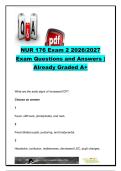
NUR 176 Exam 2 2026/2027
Exam Questions and Answers |
Already Graded A+
What are the early signs of increased ICP?
Choose an answer
1
Fever, stiff neck, photophobia, and rash.
2
Fixed dilated pupils, posturing, and bradycardia.
3
Headache, confusion, restlessness, decreased LOC, pupil changes.
,4
Severe headache, vomiting, and Loss of consciousness.
ANS 3
3
Choose an answer
1
Hypoactive delirium S/S
2
Focused assessments for delirium
3
What GCS score indicates severe brain injury?
4
What is the lowest possible Glasgow Coma Scale score?
ANS 4
What are serious side effects of valproic acid?
Choose an answer
1
, Hepatotoxicity and pulmonary fibrosis
2
Hepatotoxicity and aplastic anemia
3
Nephrotoxicity and ototoxicity
4
Hepatotoxicity and pancreatitis
ANS 4
What is the formula for IV flow rate?
Choose an answer
1
mL/hr = total volume ÷ hours
2
ml/hr = total volume
minutes
3
ml/hr = total volume
weight in kg
COPYRIGHT©NINJANERD 2026/2027. YEAR PUBLISHED 2026. COMPANY REGISTRATION NUMBER: 619652435. TERMS OF USE. PRIVACY
STATEMENT. ALL RIGHTS RESERVED
3