[STUDY GUIDE] • HIGH-YIELD PRACTICE & REVIEW EDITION
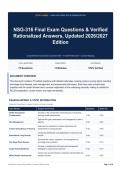
NSG-316 Final Exam Questions & Verified
Rationalized Answers, Updated 2026/2027
Edition
Comprehensive Examination Question Bank • In-Depth Rationales • Concept Mapping
TOTAL QUESTIONS EXAM TOPICS RATIONALES
75 Questions 13 Modules 100% Verified
DOCUMENT OVERVIEW
This document contains 75 verified questions with detailed rationales covering various nursing topics including
end-stage renal disease, pain management, and assessment techniques. Each item pairs a board-style
question with the correct answer and a concise explanation of the underlying principle, making it suitable for
NCLEX preparation, course review, and rapid remediation.
EXAM BLUEPRINT & TOPIC DISTRIBUTION
Systematic breakdown of subject domains and exam coverage.
Topic Module Scope & Core Focus Questions Share (%)
Health Assessment Focuses on the components and techniques of conducting
Fundamentals thorough health assessments. 7 Qs 9.3%
Explores the types, assessment, and management of pain in
Pain Management patients. 6 Qs 8.0%
Examines the importance of cultural awareness and
Cultural Competency in Nursing assessments in nursing practice. 6 Qs 8.0%
Covers the identification and classification of abnormal lung
Adventitious Lung Sounds sounds. 6 Qs 8.0%
Discusses the causes, symptoms, and management of
End Stage Renal Disease end-stage renal conditions. 5 Qs 6.7%
Focuses on assessment techniques and management
Carpal Tunnel Syndrome strategies for carpal tunnel syndrome. 5 Qs 6.7%
Covers tools and techniques for assessing mental health and
Mental Health Assessments cognitive function. 6 Qs 8.0%
Confidential • Student Study Edition • Practice & Review Guide Page 1 of 34
,STUDENT STUDY & MASTERY EDITION PRACTICE & REVIEW GUIDE
Fluid and Electrolyte Balance Examines conditions related to fluid retention and edema. 5 Qs 6.7%
Focuses on heart sounds, valve function, and related
Cardiovascular Assessment assessments. 5 Qs 6.7%
Gastrointestinal and Covers assessment techniques related to the gastrointestinal
Genitourinary Assessments and genitourinary systems. 5 Qs 6.7%
Explores assessment techniques for musculoskeletal
Musculoskeletal Assessments conditions and functional mobility. 5 Qs 6.7%
Focuses on cranial nerve assessments and neurological
Neurological Assessments function. 9 Qs 12.0%
Patient Education and Discusses effective communication strategies and
Communication educational techniques for patient care. 5 Qs 6.7%
Total Exam Coverage 13 Integrated Topic Modules 75 Qs 100.0%
Confidential • Student Study Edition • Practice & Review Guide Page 2 of 34
,STUDENT STUDY & MASTERY EDITION PRACTICE & REVIEW GUIDE
TOPIC 1: HEALTH ASSESSMENT FUNDAMENTALS
7 Questions • 9.3% of Exam • Focuses on the components and techniques of conducting thorough health assessments.
QUESTION 1
What are the elements of a general survey and health assessment?
Correct Answer: Physical appearance, body structure, mobility, behavior, and measurement.
Rationale: A general survey and health assessment involves gathering comprehensive information about an individual's
physical and behavioral characteristics, as these elements are fundamental to understanding their overall health status and
needs. These key components enable healthcare professionals to identify potential health risks, monitor changes, and
develop effective care plans, making them essential components of a thorough assessment.
QUESTION 2
What is the difference between subjective and objective data?
Correct Answer: Subjective data is what the patient say about themselves during the history taking.
Objective data is observed when inspecting, percussing, palpating, and auscultating the patient during the
physical exam.
Rationale: Subjective data is derived directly from the patient's personal experiences and perceptions, making it inherently
dependent on their individual perspective and potentially influenced by biases or inaccuracies. Objective data, on the other
hand, is gathered through direct observation and physical examination, resulting in more reliable and trustworthy information
that is less prone to manipulation or distortion.
Confidential • Student Study Edition • Practice & Review Guide Page 3 of 34
, STUDENT STUDY & MASTERY EDITION PRACTICE & REVIEW GUIDE
QUESTION 3
What is the difference between a comprehensive assessment and a focused
assessment?
Correct Answer: A comprehensive assessment includes the patient's history, physical exam, and VS; yearly
health exams.
A focused assessment is a more detailed assessment that related to a current medical condition/patient
complaint;
ER situations or after a diagnosis.
Rationale: A comprehensive assessment is a broad examination that considers the patient's entire medical history, physical
condition, and vital signs, providing a complete picture of their health, whereas a focused assessment is a more targeted
examination that narrows in on a specific medical condition or symptom to gather detailed information. This distinction
allows healthcare professionals to tailor their assessment approach to the individual needs of each patient, ensuring that
they gather the most relevant and useful information for diagnosis and treatment.
QUESTION 4
What factors affect health promotion and disease prevention throughout the lifespan?
Correct Answer: Gender, genetics, education, socioeconomic status, ethnicity, lifestyle, chronic
illness/disability, and race.
Rationale: These factors affect health promotion and disease prevention throughout the lifespan because they all interact
with and influence an individual's health determinants, such as access to healthcare, lifestyle choices, and environmental
factors, which ultimately shape their overall health and well-being. Understanding the complex interplay between these
factors is crucial for developing effective health promotion and disease prevention strategies that account for the diverse
needs and circumstances of individuals across different life stages and backgrounds.
QUESTION 5
Which of these are components of a functional assessment? (Select all that apply)
[a] vision and hearing
[b] mobility
[c] continence
[d] nutrition
[e] ADL-IADL
Correct Answer: Answer: all of them :)
A functional assessment also includes mental status, affect, home environment, and social support!
Rationale: A functional assessment evaluates an individual's ability to perform daily tasks and maintain independence,
encompassing various aspects such as physical capabilities, environmental factors, and social support. The correct answer
Confidential • Student Study Edition • Practice & Review Guide Page 4 of 34
NSG-316 Final Exam Questions & Verified
Rationalized Answers, Updated 2026/2027
Edition
Comprehensive Examination Question Bank • In-Depth Rationales • Concept Mapping
TOTAL QUESTIONS EXAM TOPICS RATIONALES
75 Questions 13 Modules 100% Verified
DOCUMENT OVERVIEW
This document contains 75 verified questions with detailed rationales covering various nursing topics including
end-stage renal disease, pain management, and assessment techniques. Each item pairs a board-style
question with the correct answer and a concise explanation of the underlying principle, making it suitable for
NCLEX preparation, course review, and rapid remediation.
EXAM BLUEPRINT & TOPIC DISTRIBUTION
Systematic breakdown of subject domains and exam coverage.
Topic Module Scope & Core Focus Questions Share (%)
Health Assessment Focuses on the components and techniques of conducting
Fundamentals thorough health assessments. 7 Qs 9.3%
Explores the types, assessment, and management of pain in
Pain Management patients. 6 Qs 8.0%
Examines the importance of cultural awareness and
Cultural Competency in Nursing assessments in nursing practice. 6 Qs 8.0%
Covers the identification and classification of abnormal lung
Adventitious Lung Sounds sounds. 6 Qs 8.0%
Discusses the causes, symptoms, and management of
End Stage Renal Disease end-stage renal conditions. 5 Qs 6.7%
Focuses on assessment techniques and management
Carpal Tunnel Syndrome strategies for carpal tunnel syndrome. 5 Qs 6.7%
Covers tools and techniques for assessing mental health and
Mental Health Assessments cognitive function. 6 Qs 8.0%
Confidential • Student Study Edition • Practice & Review Guide Page 1 of 34
,STUDENT STUDY & MASTERY EDITION PRACTICE & REVIEW GUIDE
Fluid and Electrolyte Balance Examines conditions related to fluid retention and edema. 5 Qs 6.7%
Focuses on heart sounds, valve function, and related
Cardiovascular Assessment assessments. 5 Qs 6.7%
Gastrointestinal and Covers assessment techniques related to the gastrointestinal
Genitourinary Assessments and genitourinary systems. 5 Qs 6.7%
Explores assessment techniques for musculoskeletal
Musculoskeletal Assessments conditions and functional mobility. 5 Qs 6.7%
Focuses on cranial nerve assessments and neurological
Neurological Assessments function. 9 Qs 12.0%
Patient Education and Discusses effective communication strategies and
Communication educational techniques for patient care. 5 Qs 6.7%
Total Exam Coverage 13 Integrated Topic Modules 75 Qs 100.0%
Confidential • Student Study Edition • Practice & Review Guide Page 2 of 34
,STUDENT STUDY & MASTERY EDITION PRACTICE & REVIEW GUIDE
TOPIC 1: HEALTH ASSESSMENT FUNDAMENTALS
7 Questions • 9.3% of Exam • Focuses on the components and techniques of conducting thorough health assessments.
QUESTION 1
What are the elements of a general survey and health assessment?
Correct Answer: Physical appearance, body structure, mobility, behavior, and measurement.
Rationale: A general survey and health assessment involves gathering comprehensive information about an individual's
physical and behavioral characteristics, as these elements are fundamental to understanding their overall health status and
needs. These key components enable healthcare professionals to identify potential health risks, monitor changes, and
develop effective care plans, making them essential components of a thorough assessment.
QUESTION 2
What is the difference between subjective and objective data?
Correct Answer: Subjective data is what the patient say about themselves during the history taking.
Objective data is observed when inspecting, percussing, palpating, and auscultating the patient during the
physical exam.
Rationale: Subjective data is derived directly from the patient's personal experiences and perceptions, making it inherently
dependent on their individual perspective and potentially influenced by biases or inaccuracies. Objective data, on the other
hand, is gathered through direct observation and physical examination, resulting in more reliable and trustworthy information
that is less prone to manipulation or distortion.
Confidential • Student Study Edition • Practice & Review Guide Page 3 of 34
, STUDENT STUDY & MASTERY EDITION PRACTICE & REVIEW GUIDE
QUESTION 3
What is the difference between a comprehensive assessment and a focused
assessment?
Correct Answer: A comprehensive assessment includes the patient's history, physical exam, and VS; yearly
health exams.
A focused assessment is a more detailed assessment that related to a current medical condition/patient
complaint;
ER situations or after a diagnosis.
Rationale: A comprehensive assessment is a broad examination that considers the patient's entire medical history, physical
condition, and vital signs, providing a complete picture of their health, whereas a focused assessment is a more targeted
examination that narrows in on a specific medical condition or symptom to gather detailed information. This distinction
allows healthcare professionals to tailor their assessment approach to the individual needs of each patient, ensuring that
they gather the most relevant and useful information for diagnosis and treatment.
QUESTION 4
What factors affect health promotion and disease prevention throughout the lifespan?
Correct Answer: Gender, genetics, education, socioeconomic status, ethnicity, lifestyle, chronic
illness/disability, and race.
Rationale: These factors affect health promotion and disease prevention throughout the lifespan because they all interact
with and influence an individual's health determinants, such as access to healthcare, lifestyle choices, and environmental
factors, which ultimately shape their overall health and well-being. Understanding the complex interplay between these
factors is crucial for developing effective health promotion and disease prevention strategies that account for the diverse
needs and circumstances of individuals across different life stages and backgrounds.
QUESTION 5
Which of these are components of a functional assessment? (Select all that apply)
[a] vision and hearing
[b] mobility
[c] continence
[d] nutrition
[e] ADL-IADL
Correct Answer: Answer: all of them :)
A functional assessment also includes mental status, affect, home environment, and social support!
Rationale: A functional assessment evaluates an individual's ability to perform daily tasks and maintain independence,
encompassing various aspects such as physical capabilities, environmental factors, and social support. The correct answer
Confidential • Student Study Edition • Practice & Review Guide Page 4 of 34