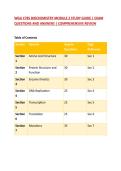
WGU C785 BIOCHEMISTRY MODULE 2 STUDY GUIDE | EXAM
QUESTIONS AND ANSWERS | COMPREHENSIVE REVIEW
Table of Contents
Section Domain Approx. Page
Questions Reference
Section Amino Acid Structure 30 Sec 1
1
Section Protein Structure and 30 Sec 2
2 Function
Section Enzyme Kinetics 30 Sec 3
3
Section DNA Replication 25 Sec 4
4
Section Transcription 25 Sec 5
5
Section Translation 25 Sec 6
6
Section Mutations 35 Sec 7
7
,SECTION 1: AMINO ACID STRUCTURE
1. What is the amino group in an amino acid?
A) A -COOH group found in organic acids
B) A functional group consisting of hydrogen and nitrogen atoms (-
NH3+)
C) The central carbon atom of each amino acid
D) A functional group that defines a particular amino acid
Correct Answer: B
Rationale: The amino group consists of a nitrogen atom bonded to
hydrogen atoms and is responsible for the basic properties of amino
acids.
2. Which of the following is the defining feature of the central carbon
(alpha carbon) in an amino acid?
A) It is bonded to four different groups
B) It is always chiral and rotates light
C) It forms a double bond with the carboxyl group
D) It is only found in essential amino acids
Correct Answer: A
Rationale: The alpha carbon is bonded to an amino group, a carboxyl
group, a hydrogen atom, and an R group, making it a chiral center in
most amino acids.
3. What determines the unique characteristics of each amino acid?
A) The amino group
B) The carboxyl group
C) The R group (side chain)
D) The alpha carbon
,Correct Answer: C
Rationale: The R group, or side chain, varies among the 20 standard
amino acids and dictates their specific chemical properties, such as
polarity and charge.
4. Which amino acid is the only one that is achiral?
A) Alanine
B) Glycine
C) Proline
D) Cysteine
Correct Answer: B
Rationale: Glycine has a hydrogen atom as its R group, meaning its
alpha carbon is bonded to two hydrogen atoms and is therefore not
chiral.
5. At a physiological pH of 7.4, what is the typical state of an amino
acid's carboxyl group?
A) Protonated (-COOH)
B) Deprotonated (-COO-)
C) Neutral (-COH)
D) Bound to the amino group
Correct Answer: B
Rationale: At physiological pH, the carboxyl group loses a proton and
becomes negatively charged (-COO-).
6. How do amino acids polymerize to form proteins?
A) Through hydrogen bonds between R groups
B) Through peptide bonds between the amino group and carboxyl
group
C) Through ionic bonds between the alpha carbons
, D) Through disulfide bridges between side chains
Correct Answer: B
Rationale: Peptide bonds are formed via a dehydration synthesis
reaction between the carboxyl group of one amino acid and the amino
group of another.
7. Which level of protein structure is primarily determined by the
sequence of amino acids?
A) Primary
B) Secondary
C) Tertiary
D) Quaternary
Correct Answer: A
Rationale: The primary structure is the specific linear sequence of
amino acids joined by peptide bonds.
8. Which amino acid contains a sulfhydryl group in its side chain and
can form disulfide bonds?
A) Methionine
B) Serine
C) Cysteine
D) Threonine
Correct Answer: C
Rationale: Cysteine has a sulfhydryl (-SH) group that can oxidize to form
a covalent disulfide bond with another cysteine.
9. Which of the following amino acids is classified as nonpolar and
hydrophobic?
A) Aspartate
B) Lysine
QUESTIONS AND ANSWERS | COMPREHENSIVE REVIEW
Table of Contents
Section Domain Approx. Page
Questions Reference
Section Amino Acid Structure 30 Sec 1
1
Section Protein Structure and 30 Sec 2
2 Function
Section Enzyme Kinetics 30 Sec 3
3
Section DNA Replication 25 Sec 4
4
Section Transcription 25 Sec 5
5
Section Translation 25 Sec 6
6
Section Mutations 35 Sec 7
7
,SECTION 1: AMINO ACID STRUCTURE
1. What is the amino group in an amino acid?
A) A -COOH group found in organic acids
B) A functional group consisting of hydrogen and nitrogen atoms (-
NH3+)
C) The central carbon atom of each amino acid
D) A functional group that defines a particular amino acid
Correct Answer: B
Rationale: The amino group consists of a nitrogen atom bonded to
hydrogen atoms and is responsible for the basic properties of amino
acids.
2. Which of the following is the defining feature of the central carbon
(alpha carbon) in an amino acid?
A) It is bonded to four different groups
B) It is always chiral and rotates light
C) It forms a double bond with the carboxyl group
D) It is only found in essential amino acids
Correct Answer: A
Rationale: The alpha carbon is bonded to an amino group, a carboxyl
group, a hydrogen atom, and an R group, making it a chiral center in
most amino acids.
3. What determines the unique characteristics of each amino acid?
A) The amino group
B) The carboxyl group
C) The R group (side chain)
D) The alpha carbon
,Correct Answer: C
Rationale: The R group, or side chain, varies among the 20 standard
amino acids and dictates their specific chemical properties, such as
polarity and charge.
4. Which amino acid is the only one that is achiral?
A) Alanine
B) Glycine
C) Proline
D) Cysteine
Correct Answer: B
Rationale: Glycine has a hydrogen atom as its R group, meaning its
alpha carbon is bonded to two hydrogen atoms and is therefore not
chiral.
5. At a physiological pH of 7.4, what is the typical state of an amino
acid's carboxyl group?
A) Protonated (-COOH)
B) Deprotonated (-COO-)
C) Neutral (-COH)
D) Bound to the amino group
Correct Answer: B
Rationale: At physiological pH, the carboxyl group loses a proton and
becomes negatively charged (-COO-).
6. How do amino acids polymerize to form proteins?
A) Through hydrogen bonds between R groups
B) Through peptide bonds between the amino group and carboxyl
group
C) Through ionic bonds between the alpha carbons
, D) Through disulfide bridges between side chains
Correct Answer: B
Rationale: Peptide bonds are formed via a dehydration synthesis
reaction between the carboxyl group of one amino acid and the amino
group of another.
7. Which level of protein structure is primarily determined by the
sequence of amino acids?
A) Primary
B) Secondary
C) Tertiary
D) Quaternary
Correct Answer: A
Rationale: The primary structure is the specific linear sequence of
amino acids joined by peptide bonds.
8. Which amino acid contains a sulfhydryl group in its side chain and
can form disulfide bonds?
A) Methionine
B) Serine
C) Cysteine
D) Threonine
Correct Answer: C
Rationale: Cysteine has a sulfhydryl (-SH) group that can oxidize to form
a covalent disulfide bond with another cysteine.
9. Which of the following amino acids is classified as nonpolar and
hydrophobic?
A) Aspartate
B) Lysine