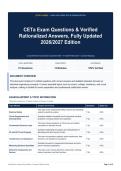
[STUDY GUIDE] • HIGH-YIELD PRACTICE & REVIEW EDITION
CETa Exam Questions & Verified
Rationalized Answers, Fully Updated
2026/2027 Edition
Comprehensive Examination Question Bank • In-Depth Rationales • Concept Mapping
TOTAL QUESTIONS EXAM TOPICS RATIONALES
81 Questions 12 Modules 100% Verified
DOCUMENT OVERVIEW
This document contains 81 verified questions with correct answers and detailed rationales focused on
electrical engineering concepts. It covers essential topics such as current, voltage, resistance, and circuit
analysis, making it suitable for exam preparation and professional certification review.
EXAM BLUEPRINT & TOPIC DISTRIBUTION
Systematic breakdown of subject domains and exam coverage.
Topic Module Scope & Core Focus Questions Share (%)
This topic covers fundamental safety concerns and standards
Electrical Safety related to electrical systems. 7 Qs 8.6%
Circuit Components and Questions related to essential circuit components and their
Characteristics properties, including resistors and capacitors. 7 Qs 8.6%
This topic includes questions on Ohm's Law and related
Fundamental Electrical Laws calculations in electrical circuits. 7 Qs 8.6%
Questions addressing the analysis and characteristics of
AC and DC Circuit Analysis alternating and direct current circuits. 7 Qs 8.6%
This topic encompasses questions about transformers, their
Transformers and Impedance functions, and impedance calculations. 7 Qs 8.6%
Questions focused on measurement techniques and tools
Measuring Electrical Quantities used in electrical engineering. 7 Qs 8.6%
Electronic Components and This topic covers various electronic components, including
Devices diodes, transistors, and their functions. 7 Qs 8.6%
Confidential • Student Study Edition • Practice & Review Guide Page 1 of 43
,STUDENT STUDY & MASTERY EDITION PRACTICE & REVIEW GUIDE
Questions about signal characteristics, processing
Signal Processing techniques, and their applications in circuits. 7 Qs 8.6%
This topic includes questions on digital systems, binary
Digital Electronics numbers, and related calculations. 7 Qs 8.6%
Soldering and Assembly Questions related to soldering methods, assembly practices,
Techniques and component handling. 6 Qs 7.4%
This topic covers basic networking principles and standards
Networking Concepts relevant to electrical engineering. 6 Qs 7.4%
Questions exploring the principles of electromagnetism and
Electromagnetism their practical applications. 6 Qs 7.4%
Total Exam Coverage 12 Integrated Topic Modules 81 Qs 100.0%
Confidential • Student Study Edition • Practice & Review Guide Page 2 of 43
,STUDENT STUDY & MASTERY EDITION PRACTICE & REVIEW GUIDE
TOPIC 1: ELECTRICAL SAFETY
7 Questions • 8.6% of Exam • This topic covers fundamental safety concerns and standards related to electrical systems.
QUESTION 1
What does the acronym ESD stand for?
[A] Electrostatic Discharge
[B] Electrostatic Device
[C] Electromagnetic Sensitivity Diac
[D] Electrostatic Damage
Correct Answer: A.
Electrostatic Discharge.
Rationale: The term "Electrostatic Discharge" accurately represents the common phenomenon of a sudden flow of
electricity between two objects at different electrical potentials, caused by a buildup of static electricity. This definition aligns
with the term "ESD" being widely used in electronics and industries to describe the protection of sensitive components from
damage due to static electricity.
QUESTION 2
Current amounts between ______ and _____ can be lethal.
[A] 100mA, 200mA
[B] 10mA, 33.3mA
[C] 33.3, 75.6mA
[D] 4mA, 10mA
Correct Answer: A.
100mA, 200mA.
Rationale: The correct answer is based on the fact that electrical currents above 100mA can cause cardiac arrest by
disrupting the heart's electrical impulses, while currents below 10mA are generally not considered lethal. This is because the
human body's response to electrical shock changes significantly at the 10mA threshold, with higher currents posing a
greater risk of serious harm or death.
Confidential • Student Study Edition • Practice & Review Guide Page 3 of 43
, STUDENT STUDY & MASTERY EDITION PRACTICE & REVIEW GUIDE
QUESTION 3
What is the number one concern in regards to electrical safety?
[A] Proper grounding
[B] ESD
[C] Shock
[D] Faulty equipment
Correct Answer: C.
Shock.
Rationale: Electrical shock is the primary concern in electrical safety because it poses a direct threat to human life by
causing cardiac arrest, burns, or even death. This risk is amplified by the fact that electrical shock can occur without any
visible injury, making it a silent and unpredictable hazard that demands proper precautions and safety measures.
QUESTION 4
Bohr's Atomic Model consists of what three components?
[A] Neutrons, ion, neutrinos
[B] Protons, neutrons and cations
[C] Tachyons gravitons and electrons
[D] Protons, neutrons and electrons
Correct Answer: D.
Protons, neutrons and electrons.
Rationale: Bohr's Atomic Model primarily focuses on the arrangement of electrons in energy levels around the nucleus,
which consists of protons and neutrons. The inclusion of electrons in the model is crucial as they are the particles
responsible for the chemical properties of an atom and occupy specific energy levels, making option D the correct choice.
Confidential • Student Study Edition • Practice & Review Guide Page 4 of 43
CETa Exam Questions & Verified
Rationalized Answers, Fully Updated
2026/2027 Edition
Comprehensive Examination Question Bank • In-Depth Rationales • Concept Mapping
TOTAL QUESTIONS EXAM TOPICS RATIONALES
81 Questions 12 Modules 100% Verified
DOCUMENT OVERVIEW
This document contains 81 verified questions with correct answers and detailed rationales focused on
electrical engineering concepts. It covers essential topics such as current, voltage, resistance, and circuit
analysis, making it suitable for exam preparation and professional certification review.
EXAM BLUEPRINT & TOPIC DISTRIBUTION
Systematic breakdown of subject domains and exam coverage.
Topic Module Scope & Core Focus Questions Share (%)
This topic covers fundamental safety concerns and standards
Electrical Safety related to electrical systems. 7 Qs 8.6%
Circuit Components and Questions related to essential circuit components and their
Characteristics properties, including resistors and capacitors. 7 Qs 8.6%
This topic includes questions on Ohm's Law and related
Fundamental Electrical Laws calculations in electrical circuits. 7 Qs 8.6%
Questions addressing the analysis and characteristics of
AC and DC Circuit Analysis alternating and direct current circuits. 7 Qs 8.6%
This topic encompasses questions about transformers, their
Transformers and Impedance functions, and impedance calculations. 7 Qs 8.6%
Questions focused on measurement techniques and tools
Measuring Electrical Quantities used in electrical engineering. 7 Qs 8.6%
Electronic Components and This topic covers various electronic components, including
Devices diodes, transistors, and their functions. 7 Qs 8.6%
Confidential • Student Study Edition • Practice & Review Guide Page 1 of 43
,STUDENT STUDY & MASTERY EDITION PRACTICE & REVIEW GUIDE
Questions about signal characteristics, processing
Signal Processing techniques, and their applications in circuits. 7 Qs 8.6%
This topic includes questions on digital systems, binary
Digital Electronics numbers, and related calculations. 7 Qs 8.6%
Soldering and Assembly Questions related to soldering methods, assembly practices,
Techniques and component handling. 6 Qs 7.4%
This topic covers basic networking principles and standards
Networking Concepts relevant to electrical engineering. 6 Qs 7.4%
Questions exploring the principles of electromagnetism and
Electromagnetism their practical applications. 6 Qs 7.4%
Total Exam Coverage 12 Integrated Topic Modules 81 Qs 100.0%
Confidential • Student Study Edition • Practice & Review Guide Page 2 of 43
,STUDENT STUDY & MASTERY EDITION PRACTICE & REVIEW GUIDE
TOPIC 1: ELECTRICAL SAFETY
7 Questions • 8.6% of Exam • This topic covers fundamental safety concerns and standards related to electrical systems.
QUESTION 1
What does the acronym ESD stand for?
[A] Electrostatic Discharge
[B] Electrostatic Device
[C] Electromagnetic Sensitivity Diac
[D] Electrostatic Damage
Correct Answer: A.
Electrostatic Discharge.
Rationale: The term "Electrostatic Discharge" accurately represents the common phenomenon of a sudden flow of
electricity between two objects at different electrical potentials, caused by a buildup of static electricity. This definition aligns
with the term "ESD" being widely used in electronics and industries to describe the protection of sensitive components from
damage due to static electricity.
QUESTION 2
Current amounts between ______ and _____ can be lethal.
[A] 100mA, 200mA
[B] 10mA, 33.3mA
[C] 33.3, 75.6mA
[D] 4mA, 10mA
Correct Answer: A.
100mA, 200mA.
Rationale: The correct answer is based on the fact that electrical currents above 100mA can cause cardiac arrest by
disrupting the heart's electrical impulses, while currents below 10mA are generally not considered lethal. This is because the
human body's response to electrical shock changes significantly at the 10mA threshold, with higher currents posing a
greater risk of serious harm or death.
Confidential • Student Study Edition • Practice & Review Guide Page 3 of 43
, STUDENT STUDY & MASTERY EDITION PRACTICE & REVIEW GUIDE
QUESTION 3
What is the number one concern in regards to electrical safety?
[A] Proper grounding
[B] ESD
[C] Shock
[D] Faulty equipment
Correct Answer: C.
Shock.
Rationale: Electrical shock is the primary concern in electrical safety because it poses a direct threat to human life by
causing cardiac arrest, burns, or even death. This risk is amplified by the fact that electrical shock can occur without any
visible injury, making it a silent and unpredictable hazard that demands proper precautions and safety measures.
QUESTION 4
Bohr's Atomic Model consists of what three components?
[A] Neutrons, ion, neutrinos
[B] Protons, neutrons and cations
[C] Tachyons gravitons and electrons
[D] Protons, neutrons and electrons
Correct Answer: D.
Protons, neutrons and electrons.
Rationale: Bohr's Atomic Model primarily focuses on the arrangement of electrons in energy levels around the nucleus,
which consists of protons and neutrons. The inclusion of electrons in the model is crucial as they are the particles
responsible for the chemical properties of an atom and occupy specific energy levels, making option D the correct choice.
Confidential • Student Study Edition • Practice & Review Guide Page 4 of 43