[STUDY GUIDE] • HIGH-YIELD PRACTICE & REVIEW EDITION
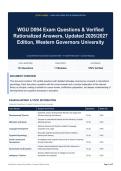
WGU D094 Exam Questions & Verified
Rationalized Answers, Updated 2026/2027
Edition, Western Governors University
Comprehensive Examination Question Bank • In-Depth Rationales • Concept Mapping
TOTAL QUESTIONS EXAM TOPICS RATIONALES
133 Questions 11 Modules 100% Verified
DOCUMENT OVERVIEW
This document contains 133 verified questions with detailed rationales covering key concepts in educational
psychology. Each item pairs a question with the correct answer and a concise explanation of the relevant
theory or principle, making it suitable for course review, certification preparation, and deeper understanding of
developmental and cognitive processes in education.
EXAM BLUEPRINT & TOPIC DISTRIBUTION
Systematic breakdown of subject domains and exam coverage.
Topic Module Scope & Core Focus Questions Share (%)
Examines various developmental theories and stages that
Developmental Theories influence learning and behavior. 13 Qs 9.8%
Focuses on motivational theories and the hierarchy of needs
Motivation and Needs affecting learners. 12 Qs 9.0%
Explores theories and disorders related to language
Language Development acquisition and usage. 12 Qs 9.0%
Discusses cognitive processes and theories related to
Cognitive Psychology learning and memory. 12 Qs 9.0%
Social Learning and Investigates social cognitive theory and its impact on learning
Development through observation. 12 Qs 9.0%
Covers various assessment types and their relevance in
Assessment and Evaluation measuring student learning. 12 Qs 9.0%
Reviews different theories of intelligence and their
Intelligence Theories implications for education. 12 Qs 9.0%
Confidential • Student Study Edition • Practice & Review Guide Page 1 of 47
,STUDENT STUDY & MASTERY EDITION PRACTICE & REVIEW GUIDE
Behavioral Disorders and Examines various behavioral disorders and their impact on
Impairments learning environments. 12 Qs 9.0%
Explores intrinsic and extrinsic motivation and their roles in
Motivational Theories learning. 12 Qs 9.0%
Explores foundational learning theories including
Learning Theories constructivism and humanism. 12 Qs 9.0%
Memory and Information Focuses on memory types and the processes involved in
Processing information retention. 12 Qs 9.0%
Total Exam Coverage 11 Integrated Topic Modules 133 Qs 100.0%
Confidential • Student Study Edition • Practice & Review Guide Page 2 of 47
,STUDENT STUDY & MASTERY EDITION PRACTICE & REVIEW GUIDE
TOPIC 1: DEVELOPMENTAL THEORIES
13 Questions • 9.8% of Exam • Examines various developmental theories and stages that influence learning and behavior.
QUESTION 1
Maslow's Hierarchy of Needs Main Idea
Correct Answer: Individuals must satisfy a basic series of needs before they can reach their potential.
Rationale: Maslow's Hierarchy of Needs Main Idea is based on the concept that lower-level needs, such as physiological
and safety needs, must be fulfilled in order to provide a foundation for higher-level needs, like self-actualization, to emerge.
This sequential progression is essential for individuals to reach their full potential, as unmet basic needs hinder the
development of more complex and fulfilling aspects of human life.
QUESTION 2
Gesell's Maturational Theory
Correct Answer: Child's growth & development are influenced by both their environment and genes in
sequential order.
Rationale: Gesell's Maturational Theory suggests that children's growth and development unfold in a predetermined
sequence of stages, with each milestone built upon the previous one, influenced by both genetic predispositions and
environmental factors. This theory proposes that genetic factors initiate the developmental process, while environmental
factors interact with and shape the unfolding of these predetermined stages, illustrating the interplay between nature and
nurture.
QUESTION 3
Early Childhood
Correct Answer: The stage of development from 2 - 6 years old. Improvements occur in both fine and gross
motor skills.
Rationale: This answer is correct because the stage of development from 2-6 years old is typically considered early
childhood, characterized by significant improvements in both fine motor skills (e.g., drawing, writing) and gross motor skills
(e.g., running, jumping). This period is often associated with the development of basic physical abilities that lay the
foundation for future growth and learning.
Confidential • Student Study Edition • Practice & Review Guide Page 3 of 47
, STUDENT STUDY & MASTERY EDITION PRACTICE & REVIEW GUIDE
QUESTION 4
Middle Childhood
Correct Answer: The stage of development from 6 - 10 years old. Slow but steady gains in weight and height.
Rationale: Middle Childhood is characterized by slow but steady gains in weight and height due to the physical growth and
development that occurs during this stage. This stage spans from 6 to 10 years old, marked by gradual advancements in
physical, cognitive, and social abilities.
QUESTION 5
Jean Piaget
Correct Answer: Swiss psychologist known for his Theory of Cognitive Development.
Rationale: Jean Piaget's theory of cognitive development focuses on how children construct knowledge and understanding
through active interaction with their environment, which is a fundamental concept in psychology. This emphasis on
experiential learning and childcentered development aligns with the characteristics of Swiss psychology, making it a fitting
description of Piaget's work.
QUESTION 6
Sensorimotor Stage
Correct Answer: Stage of development from birth to 2 years. Infants and toddlers acquire knowledge through
sensory experiences and manipulating objects.
Rationale: The correct answer is accurate because the Sensorimotor Stage, a concept in developmental psychology, refers
to the early stage of cognitive development where children learn and understand the world through their senses and motor
actions, which is evident in infants and toddlers. This stage is characterized by the idea that children construct their
knowledge by directly interacting with their environment through sensory experiences and manipulating objects.
Confidential • Student Study Edition • Practice & Review Guide Page 4 of 47
WGU D094 Exam Questions & Verified
Rationalized Answers, Updated 2026/2027
Edition, Western Governors University
Comprehensive Examination Question Bank • In-Depth Rationales • Concept Mapping
TOTAL QUESTIONS EXAM TOPICS RATIONALES
133 Questions 11 Modules 100% Verified
DOCUMENT OVERVIEW
This document contains 133 verified questions with detailed rationales covering key concepts in educational
psychology. Each item pairs a question with the correct answer and a concise explanation of the relevant
theory or principle, making it suitable for course review, certification preparation, and deeper understanding of
developmental and cognitive processes in education.
EXAM BLUEPRINT & TOPIC DISTRIBUTION
Systematic breakdown of subject domains and exam coverage.
Topic Module Scope & Core Focus Questions Share (%)
Examines various developmental theories and stages that
Developmental Theories influence learning and behavior. 13 Qs 9.8%
Focuses on motivational theories and the hierarchy of needs
Motivation and Needs affecting learners. 12 Qs 9.0%
Explores theories and disorders related to language
Language Development acquisition and usage. 12 Qs 9.0%
Discusses cognitive processes and theories related to
Cognitive Psychology learning and memory. 12 Qs 9.0%
Social Learning and Investigates social cognitive theory and its impact on learning
Development through observation. 12 Qs 9.0%
Covers various assessment types and their relevance in
Assessment and Evaluation measuring student learning. 12 Qs 9.0%
Reviews different theories of intelligence and their
Intelligence Theories implications for education. 12 Qs 9.0%
Confidential • Student Study Edition • Practice & Review Guide Page 1 of 47
,STUDENT STUDY & MASTERY EDITION PRACTICE & REVIEW GUIDE
Behavioral Disorders and Examines various behavioral disorders and their impact on
Impairments learning environments. 12 Qs 9.0%
Explores intrinsic and extrinsic motivation and their roles in
Motivational Theories learning. 12 Qs 9.0%
Explores foundational learning theories including
Learning Theories constructivism and humanism. 12 Qs 9.0%
Memory and Information Focuses on memory types and the processes involved in
Processing information retention. 12 Qs 9.0%
Total Exam Coverage 11 Integrated Topic Modules 133 Qs 100.0%
Confidential • Student Study Edition • Practice & Review Guide Page 2 of 47
,STUDENT STUDY & MASTERY EDITION PRACTICE & REVIEW GUIDE
TOPIC 1: DEVELOPMENTAL THEORIES
13 Questions • 9.8% of Exam • Examines various developmental theories and stages that influence learning and behavior.
QUESTION 1
Maslow's Hierarchy of Needs Main Idea
Correct Answer: Individuals must satisfy a basic series of needs before they can reach their potential.
Rationale: Maslow's Hierarchy of Needs Main Idea is based on the concept that lower-level needs, such as physiological
and safety needs, must be fulfilled in order to provide a foundation for higher-level needs, like self-actualization, to emerge.
This sequential progression is essential for individuals to reach their full potential, as unmet basic needs hinder the
development of more complex and fulfilling aspects of human life.
QUESTION 2
Gesell's Maturational Theory
Correct Answer: Child's growth & development are influenced by both their environment and genes in
sequential order.
Rationale: Gesell's Maturational Theory suggests that children's growth and development unfold in a predetermined
sequence of stages, with each milestone built upon the previous one, influenced by both genetic predispositions and
environmental factors. This theory proposes that genetic factors initiate the developmental process, while environmental
factors interact with and shape the unfolding of these predetermined stages, illustrating the interplay between nature and
nurture.
QUESTION 3
Early Childhood
Correct Answer: The stage of development from 2 - 6 years old. Improvements occur in both fine and gross
motor skills.
Rationale: This answer is correct because the stage of development from 2-6 years old is typically considered early
childhood, characterized by significant improvements in both fine motor skills (e.g., drawing, writing) and gross motor skills
(e.g., running, jumping). This period is often associated with the development of basic physical abilities that lay the
foundation for future growth and learning.
Confidential • Student Study Edition • Practice & Review Guide Page 3 of 47
, STUDENT STUDY & MASTERY EDITION PRACTICE & REVIEW GUIDE
QUESTION 4
Middle Childhood
Correct Answer: The stage of development from 6 - 10 years old. Slow but steady gains in weight and height.
Rationale: Middle Childhood is characterized by slow but steady gains in weight and height due to the physical growth and
development that occurs during this stage. This stage spans from 6 to 10 years old, marked by gradual advancements in
physical, cognitive, and social abilities.
QUESTION 5
Jean Piaget
Correct Answer: Swiss psychologist known for his Theory of Cognitive Development.
Rationale: Jean Piaget's theory of cognitive development focuses on how children construct knowledge and understanding
through active interaction with their environment, which is a fundamental concept in psychology. This emphasis on
experiential learning and childcentered development aligns with the characteristics of Swiss psychology, making it a fitting
description of Piaget's work.
QUESTION 6
Sensorimotor Stage
Correct Answer: Stage of development from birth to 2 years. Infants and toddlers acquire knowledge through
sensory experiences and manipulating objects.
Rationale: The correct answer is accurate because the Sensorimotor Stage, a concept in developmental psychology, refers
to the early stage of cognitive development where children learn and understand the world through their senses and motor
actions, which is evident in infants and toddlers. This stage is characterized by the idea that children construct their
knowledge by directly interacting with their environment through sensory experiences and manipulating objects.
Confidential • Student Study Edition • Practice & Review Guide Page 4 of 47