

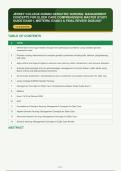
JERSEY COLLEGE NUR202 GERIATRIC NURSING: MANAGEMENT
CONCEPTS FOR ELDER CARE COMPREHENSIVE MASTER STUDY
GUIDE EXAM 1, MIDTERM, EXAM 2 & FINAL REVIEW 2026/2027
148 QUESTIONS
TABLE OF CONTENTS
# TOPIC
1 Differentiate normal age-related changes from pathological conditions using validated geriatric
assessment tools
2 Prioritize nursing interventions for complex geriatric syndromes including falls, delirium, polypharmacy,
and frailty
3 Apply ethical and legal principles to advance care planning, elder mistreatment, and resource allocation
4 Evaluate pharmacologic and non-pharmacologic management of chronic illness in older adults using
Beers Criteria and deprescribing frameworks
5 Demonstrate leadership in interdisciplinary team coordination and quality improvement for elder care
6 Jersey College NUR202 Geriatric Nursing
7 Management Concepts for Elder Care Comprehensive Master Study Guide Exam 1
8 Midterm
9 Exam 2 & Final Review 2026
10 2027
11 Foundations of Geriatric Nursing: Management Concepts for Elder Care
12 Applied Geriatric Nursing: Management Concepts for Elder Care
13 Advanced Geriatric Nursing: Management Concepts for Elder Care
14 Geriatric Nursing: Management Concepts for Elder Care Review
ABSTRACT
Page 1
,This study document brings together 148 carefully worded exam questions drawn from Jersey
College NUR202 Geriatric Nursing: Management Concepts for Elder Care Comprehensive Master
Study Guide Exam 1, Midterm, Exam 2 & Final Review 2026/2027, with the strongest emphasis
placed on Differentiate normal age-related changes from pathological conditions using validated
geriatric assessment tools, Prioritize nursing interventions for complex geriatric syndromes
including falls, delirium, polypharmacy, and frailty, Apply ethical and legal principles to advance
care planning, elder mistreatment and and resource allocation. Every item follows the wording style
and level of reasoning you meet in the real paper, and each one is paired with a clear rationale so
the correct choice is never a guess. Work through the set at your own pace, mark the questions
that slow you down, then come back to them until the reasoning feels automatic. Learners who
revise this way walk into the exam room recognising the pattern behind the questions instead of
meeting them for the first time. Keep going - steady, honest practice is what turns a difficult paper
into a comfortable pass.
Q1 DIFFERENTIATE NORMAL AGE-RELATED CHANGES FROM PATHOLOGICAL CONDITIONS
USING VALIDATED GERIATRIC ASSESSMENT TOOLS
An older adult with heart failure and preserved ejection fraction reports new-onset
confusion and a fall at home. Which pathophysiologic mechanism best explains
this atypical presentation?
A. Reduced cerebral perfusion from diastolic dysfunction and blunted baroreceptor sensitivity
CORRECT
B. Increased intracranial pressure from cerebral edema secondary to fluid overload
C. Acute alcohol withdrawal precipitated by hospitalization
D. Hyperglycemic hyperosmolar state from diuretic-induced dehydration
RATIONALE: Older adults with HFpEF often present atypically due to age-related decreases in
baroreceptor sensitivity and diastolic reserve, leading to cerebral hypoperfusion and
delirium/falls. B is unlikely without focal neurologic signs; C lacks supporting history; D is less
common and would show severe hyperglycemia.
Page 2
,Q2 DIFFERENTIATE NORMAL AGE-RELATED CHANGES FROM PATHOLOGICAL CONDITIONS
USING VALIDATED GERIATRIC ASSESSMENT TOOLS
Which finding during a geriatric functional assessment most strongly predicts
6-month mortality independent of comorbidity?
A. Slow gait speed on the 4-meter walk test CORRECT
B. Mini-Mental State Examination score of 24
C. Body mass index of 22 kg/m²
D. Occasional urinary incontinence
RATIONALE: Gait speed is a robust predictor of mortality, disability, and institutionalization in
older adults, often outperforming traditional risk factors. MMSE, BMI, and incontinence are
important but less predictive of short-term mortality.
Q3 DIFFERENTIATE NORMAL AGE-RELATED CHANGES FROM PATHOLOGICAL CONDITIONS
USING VALIDATED GERIATRIC ASSESSMENT TOOLS
A cognitively intact older adult with advanced cancer refuses a recommended
feeding tube. The family insists on placement. Which ethical principle should
guide the nurse's advocacy?
A. Beneficence, because the family wants what is best
B. Autonomy, because the patient has decision-making capacity CORRECT
C. Justice, because resources should be allocated fairly
D. Paternalism, because the nurse knows best
RATIONALE: Autonomy prevails when the patient has capacity and refuses treatment, even if
family disagrees. Beneficence and justice are relevant but secondary; paternalism is ethically
inappropriate.
Page 3
, Q4 DIFFERENTIATE NORMAL AGE-RELATED CHANGES FROM PATHOLOGICAL CONDITIONS
USING VALIDATED GERIATRIC ASSESSMENT TOOLS
An older adult is prescribed a new medication that is highly protein-bound. Which
age-related change most increases the risk of toxicity?
A. Decreased serum albumin CORRECT
B. Increased body fat percentage
C. Decreased gastric motility
D. Increased hepatic blood flow
RATIONALE: Decreased serum albumin reduces binding sites, increasing free drug
concentration and toxicity risk. Increased body fat affects lipid-soluble drugs; decreased motility
alters absorption; hepatic blood flow typically decreases, not increases.
Q5 DIFFERENTIATE NORMAL AGE-RELATED CHANGES FROM PATHOLOGICAL CONDITIONS
USING VALIDATED GERIATRIC ASSESSMENT TOOLS
Which intervention is most effective in preventing delirium in hospitalized older
adults according to the Hospital Elder Life Program (HELP)?
A. Routine use of antipsychotics for agitation
B. Early mobilization and sleep protocols CORRECT
C. Restricting family visitation to reduce stimulation
D. Indwelling urinary catheter to monitor output
RATIONALE: HELP emphasizes non-pharmacologic multicomponent interventions including early
mobility, sleep enhancement, orientation, and hydration. Antipsychotics, visitation restriction, and
catheters increase delirium risk.
Page 4
CONCEPTS FOR ELDER CARE COMPREHENSIVE MASTER STUDY
GUIDE EXAM 1, MIDTERM, EXAM 2 & FINAL REVIEW 2026/2027
148 QUESTIONS
TABLE OF CONTENTS
# TOPIC
1 Differentiate normal age-related changes from pathological conditions using validated geriatric
assessment tools
2 Prioritize nursing interventions for complex geriatric syndromes including falls, delirium, polypharmacy,
and frailty
3 Apply ethical and legal principles to advance care planning, elder mistreatment, and resource allocation
4 Evaluate pharmacologic and non-pharmacologic management of chronic illness in older adults using
Beers Criteria and deprescribing frameworks
5 Demonstrate leadership in interdisciplinary team coordination and quality improvement for elder care
6 Jersey College NUR202 Geriatric Nursing
7 Management Concepts for Elder Care Comprehensive Master Study Guide Exam 1
8 Midterm
9 Exam 2 & Final Review 2026
10 2027
11 Foundations of Geriatric Nursing: Management Concepts for Elder Care
12 Applied Geriatric Nursing: Management Concepts for Elder Care
13 Advanced Geriatric Nursing: Management Concepts for Elder Care
14 Geriatric Nursing: Management Concepts for Elder Care Review
ABSTRACT
Page 1
,This study document brings together 148 carefully worded exam questions drawn from Jersey
College NUR202 Geriatric Nursing: Management Concepts for Elder Care Comprehensive Master
Study Guide Exam 1, Midterm, Exam 2 & Final Review 2026/2027, with the strongest emphasis
placed on Differentiate normal age-related changes from pathological conditions using validated
geriatric assessment tools, Prioritize nursing interventions for complex geriatric syndromes
including falls, delirium, polypharmacy, and frailty, Apply ethical and legal principles to advance
care planning, elder mistreatment and and resource allocation. Every item follows the wording style
and level of reasoning you meet in the real paper, and each one is paired with a clear rationale so
the correct choice is never a guess. Work through the set at your own pace, mark the questions
that slow you down, then come back to them until the reasoning feels automatic. Learners who
revise this way walk into the exam room recognising the pattern behind the questions instead of
meeting them for the first time. Keep going - steady, honest practice is what turns a difficult paper
into a comfortable pass.
Q1 DIFFERENTIATE NORMAL AGE-RELATED CHANGES FROM PATHOLOGICAL CONDITIONS
USING VALIDATED GERIATRIC ASSESSMENT TOOLS
An older adult with heart failure and preserved ejection fraction reports new-onset
confusion and a fall at home. Which pathophysiologic mechanism best explains
this atypical presentation?
A. Reduced cerebral perfusion from diastolic dysfunction and blunted baroreceptor sensitivity
CORRECT
B. Increased intracranial pressure from cerebral edema secondary to fluid overload
C. Acute alcohol withdrawal precipitated by hospitalization
D. Hyperglycemic hyperosmolar state from diuretic-induced dehydration
RATIONALE: Older adults with HFpEF often present atypically due to age-related decreases in
baroreceptor sensitivity and diastolic reserve, leading to cerebral hypoperfusion and
delirium/falls. B is unlikely without focal neurologic signs; C lacks supporting history; D is less
common and would show severe hyperglycemia.
Page 2
,Q2 DIFFERENTIATE NORMAL AGE-RELATED CHANGES FROM PATHOLOGICAL CONDITIONS
USING VALIDATED GERIATRIC ASSESSMENT TOOLS
Which finding during a geriatric functional assessment most strongly predicts
6-month mortality independent of comorbidity?
A. Slow gait speed on the 4-meter walk test CORRECT
B. Mini-Mental State Examination score of 24
C. Body mass index of 22 kg/m²
D. Occasional urinary incontinence
RATIONALE: Gait speed is a robust predictor of mortality, disability, and institutionalization in
older adults, often outperforming traditional risk factors. MMSE, BMI, and incontinence are
important but less predictive of short-term mortality.
Q3 DIFFERENTIATE NORMAL AGE-RELATED CHANGES FROM PATHOLOGICAL CONDITIONS
USING VALIDATED GERIATRIC ASSESSMENT TOOLS
A cognitively intact older adult with advanced cancer refuses a recommended
feeding tube. The family insists on placement. Which ethical principle should
guide the nurse's advocacy?
A. Beneficence, because the family wants what is best
B. Autonomy, because the patient has decision-making capacity CORRECT
C. Justice, because resources should be allocated fairly
D. Paternalism, because the nurse knows best
RATIONALE: Autonomy prevails when the patient has capacity and refuses treatment, even if
family disagrees. Beneficence and justice are relevant but secondary; paternalism is ethically
inappropriate.
Page 3
, Q4 DIFFERENTIATE NORMAL AGE-RELATED CHANGES FROM PATHOLOGICAL CONDITIONS
USING VALIDATED GERIATRIC ASSESSMENT TOOLS
An older adult is prescribed a new medication that is highly protein-bound. Which
age-related change most increases the risk of toxicity?
A. Decreased serum albumin CORRECT
B. Increased body fat percentage
C. Decreased gastric motility
D. Increased hepatic blood flow
RATIONALE: Decreased serum albumin reduces binding sites, increasing free drug
concentration and toxicity risk. Increased body fat affects lipid-soluble drugs; decreased motility
alters absorption; hepatic blood flow typically decreases, not increases.
Q5 DIFFERENTIATE NORMAL AGE-RELATED CHANGES FROM PATHOLOGICAL CONDITIONS
USING VALIDATED GERIATRIC ASSESSMENT TOOLS
Which intervention is most effective in preventing delirium in hospitalized older
adults according to the Hospital Elder Life Program (HELP)?
A. Routine use of antipsychotics for agitation
B. Early mobilization and sleep protocols CORRECT
C. Restricting family visitation to reduce stimulation
D. Indwelling urinary catheter to monitor output
RATIONALE: HELP emphasizes non-pharmacologic multicomponent interventions including early
mobility, sleep enhancement, orientation, and hydration. Antipsychotics, visitation restriction, and
catheters increase delirium risk.
Page 4


