

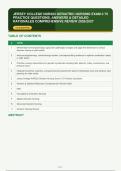
JERSEY COLLEGE NUR202 GERIATRIC NURSING EXAM 2 75
PRACTICE QUESTIONS, ANSWERS & DETAILED
RATIONALES COMPREHENSIVE REVIEW 2026/2027
149 QUESTIONS
TABLE OF CONTENTS
# TOPIC
1 Differentiate normal physiologic aging from pathologic changes and apply this distinction to clinical
decision-making in older adults
2 Analyze polypharmacy, anticholinergic burden, and deprescribing evidence to optimize medication safety
in older adults
3 Prioritize nursing interventions for geriatric syndromes including falls, delirium, frailty, incontinence, and
pressure injury
4 Integrate functional, cognitive, and psychosocial assessment data to individualize care and advance care
planning for older adults
5 Jersey College NUR202 Geriatric Nursing Exam 2 75 Practice Questions
6 Answers & Detailed Rationales Comprehensive Review 2026
7 2027
8 Foundations of Geriatric Nursing
9 Applied Geriatric Nursing
10 Advanced Geriatric Nursing
11 Geriatric Nursing Review
ABSTRACT
Page 1
,This study document brings together 149 carefully worded exam questions drawn from Jersey
College NUR202 Geriatric Nursing Exam 2 75 Practice Questions, Answers & Detailed Rationales
Comprehensive Review 2026/2027, with the strongest emphasis placed on Differentiate normal
physiologic aging from pathologic changes and apply this distinction to clinical decision-making in
older adults, Analyze polypharmacy, anticholinergic burden, and deprescribing evidence to
optimize medication safety in older adults, Prioritize nursing interventions for geriatric syndromes
including falls, delirium, frailty, incontinence and and pressure injury. Every item follows the wording
style and level of reasoning you meet in the real paper, and each one is paired with a clear
rationale so the correct choice is never a guess. Work through the set at your own pace, mark the
questions that slow you down, then come back to them until the reasoning feels automatic.
Learners who revise this way walk into the exam room recognising the pattern behind the
questions instead of meeting them for the first time. Keep going - steady, honest practice is what
turns a difficult paper into a comfortable pass.
Q1 DIFFERENTIATE NORMAL PHYSIOLOGIC AGING FROM PATHOLOGIC CHANGES AND
APPLY THIS DISTINCTION TO CLINICAL DECISION-MAKING IN OLDER ADULTS
An older adult with chronic kidney disease and a creatinine clearance of 28
mL/min is prescribed apixaban for nonvalvular atrial fibrillation. Which principle
best guides the nurse's evaluation of this order?
A. Apixaban is contraindicated at any degree of renal impairment and should be replaced with
warfarin.
B. Direct oral anticoagulants require dose adjustment or avoidance based on renal function, so
the prescribed dose must be verified against current labeling. CORRECT
C. Renal impairment increases apixaban efficacy, so the standard dose is appropriate without
adjustment.
D. Apixaban is safe at any creatinine clearance because it is not renally eliminated.
RATIONALE: Apixaban is partially renally cleared, and reduced creatinine clearance requires
dose reduction or avoidance per current labeling, so the nurse must verify the prescribed dose.
Option A is incorrect because apixaban is not absolutely contraindicated at all levels of renal
impairment. Option C misstates the pharmacodynamic effect of renal impairment. Option D is
factually wrong because apixaban does undergo renal elimination.
Page 2
,Q2 DIFFERENTIATE NORMAL PHYSIOLOGIC AGING FROM PATHOLOGIC CHANGES AND
APPLY THIS DISTINCTION TO CLINICAL DECISION-MAKING IN OLDER ADULTS
An older adult is admitted with new confusion, and the nurse must distinguish
delirium from dementia. Which finding most strongly supports delirium?
A. Insidious onset with steady progression over years
B. Fluctuating course with acute onset and impaired attention CORRECT
C. Stable cognitive deficits with no change in alertness
D. Preserved attention with isolated memory loss
RATIONALE: Delirium is characterized by acute onset, fluctuating course, and inattention, which
are its hallmark features. Option A describes dementia's typical insidious and progressive
pattern. Option C reflects a stable dementia presentation without the acute fluctuation of delirium.
Option D is inconsistent with delirium because attention is impaired, not preserved.
Q3 DIFFERENTIATE NORMAL PHYSIOLOGIC AGING FROM PATHOLOGIC CHANGES AND
APPLY THIS DISTINCTION TO CLINICAL DECISION-MAKING IN OLDER ADULTS
An older adult with heart failure and a recent fall is taking oxybutynin,
diphenhydramine, and amitriptyline. Which action best reflects evidence-based
deprescribing?
A. Continue all medications because each treats a separate diagnosis.
B. Add a cholinesterase inhibitor to counteract anticholinergic effects.
C. Review the anticholinergic burden and taper or replace the highest-risk agents in collaboration
with the prescriber. CORRECT
D. Discontinue all three medications simultaneously without tapering.
RATIONALE: These medications have high anticholinergic burden and are linked to falls and
cognitive impairment in older adults, so the nurse should review the burden and collaborate on
tapering or substitution. Option A ignores the cumulative risk. Option B treats the effect rather
than the cause and adds risk. Option D is unsafe because abrupt discontinuation can cause
withdrawal or rebound symptoms.
Page 3
, Q4 DIFFERENTIATE NORMAL PHYSIOLOGIC AGING FROM PATHOLOGIC CHANGES AND
APPLY THIS DISTINCTION TO CLINICAL DECISION-MAKING IN OLDER ADULTS
An older adult reports involuntary loss of small amounts of urine with coughing
and laughing. Which type of urinary incontinence is most consistent with this
presentation?
A. Urge incontinence
B. Stress incontinence CORRECT
C. Overflow incontinence
D. Functional incontinence
RATIONALE: Stress incontinence is caused by increased intra-abdominal pressure from
coughing, laughing, or sneezing, leading to small urine loss. Option A involves a sudden urge
and larger volume loss. Option C involves incomplete bladder emptying with dribbling. Option D
is related to environmental or cognitive barriers to reaching the toilet, not pressure.
Q5 DIFFERENTIATE NORMAL PHYSIOLOGIC AGING FROM PATHOLOGIC CHANGES AND
APPLY THIS DISTINCTION TO CLINICAL DECISION-MAKING IN OLDER ADULTS
An older adult has a Braden Scale score of 14 and is immobile after hip surgery.
Which nursing action is the priority to prevent pressure injury?
A. Massage bony prominences every shift to improve circulation.
B. Reposition at least every 2 hours and use a pressure-redistribution surface. CORRECT
C. Apply a heating pad to the sacrum to increase blood flow.
D. Limit oral fluids to keep the skin dry.
RATIONALE: Repositioning and pressure-redistribution surfaces are core evidence-based
interventions to prevent pressure injury in immobile older adults. Option A is contraindicated
because massage over bony prominences can damage tissue. Option C risks burns and does
not prevent pressure injury. Option D can cause dehydration and does not address pressure.
Page 4
PRACTICE QUESTIONS, ANSWERS & DETAILED
RATIONALES COMPREHENSIVE REVIEW 2026/2027
149 QUESTIONS
TABLE OF CONTENTS
# TOPIC
1 Differentiate normal physiologic aging from pathologic changes and apply this distinction to clinical
decision-making in older adults
2 Analyze polypharmacy, anticholinergic burden, and deprescribing evidence to optimize medication safety
in older adults
3 Prioritize nursing interventions for geriatric syndromes including falls, delirium, frailty, incontinence, and
pressure injury
4 Integrate functional, cognitive, and psychosocial assessment data to individualize care and advance care
planning for older adults
5 Jersey College NUR202 Geriatric Nursing Exam 2 75 Practice Questions
6 Answers & Detailed Rationales Comprehensive Review 2026
7 2027
8 Foundations of Geriatric Nursing
9 Applied Geriatric Nursing
10 Advanced Geriatric Nursing
11 Geriatric Nursing Review
ABSTRACT
Page 1
,This study document brings together 149 carefully worded exam questions drawn from Jersey
College NUR202 Geriatric Nursing Exam 2 75 Practice Questions, Answers & Detailed Rationales
Comprehensive Review 2026/2027, with the strongest emphasis placed on Differentiate normal
physiologic aging from pathologic changes and apply this distinction to clinical decision-making in
older adults, Analyze polypharmacy, anticholinergic burden, and deprescribing evidence to
optimize medication safety in older adults, Prioritize nursing interventions for geriatric syndromes
including falls, delirium, frailty, incontinence and and pressure injury. Every item follows the wording
style and level of reasoning you meet in the real paper, and each one is paired with a clear
rationale so the correct choice is never a guess. Work through the set at your own pace, mark the
questions that slow you down, then come back to them until the reasoning feels automatic.
Learners who revise this way walk into the exam room recognising the pattern behind the
questions instead of meeting them for the first time. Keep going - steady, honest practice is what
turns a difficult paper into a comfortable pass.
Q1 DIFFERENTIATE NORMAL PHYSIOLOGIC AGING FROM PATHOLOGIC CHANGES AND
APPLY THIS DISTINCTION TO CLINICAL DECISION-MAKING IN OLDER ADULTS
An older adult with chronic kidney disease and a creatinine clearance of 28
mL/min is prescribed apixaban for nonvalvular atrial fibrillation. Which principle
best guides the nurse's evaluation of this order?
A. Apixaban is contraindicated at any degree of renal impairment and should be replaced with
warfarin.
B. Direct oral anticoagulants require dose adjustment or avoidance based on renal function, so
the prescribed dose must be verified against current labeling. CORRECT
C. Renal impairment increases apixaban efficacy, so the standard dose is appropriate without
adjustment.
D. Apixaban is safe at any creatinine clearance because it is not renally eliminated.
RATIONALE: Apixaban is partially renally cleared, and reduced creatinine clearance requires
dose reduction or avoidance per current labeling, so the nurse must verify the prescribed dose.
Option A is incorrect because apixaban is not absolutely contraindicated at all levels of renal
impairment. Option C misstates the pharmacodynamic effect of renal impairment. Option D is
factually wrong because apixaban does undergo renal elimination.
Page 2
,Q2 DIFFERENTIATE NORMAL PHYSIOLOGIC AGING FROM PATHOLOGIC CHANGES AND
APPLY THIS DISTINCTION TO CLINICAL DECISION-MAKING IN OLDER ADULTS
An older adult is admitted with new confusion, and the nurse must distinguish
delirium from dementia. Which finding most strongly supports delirium?
A. Insidious onset with steady progression over years
B. Fluctuating course with acute onset and impaired attention CORRECT
C. Stable cognitive deficits with no change in alertness
D. Preserved attention with isolated memory loss
RATIONALE: Delirium is characterized by acute onset, fluctuating course, and inattention, which
are its hallmark features. Option A describes dementia's typical insidious and progressive
pattern. Option C reflects a stable dementia presentation without the acute fluctuation of delirium.
Option D is inconsistent with delirium because attention is impaired, not preserved.
Q3 DIFFERENTIATE NORMAL PHYSIOLOGIC AGING FROM PATHOLOGIC CHANGES AND
APPLY THIS DISTINCTION TO CLINICAL DECISION-MAKING IN OLDER ADULTS
An older adult with heart failure and a recent fall is taking oxybutynin,
diphenhydramine, and amitriptyline. Which action best reflects evidence-based
deprescribing?
A. Continue all medications because each treats a separate diagnosis.
B. Add a cholinesterase inhibitor to counteract anticholinergic effects.
C. Review the anticholinergic burden and taper or replace the highest-risk agents in collaboration
with the prescriber. CORRECT
D. Discontinue all three medications simultaneously without tapering.
RATIONALE: These medications have high anticholinergic burden and are linked to falls and
cognitive impairment in older adults, so the nurse should review the burden and collaborate on
tapering or substitution. Option A ignores the cumulative risk. Option B treats the effect rather
than the cause and adds risk. Option D is unsafe because abrupt discontinuation can cause
withdrawal or rebound symptoms.
Page 3
, Q4 DIFFERENTIATE NORMAL PHYSIOLOGIC AGING FROM PATHOLOGIC CHANGES AND
APPLY THIS DISTINCTION TO CLINICAL DECISION-MAKING IN OLDER ADULTS
An older adult reports involuntary loss of small amounts of urine with coughing
and laughing. Which type of urinary incontinence is most consistent with this
presentation?
A. Urge incontinence
B. Stress incontinence CORRECT
C. Overflow incontinence
D. Functional incontinence
RATIONALE: Stress incontinence is caused by increased intra-abdominal pressure from
coughing, laughing, or sneezing, leading to small urine loss. Option A involves a sudden urge
and larger volume loss. Option C involves incomplete bladder emptying with dribbling. Option D
is related to environmental or cognitive barriers to reaching the toilet, not pressure.
Q5 DIFFERENTIATE NORMAL PHYSIOLOGIC AGING FROM PATHOLOGIC CHANGES AND
APPLY THIS DISTINCTION TO CLINICAL DECISION-MAKING IN OLDER ADULTS
An older adult has a Braden Scale score of 14 and is immobile after hip surgery.
Which nursing action is the priority to prevent pressure injury?
A. Massage bony prominences every shift to improve circulation.
B. Reposition at least every 2 hours and use a pressure-redistribution surface. CORRECT
C. Apply a heating pad to the sacrum to increase blood flow.
D. Limit oral fluids to keep the skin dry.
RATIONALE: Repositioning and pressure-redistribution surfaces are core evidence-based
interventions to prevent pressure injury in immobile older adults. Option A is contraindicated
because massage over bony prominences can damage tissue. Option C risks burns and does
not prevent pressure injury. Option D can cause dehydration and does not address pressure.
Page 4


