

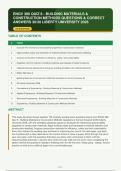
ENGV 380 QUIZ 8 - BUILDING MATERIALS &
CONSTRUCTION METHODS QUESTIONS & CORRECT
ANSWERS 30/30 LIBERTY UNIVERSITY 2026
150 QUESTIONS
TABLE OF CONTENTS
# TOPIC
1 Evaluate the mechanical and durability properties of construction materials
2 Apply building codes and standards to material selection and construction detailing
3 Analyze construction methods for efficiency, safety, and sustainability
4 Diagnose common failures in building materials and propose remedial measures
5 Integrate lifecycle assessment and green building principles into material decisions
6 ENGV 380 Quiz 8
7 Building Materials & Construction Methods Questions & Correct Answers 30
8 30 Liberty University 2026
9 Foundations of Engineering - Building Materials & Construction Methods
10 Applied Engineering - Building Materials & Construction Methods
11 Advanced Engineering - Building Materials & Construction Methods
12 Engineering - Building Materials & Construction Methods Review
ABSTRACT
This study document brings together 150 carefully worded exam questions drawn from ENGV 380
Quiz 8 - Building Materials & Construction Methods Questions & Correct Answers 30/30 Liberty
University 2026, with the strongest emphasis placed on Evaluate the mechanical and durability
properties of construction materials, Apply building codes and standards to material selection and
construction detailing, Analyze construction methods for efficiency, safety and and sustainability.
Every item follows the wording style and level of reasoning you meet in the real paper, and each
one is paired with a clear rationale so the correct choice is never a guess. Work through the set at
your own pace, mark the questions that slow you down, then come back to them until the
reasoning feels automatic. Learners who revise this way walk into the exam room recognising the
pattern behind the questions instead of meeting them for the first time. Keep going - steady, honest
practice is what turns a difficult paper into a comfortable pass.
Page 1
,Q1 EVALUATE THE MECHANICAL AND DURABILITY PROPERTIES OF CONSTRUCTION
MATERIALS
A concrete mix design specifies a water-cementitious materials ratio (w/cm) of
0.40. If the total cementitious content is 400 kg/m³, what is the approximate free
water content?
A. 140 kg/m³
B. 160 kg/m³ CORRECT
C. 180 kg/m³
D. 200 kg/m³
RATIONALE: The w/cm ratio is the ratio of free water to cementitious materials by mass. Thus,
water = 0.40 × 400 = 160 kg/m³. Options A, C, and D result from incorrect multiplication or
misunderstanding of the ratio.
Q2 EVALUATE THE MECHANICAL AND DURABILITY PROPERTIES OF CONSTRUCTION
MATERIALS
Which of the following best explains why Type V Portland cement is specified for
concrete exposed to high sulfate soils?
A. It has a high tricalcium aluminate (C3A) content to resist sulfate attack.
B. It has a low C3A content, reducing the formation of expansive ettringite. CORRECT
C. It contains air-entraining admixtures that block sulfate penetration.
D. It develops higher early strength to counteract sulfate-induced cracking.
RATIONALE: Type V cement is sulfate-resistant due to a low C3A content (typically <5%), which
minimizes the formation of expansive compounds like ettringite. High C3A (Option A) would
worsen sulfate attack. Air entrainment (Option C) addresses freeze-thaw, not sulfate resistance.
Early strength (Option D) is unrelated to sulfate resistance.
Page 2
,Q3 EVALUATE THE MECHANICAL AND DURABILITY PROPERTIES OF CONSTRUCTION
MATERIALS
In structural steel design, which of the following is the primary reason for
specifying ASTM A992 steel over ASTM A36 for wide-flange beams?
A. A992 has a higher yield strength, allowing for lighter sections. CORRECT
B. A992 has superior weldability due to lower carbon equivalent.
C. A992 exhibits better corrosion resistance in marine environments.
D. A992 has a lower modulus of elasticity, improving ductility.
RATIONALE: ASTM A992 has a minimum yield strength of 50 ksi compared to 36 ksi for A36,
enabling more efficient designs with smaller sections. Weldability (Option B) is generally good for
both, but A992's main advantage is strength. Corrosion resistance (Option C) is not significantly
different. Modulus of elasticity (Option D) is essentially the same for all structural steels.
Q4 EVALUATE THE MECHANICAL AND DURABILITY PROPERTIES OF CONSTRUCTION
MATERIALS
A masonry wall is constructed with concrete masonry units (CMUs) and is
expected to resist wind loads. Which of the following reinforcement details is most
critical to control cracking due to differential movement?
A. Horizontal joint reinforcement at 16 inches on center.
B. Vertical reinforcement grouted in every other cell.
C. Joint reinforcement with deformable wire for movement accommodation. CORRECT
D. Increased mortar strength from Type S to Type M.
RATIONALE: Differential movement between masonry and other materials (e.g., concrete
frames) can cause cracking; joint reinforcement with deformable wire (e.g., ladder or truss type
with bends) accommodates movement. Standard horizontal joint reinforcement (Option A) may
not accommodate movement. Vertical reinforcement (Option B) primarily resists flexural stresses.
Mortar type (Option D) affects compressive strength but not movement accommodation.
Page 3
, Q5 EVALUATE THE MECHANICAL AND DURABILITY PROPERTIES OF CONSTRUCTION
MATERIALS
In timber construction, which of the following is the most effective method to
prevent decay in wood foundation sill plates?
A. Applying a water-repellent preservative to the wood surface.
B. Using naturally durable species such as redwood or cedar.
C. Installing a capillary break and using preservative-treated wood. CORRECT
D. Increasing the size of the sill plate to reduce stress.
RATIONALE: Decay prevention requires both moisture control (capillary break) and pressure
treatment with preservatives. Surface treatments (Option A) are less effective long-term.
Naturally durable species (Option B) may still decay if moisture is present. Increasing size
(Option D) does not address decay.
Q6 EVALUATE THE MECHANICAL AND DURABILITY PROPERTIES OF CONSTRUCTION
MATERIALS
A building envelope in a cold climate experiences interstitial condensation. Which
of the following design strategies is most effective to mitigate this issue?
A. Installing a vapor barrier on the cold side of the insulation.
B. Using an impermeable exterior cladding to block moisture.
C. Placing a vapor retarder on the warm side and ensuring exterior breathability. CORRECT
D. Increasing insulation thickness without addressing air leakage.
RATIONALE: In cold climates, the vapor retarder should be on the warm (interior) side to prevent
moisture from entering the assembly, while the exterior should allow drying. Option A would trap
moisture. Impermeable cladding (Option B) can trap moisture. More insulation (Option D) without
air sealing can worsen condensation.
Page 4
CONSTRUCTION METHODS QUESTIONS & CORRECT
ANSWERS 30/30 LIBERTY UNIVERSITY 2026
150 QUESTIONS
TABLE OF CONTENTS
# TOPIC
1 Evaluate the mechanical and durability properties of construction materials
2 Apply building codes and standards to material selection and construction detailing
3 Analyze construction methods for efficiency, safety, and sustainability
4 Diagnose common failures in building materials and propose remedial measures
5 Integrate lifecycle assessment and green building principles into material decisions
6 ENGV 380 Quiz 8
7 Building Materials & Construction Methods Questions & Correct Answers 30
8 30 Liberty University 2026
9 Foundations of Engineering - Building Materials & Construction Methods
10 Applied Engineering - Building Materials & Construction Methods
11 Advanced Engineering - Building Materials & Construction Methods
12 Engineering - Building Materials & Construction Methods Review
ABSTRACT
This study document brings together 150 carefully worded exam questions drawn from ENGV 380
Quiz 8 - Building Materials & Construction Methods Questions & Correct Answers 30/30 Liberty
University 2026, with the strongest emphasis placed on Evaluate the mechanical and durability
properties of construction materials, Apply building codes and standards to material selection and
construction detailing, Analyze construction methods for efficiency, safety and and sustainability.
Every item follows the wording style and level of reasoning you meet in the real paper, and each
one is paired with a clear rationale so the correct choice is never a guess. Work through the set at
your own pace, mark the questions that slow you down, then come back to them until the
reasoning feels automatic. Learners who revise this way walk into the exam room recognising the
pattern behind the questions instead of meeting them for the first time. Keep going - steady, honest
practice is what turns a difficult paper into a comfortable pass.
Page 1
,Q1 EVALUATE THE MECHANICAL AND DURABILITY PROPERTIES OF CONSTRUCTION
MATERIALS
A concrete mix design specifies a water-cementitious materials ratio (w/cm) of
0.40. If the total cementitious content is 400 kg/m³, what is the approximate free
water content?
A. 140 kg/m³
B. 160 kg/m³ CORRECT
C. 180 kg/m³
D. 200 kg/m³
RATIONALE: The w/cm ratio is the ratio of free water to cementitious materials by mass. Thus,
water = 0.40 × 400 = 160 kg/m³. Options A, C, and D result from incorrect multiplication or
misunderstanding of the ratio.
Q2 EVALUATE THE MECHANICAL AND DURABILITY PROPERTIES OF CONSTRUCTION
MATERIALS
Which of the following best explains why Type V Portland cement is specified for
concrete exposed to high sulfate soils?
A. It has a high tricalcium aluminate (C3A) content to resist sulfate attack.
B. It has a low C3A content, reducing the formation of expansive ettringite. CORRECT
C. It contains air-entraining admixtures that block sulfate penetration.
D. It develops higher early strength to counteract sulfate-induced cracking.
RATIONALE: Type V cement is sulfate-resistant due to a low C3A content (typically <5%), which
minimizes the formation of expansive compounds like ettringite. High C3A (Option A) would
worsen sulfate attack. Air entrainment (Option C) addresses freeze-thaw, not sulfate resistance.
Early strength (Option D) is unrelated to sulfate resistance.
Page 2
,Q3 EVALUATE THE MECHANICAL AND DURABILITY PROPERTIES OF CONSTRUCTION
MATERIALS
In structural steel design, which of the following is the primary reason for
specifying ASTM A992 steel over ASTM A36 for wide-flange beams?
A. A992 has a higher yield strength, allowing for lighter sections. CORRECT
B. A992 has superior weldability due to lower carbon equivalent.
C. A992 exhibits better corrosion resistance in marine environments.
D. A992 has a lower modulus of elasticity, improving ductility.
RATIONALE: ASTM A992 has a minimum yield strength of 50 ksi compared to 36 ksi for A36,
enabling more efficient designs with smaller sections. Weldability (Option B) is generally good for
both, but A992's main advantage is strength. Corrosion resistance (Option C) is not significantly
different. Modulus of elasticity (Option D) is essentially the same for all structural steels.
Q4 EVALUATE THE MECHANICAL AND DURABILITY PROPERTIES OF CONSTRUCTION
MATERIALS
A masonry wall is constructed with concrete masonry units (CMUs) and is
expected to resist wind loads. Which of the following reinforcement details is most
critical to control cracking due to differential movement?
A. Horizontal joint reinforcement at 16 inches on center.
B. Vertical reinforcement grouted in every other cell.
C. Joint reinforcement with deformable wire for movement accommodation. CORRECT
D. Increased mortar strength from Type S to Type M.
RATIONALE: Differential movement between masonry and other materials (e.g., concrete
frames) can cause cracking; joint reinforcement with deformable wire (e.g., ladder or truss type
with bends) accommodates movement. Standard horizontal joint reinforcement (Option A) may
not accommodate movement. Vertical reinforcement (Option B) primarily resists flexural stresses.
Mortar type (Option D) affects compressive strength but not movement accommodation.
Page 3
, Q5 EVALUATE THE MECHANICAL AND DURABILITY PROPERTIES OF CONSTRUCTION
MATERIALS
In timber construction, which of the following is the most effective method to
prevent decay in wood foundation sill plates?
A. Applying a water-repellent preservative to the wood surface.
B. Using naturally durable species such as redwood or cedar.
C. Installing a capillary break and using preservative-treated wood. CORRECT
D. Increasing the size of the sill plate to reduce stress.
RATIONALE: Decay prevention requires both moisture control (capillary break) and pressure
treatment with preservatives. Surface treatments (Option A) are less effective long-term.
Naturally durable species (Option B) may still decay if moisture is present. Increasing size
(Option D) does not address decay.
Q6 EVALUATE THE MECHANICAL AND DURABILITY PROPERTIES OF CONSTRUCTION
MATERIALS
A building envelope in a cold climate experiences interstitial condensation. Which
of the following design strategies is most effective to mitigate this issue?
A. Installing a vapor barrier on the cold side of the insulation.
B. Using an impermeable exterior cladding to block moisture.
C. Placing a vapor retarder on the warm side and ensuring exterior breathability. CORRECT
D. Increasing insulation thickness without addressing air leakage.
RATIONALE: In cold climates, the vapor retarder should be on the warm (interior) side to prevent
moisture from entering the assembly, while the exterior should allow drying. Option A would trap
moisture. Impermeable cladding (Option B) can trap moisture. More insulation (Option D) without
air sealing can worsen condensation.
Page 4


