
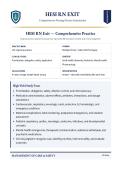
HESI RN EXIT
ECITCARP 6202
Comprehensive Nursing Practice Examination
HESI RN Exit — Comprehensive Practice
Original practice questions focused on high-yield RN exit-exam content and clinical judgment.
PRACTICE BANK FORMAT
160 original questions Multiple Choice + Select-All-That-Apply
CLINICAL FOCUS CONTENT
Prioritization, delegation, safety, application Adult Health, Maternity, Pediatrics, Mental Health,
Pharmacology
CALCULATIONS REVIEW METHOD
IV rates, dosage, weight-based dosing Answer + rationale immediately after each item
High-Yield Study Focus
Prioritization, delegation, safety, infection control, and client advocacy
Medication administration, adverse effects, antidotes, interactions, and dosage
calculations
Cardiovascular, respiratory, neurologic, renal, endocrine, GI, hematologic, and
emergency conditions
Maternal complications, fetal monitoring, postpartum emergencies, and newborn
assessment
Pediatric respiratory, cardiac, neurologic, endocrine, infectious, and developmental
concepts
Mental-health emergencies, therapeutic communication, substance withdrawal, and
psychiatric medications
Clinical judgment: recognize cues, identify priorities, intervene safely, and evaluate
outcomes
MANAGEMENT OF CARE & SAFETY 10 items
,QUESTION 1 · PRACTICE ITEM
Which client should the RN assess first?
A. A client with chronic arthritis and pain rated 5/10
B. A client with COPD whose oxygen saturation is 92% on prescribed oxygen
C. A client after thyroidectomy who reports tingling around the mouth
D. A client with diabetes whose glucose is 184 mg/dL
Correct Answer: C
Rationale: Perioral tingling after thyroid surgery may indicate hypocalcemia and possible
airway-threatening complications.
Clinical focus: Prioritize airway, breathing, circulation, safety, and the most immediate threat before
lower-priority needs.
QUESTION 2 · PRACTICE ITEM
Which task is appropriate for the UAP?
A. Initial assessment of a new admission
B. Teaching insulin injection
C. Routine vital signs for a stable client
D. Evaluating response to IV analgesia
Correct Answer: C
Rationale: Routine measurements for a stable client are predictable; assessment,
teaching, and evaluation require nursing judgment.
Clinical focus: Prioritize airway, breathing, circulation, safety, and the most immediate threat before
lower-priority needs.
,QUESTION 3 · PRACTICE ITEM
A competent client refuses a blood transfusion for religious reasons. What should the nurse
do?
A. Ask the family to persuade the client
B. Respect the informed refusal and notify the provider
C. Administer the blood because it is prescribed
D. Delay the decision until discharge
Correct Answer: B
Rationale: A competent adult has the right to refuse treatment.
Clinical focus: Prioritize airway, breathing, circulation, safety, and the most immediate threat before
lower-priority needs.
QUESTION 4 · PRACTICE ITEM
Which documentation is most objective?
A. Client seems better
B. Client is doing well
C. Client ambulated 50 feet with a walker and denied dizziness
D. Client had a good response
Correct Answer: C
Rationale: Objective documentation uses measurable observations rather than vague
judgments.
Clinical focus: Prioritize airway, breathing, circulation, safety, and the most immediate threat before
lower-priority needs.
, QUESTION 5 · PRACTICE ITEM
A medication error is discovered. What is the nurse's first priority?
A. Complete an incident report
B. Assess the client
C. Notify the manager
D. Document the error
Correct Answer: B
Rationale: Client assessment and safety take priority after an error.
Clinical focus: Prioritize airway, breathing, circulation, safety, and the most immediate threat before
lower-priority needs.
QUESTION 6 · PRACTICE ITEM
Which client is generally appropriate for an experienced LPN/LVN assignment, subject to state
scope?
A. New chest pain
B. Stable client needing a routine dressing change
C. New-onset confusion
D. Client requiring initial discharge teaching
Correct Answer: B
Rationale: Stable clients with predictable outcomes are generally appropriate for LPN/LVN
assignment.
Clinical focus: Prioritize airway, breathing, circulation, safety, and the most immediate threat before
lower-priority needs.
ECITCARP 6202
Comprehensive Nursing Practice Examination
HESI RN Exit — Comprehensive Practice
Original practice questions focused on high-yield RN exit-exam content and clinical judgment.
PRACTICE BANK FORMAT
160 original questions Multiple Choice + Select-All-That-Apply
CLINICAL FOCUS CONTENT
Prioritization, delegation, safety, application Adult Health, Maternity, Pediatrics, Mental Health,
Pharmacology
CALCULATIONS REVIEW METHOD
IV rates, dosage, weight-based dosing Answer + rationale immediately after each item
High-Yield Study Focus
Prioritization, delegation, safety, infection control, and client advocacy
Medication administration, adverse effects, antidotes, interactions, and dosage
calculations
Cardiovascular, respiratory, neurologic, renal, endocrine, GI, hematologic, and
emergency conditions
Maternal complications, fetal monitoring, postpartum emergencies, and newborn
assessment
Pediatric respiratory, cardiac, neurologic, endocrine, infectious, and developmental
concepts
Mental-health emergencies, therapeutic communication, substance withdrawal, and
psychiatric medications
Clinical judgment: recognize cues, identify priorities, intervene safely, and evaluate
outcomes
MANAGEMENT OF CARE & SAFETY 10 items
,QUESTION 1 · PRACTICE ITEM
Which client should the RN assess first?
A. A client with chronic arthritis and pain rated 5/10
B. A client with COPD whose oxygen saturation is 92% on prescribed oxygen
C. A client after thyroidectomy who reports tingling around the mouth
D. A client with diabetes whose glucose is 184 mg/dL
Correct Answer: C
Rationale: Perioral tingling after thyroid surgery may indicate hypocalcemia and possible
airway-threatening complications.
Clinical focus: Prioritize airway, breathing, circulation, safety, and the most immediate threat before
lower-priority needs.
QUESTION 2 · PRACTICE ITEM
Which task is appropriate for the UAP?
A. Initial assessment of a new admission
B. Teaching insulin injection
C. Routine vital signs for a stable client
D. Evaluating response to IV analgesia
Correct Answer: C
Rationale: Routine measurements for a stable client are predictable; assessment,
teaching, and evaluation require nursing judgment.
Clinical focus: Prioritize airway, breathing, circulation, safety, and the most immediate threat before
lower-priority needs.
,QUESTION 3 · PRACTICE ITEM
A competent client refuses a blood transfusion for religious reasons. What should the nurse
do?
A. Ask the family to persuade the client
B. Respect the informed refusal and notify the provider
C. Administer the blood because it is prescribed
D. Delay the decision until discharge
Correct Answer: B
Rationale: A competent adult has the right to refuse treatment.
Clinical focus: Prioritize airway, breathing, circulation, safety, and the most immediate threat before
lower-priority needs.
QUESTION 4 · PRACTICE ITEM
Which documentation is most objective?
A. Client seems better
B. Client is doing well
C. Client ambulated 50 feet with a walker and denied dizziness
D. Client had a good response
Correct Answer: C
Rationale: Objective documentation uses measurable observations rather than vague
judgments.
Clinical focus: Prioritize airway, breathing, circulation, safety, and the most immediate threat before
lower-priority needs.
, QUESTION 5 · PRACTICE ITEM
A medication error is discovered. What is the nurse's first priority?
A. Complete an incident report
B. Assess the client
C. Notify the manager
D. Document the error
Correct Answer: B
Rationale: Client assessment and safety take priority after an error.
Clinical focus: Prioritize airway, breathing, circulation, safety, and the most immediate threat before
lower-priority needs.
QUESTION 6 · PRACTICE ITEM
Which client is generally appropriate for an experienced LPN/LVN assignment, subject to state
scope?
A. New chest pain
B. Stable client needing a routine dressing change
C. New-onset confusion
D. Client requiring initial discharge teaching
Correct Answer: B
Rationale: Stable clients with predictable outcomes are generally appropriate for LPN/LVN
assignment.
Clinical focus: Prioritize airway, breathing, circulation, safety, and the most immediate threat before
lower-priority needs.


