
NJ Tax Assessors Exam - Terms and Conceptshttps://www.stuvia.com/user/gabrielucky
https://www.stuvia.com/user/gabrielucky https://www.stuvia.com/user/gabrielucky
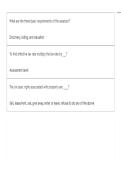
What are the three basic requirements of the assessor?
Discovery, listing, and valuation
To find effective tax rate multiply the tax rate by ____?
Assessment level
The six basic rights associated with property are ______?
Sell, lease/rent, use, give away, enter or leave, refusal to do any of the above
https://www.stuvia.com/user/gabrielucky https://www.stuvia.com/user/gabrielucky https://www.stuvia.com/user/gabrielucky
,NJ Tax Assessors Exam - Terms and Conceptshttps://www.stuvia.com/user/gabrielucky
https://www.stuvia.com/user/gabrielucky https://www.stuvia.com/user/gabrielucky
What are the three major classifications of property?
Real property, personal property, intangible personal property
List the appraisal principles which form the foundation for highest and best use analysis.
Anticipation, balance, change, competition, conformity, consistent use, contribution,
increasing and decreasing returns, substitution, supply and demand, surplus productivity
What are the four forces that influence value?
Physical, economic, governmental, social
https://www.stuvia.com/user/gabrielucky https://www.stuvia.com/user/gabrielucky https://www.stuvia.com/user/gabrielucky
,NJ Tax Assessors Exam - Terms and Conceptshttps://www.stuvia.com/user/gabrielucky
https://www.stuvia.com/user/gabrielucky https://www.stuvia.com/user/gabrielucky
Highest and best use is always the that use that would produce the ______ ____ of a property,
regardless of its actual current use.
Highest value
The four tests for highest and best use are _____
Legally allowable, physically allowable, financially feasible, maximally productive
List the 7 major steps of the appraisal process.
1. Definition of the problem,
2. Determination of the scope of the appraisal
3. Preliminary survey and analysis
4. Data collection and analysis
5. Highest and best use analysis
6. Application of the three approaches to value
7. Correlation/reconciliations of indicated values to derive final estimate of defined value
https://www.stuvia.com/user/gabrielucky https://www.stuvia.com/user/gabrielucky https://www.stuvia.com/user/gabrielucky
, NJ Tax Assessors Exam - Terms and Conceptshttps://www.stuvia.com/user/gabrielucky
https://www.stuvia.com/user/gabrielucky https://www.stuvia.com/user/gabrielucky
What are the three approaches to value used by appraisers to estimate value?
Cost, sales comparison, and income
The land identification system based on semi-permanent physical features or bearings on a
compass is known as ____ and ____.
Metes and bounds
Residential subdivisions are commonly described by the ____ and ____ system of land
identification.
Block and lot
https://www.stuvia.com/user/gabrielucky https://www.stuvia.com/user/gabrielucky https://www.stuvia.com/user/gabrielucky
https://www.stuvia.com/user/gabrielucky https://www.stuvia.com/user/gabrielucky
What are the three basic requirements of the assessor?
Discovery, listing, and valuation
To find effective tax rate multiply the tax rate by ____?
Assessment level
The six basic rights associated with property are ______?
Sell, lease/rent, use, give away, enter or leave, refusal to do any of the above
https://www.stuvia.com/user/gabrielucky https://www.stuvia.com/user/gabrielucky https://www.stuvia.com/user/gabrielucky
,NJ Tax Assessors Exam - Terms and Conceptshttps://www.stuvia.com/user/gabrielucky
https://www.stuvia.com/user/gabrielucky https://www.stuvia.com/user/gabrielucky
What are the three major classifications of property?
Real property, personal property, intangible personal property
List the appraisal principles which form the foundation for highest and best use analysis.
Anticipation, balance, change, competition, conformity, consistent use, contribution,
increasing and decreasing returns, substitution, supply and demand, surplus productivity
What are the four forces that influence value?
Physical, economic, governmental, social
https://www.stuvia.com/user/gabrielucky https://www.stuvia.com/user/gabrielucky https://www.stuvia.com/user/gabrielucky
,NJ Tax Assessors Exam - Terms and Conceptshttps://www.stuvia.com/user/gabrielucky
https://www.stuvia.com/user/gabrielucky https://www.stuvia.com/user/gabrielucky
Highest and best use is always the that use that would produce the ______ ____ of a property,
regardless of its actual current use.
Highest value
The four tests for highest and best use are _____
Legally allowable, physically allowable, financially feasible, maximally productive
List the 7 major steps of the appraisal process.
1. Definition of the problem,
2. Determination of the scope of the appraisal
3. Preliminary survey and analysis
4. Data collection and analysis
5. Highest and best use analysis
6. Application of the three approaches to value
7. Correlation/reconciliations of indicated values to derive final estimate of defined value
https://www.stuvia.com/user/gabrielucky https://www.stuvia.com/user/gabrielucky https://www.stuvia.com/user/gabrielucky
, NJ Tax Assessors Exam - Terms and Conceptshttps://www.stuvia.com/user/gabrielucky
https://www.stuvia.com/user/gabrielucky https://www.stuvia.com/user/gabrielucky
What are the three approaches to value used by appraisers to estimate value?
Cost, sales comparison, and income
The land identification system based on semi-permanent physical features or bearings on a
compass is known as ____ and ____.
Metes and bounds
Residential subdivisions are commonly described by the ____ and ____ system of land
identification.
Block and lot
https://www.stuvia.com/user/gabrielucky https://www.stuvia.com/user/gabrielucky https://www.stuvia.com/user/gabrielucky


