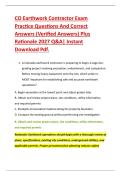
CO Earthwork Contractor Exam
Practice Questions And Correct
Answers (Verified Answers) Plus
Rationale 2027 Q&A| Instant
Download Pdf.
1. A Colorado earthwork contractor is preparing to begin a large site-
grading project involving excavation, embankment, and compaction.
Before moving heavy equipment onto the site, which action is
MOST important for establishing safe and accurate earthwork
operations?
A. Begin excavation at the lowest point and adjust grades later
B. Obtain and review project plans, site conditions, utility information,
and required permits
C. Stockpile all excavated material along the property boundary
D. Compact the existing ground without performing site investigation
B. Obtain and review project plans, site conditions, utility information,
and required permits
Rationale: Earthwork operations should begin with a thorough review of
plans, specifications, existing site conditions, underground utilities, and
applicable permits. Proper preconstruction planning reduces safety
,hazards, prevents utility damage, and helps ensure that excavation and
grading conform to the required design.
2. During excavation for a building foundation, the contractor
encounters an underground utility that was not shown on the
available plans. What should the contractor do FIRST?
A. Continue excavation carefully around the utility
B. Remove the utility if it interferes with the excavation
C. Stop work in the affected area and notify the appropriate utility owner
and project representatives
D. Cover the utility with soil and continue excavation elsewhere
C. Stop work in the affected area and notify the appropriate utility
owner and project representatives
Rationale: Unknown underground utilities present serious electrocution,
explosion, flooding, and service-interruption hazards. Work should stop
in the affected area until the utility is properly identified and instructions
are received from the responsible parties.
3. Which soil characteristic generally has the GREATEST influence on
whether a soil can be compacted effectively to support structural
loads?
A. Soil color
B. Particle size distribution and moisture content
C. Depth of the excavation only
D. Surface vegetation only
,B. Particle size distribution and moisture content
Rationale: Soil gradation and moisture content strongly influence
compaction behavior. Different soils require different compaction
equipment and moisture conditions to achieve the required density and
bearing capacity.
4. A contractor is constructing an engineered fill. Why is fill commonly
placed in relatively thin lifts rather than in one large layer?
A. Thin lifts eliminate the need for compaction testing
B. Thin lifts allow compaction equipment to densify the material more
uniformly
C. Thin lifts always reduce the amount of imported soil required
D. Thin lifts prevent settlement without compaction
B. Thin lifts allow compaction equipment to densify the material more
uniformly
Rationale: Compaction energy is effective only to a limited depth.
Placing fill in controlled lifts allows each layer to be compacted
uniformly before the next layer is placed, improving density and
reducing future settlement.
5. What is the PRIMARY purpose of a geotechnical investigation for a
major earthwork project?
A. To determine the architectural appearance of the completed project
B. To identify subsurface conditions and provide engineering
recommendations for earthwork and foundations
, C. To establish employee work schedules
D. To determine the final landscaping design
B. To identify subsurface conditions and provide engineering
recommendations for earthwork and foundations
Rationale: A geotechnical investigation evaluates soil, rock,
groundwater, and other subsurface conditions. The resulting
recommendations may address excavation, fill placement, compaction,
slopes, foundations, and drainage.
6. Which type of compaction equipment is generally well suited for
cohesive soils such as clay?
A. Smooth-wheel roller only
B. Sheepsfoot or padfoot roller
C. Pneumatic hand pump
D. Asphalt milling machine
B. Sheepsfoot or padfoot roller
Rationale: Padfoot and sheepsfoot rollers apply concentrated kneading
action that is particularly effective in compacting cohesive soils. Smooth-
drum vibratory rollers are generally more effective for granular
materials.
7. A contractor is excavating a trench and observes cracks developing
near the top edge of the excavation. What is the MOST appropriate
response?
Practice Questions And Correct
Answers (Verified Answers) Plus
Rationale 2027 Q&A| Instant
Download Pdf.
1. A Colorado earthwork contractor is preparing to begin a large site-
grading project involving excavation, embankment, and compaction.
Before moving heavy equipment onto the site, which action is
MOST important for establishing safe and accurate earthwork
operations?
A. Begin excavation at the lowest point and adjust grades later
B. Obtain and review project plans, site conditions, utility information,
and required permits
C. Stockpile all excavated material along the property boundary
D. Compact the existing ground without performing site investigation
B. Obtain and review project plans, site conditions, utility information,
and required permits
Rationale: Earthwork operations should begin with a thorough review of
plans, specifications, existing site conditions, underground utilities, and
applicable permits. Proper preconstruction planning reduces safety
,hazards, prevents utility damage, and helps ensure that excavation and
grading conform to the required design.
2. During excavation for a building foundation, the contractor
encounters an underground utility that was not shown on the
available plans. What should the contractor do FIRST?
A. Continue excavation carefully around the utility
B. Remove the utility if it interferes with the excavation
C. Stop work in the affected area and notify the appropriate utility owner
and project representatives
D. Cover the utility with soil and continue excavation elsewhere
C. Stop work in the affected area and notify the appropriate utility
owner and project representatives
Rationale: Unknown underground utilities present serious electrocution,
explosion, flooding, and service-interruption hazards. Work should stop
in the affected area until the utility is properly identified and instructions
are received from the responsible parties.
3. Which soil characteristic generally has the GREATEST influence on
whether a soil can be compacted effectively to support structural
loads?
A. Soil color
B. Particle size distribution and moisture content
C. Depth of the excavation only
D. Surface vegetation only
,B. Particle size distribution and moisture content
Rationale: Soil gradation and moisture content strongly influence
compaction behavior. Different soils require different compaction
equipment and moisture conditions to achieve the required density and
bearing capacity.
4. A contractor is constructing an engineered fill. Why is fill commonly
placed in relatively thin lifts rather than in one large layer?
A. Thin lifts eliminate the need for compaction testing
B. Thin lifts allow compaction equipment to densify the material more
uniformly
C. Thin lifts always reduce the amount of imported soil required
D. Thin lifts prevent settlement without compaction
B. Thin lifts allow compaction equipment to densify the material more
uniformly
Rationale: Compaction energy is effective only to a limited depth.
Placing fill in controlled lifts allows each layer to be compacted
uniformly before the next layer is placed, improving density and
reducing future settlement.
5. What is the PRIMARY purpose of a geotechnical investigation for a
major earthwork project?
A. To determine the architectural appearance of the completed project
B. To identify subsurface conditions and provide engineering
recommendations for earthwork and foundations
, C. To establish employee work schedules
D. To determine the final landscaping design
B. To identify subsurface conditions and provide engineering
recommendations for earthwork and foundations
Rationale: A geotechnical investigation evaluates soil, rock,
groundwater, and other subsurface conditions. The resulting
recommendations may address excavation, fill placement, compaction,
slopes, foundations, and drainage.
6. Which type of compaction equipment is generally well suited for
cohesive soils such as clay?
A. Smooth-wheel roller only
B. Sheepsfoot or padfoot roller
C. Pneumatic hand pump
D. Asphalt milling machine
B. Sheepsfoot or padfoot roller
Rationale: Padfoot and sheepsfoot rollers apply concentrated kneading
action that is particularly effective in compacting cohesive soils. Smooth-
drum vibratory rollers are generally more effective for granular
materials.
7. A contractor is excavating a trench and observes cracks developing
near the top edge of the excavation. What is the MOST appropriate
response?