
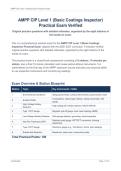
AMPP CIP Level 1 Practical Exam Practice Guide
AMPP CIP Level 1 (Basic Coatings Inspector)
Practical Exam Verified
Original practice questions with detailed rationales, organized by the eight stations of
the hands-on exam.
This is a comprehensive practice exam for the AMPP CIP Level 1 (Basic Coatings
Inspector) Practical Exam, aligned with the 2026–2027 curriculum. It includes Verified
original practice questions with detailed rationales, organized by the eight stations of the
hands-on exam.
The practical exam is a closed-book assessment consisting of 8 stations, 10 minutes per
station, plus a final 10-minute calculation and review period without instruments. It is
administered on the final day of the AMPP classroom course and tests your physical ability
to use inspection instruments and correctly log readings.
Exam Overview & Station Blueprint
Station Topic Key Instruments / Skills
1 Environmental Conditions Sling psychrometer, surface thermometer, psychrometric chart
Comparators, replica tape (Testex), spring micrometer, 224
2 Surface Profile
gauge
High-Voltage Holiday
3 High-voltage DC holiday detector, NACE SP0188
Detection
4 Type 1 DFT Gauge Magnetic pull-off gauge, bare metal readings (BMR)
5 Low-Voltage Holiday Detection Wet-sponge detector, grounding, visual inspection
Notched comb gauge, WFT/DFT conversion, thinning
6 Wet Film Thickness (WFT)
adjustment
7 Type 2 DFT Gauge Electronic gauge (e.g., PosiTector), shims, spot readings
8 Soluble Salt Detection Bresle test, sleeve test, conductivity meter
Total Practical Points: 100
Confidential - Page 1 of 16
,AMPP CIP Level 1 Practical Exam Practice Guide
Station 1: Environmental Conditions
Q1. What is the primary purpose of taking environmental readings before coating
application?
A) To determine the coating color
B) To verify that ambient conditions are within the specification before work begins
C) To measure coating thickness
D) To test adhesion
Answer: B
Rationale: Environmental readings are taken to verify that ambient conditions (temperature, humidity, dew
point) are within the limits specified by the coating manufacturer before application begins.
Q2. Which instrument is used to measure wet-bulb and dry-bulb temperatures?
A) DFT gauge
B) Sling psychrometer
C) Holiday detector
D) Replica tape
Answer: B
Rationale: A sling psychrometer (also called a whirling hygrometer) measures wet-bulb and dry-bulb
temperatures, from which relative humidity and dew point are derived using a psychrometric chart.
Q3. How long should the sling psychrometer be whirled through the air?
A) 10 seconds
B) 30 seconds
C) Approximately 90 seconds or until the wet-bulb reading stabilizes
D) 5 minutes
Answer: C
Rationale: The inspector whirls the assembly through the air for approximately 90 seconds (or until the wet-
bulb reading stabilizes at its lowest point), then reads both thermometers immediately.
Q4. What is the wet-bulb depression?
A) The sum of dry-bulb and wet-bulb temperatures
B) Dry-bulb temperature minus wet-bulb temperature
C) Wet-bulb temperature minus dry-bulb temperature
Confidential - Page 2 of 16
, AMPP CIP Level 1 Practical Exam Practice Guide
D) The dew point
Answer: B
Rationale: Wet-bulb depression is the difference between the dry-bulb temperature and the wet-bulb
temperature (DBT - WBT). A large depression means low humidity; a depression of zero means the air is
saturated (100% RH).
Q5. If the dry-bulb temperature is 70°F and the wet-bulb temperature is 60°F, what is
the wet-bulb depression?
A) 130°F
B) 10°F
C) 70°F
D) 60°F
Answer: B
Rationale: Wet-bulb depression = DBT - WBT = 70°F - 60°F = 10°F.
Q6. What does a wet-bulb depression of zero indicate?
A) The air is completely dry
B) The air is saturated (100% relative humidity)
C) The dew point is below freezing
D) The surface temperature is too high
Answer: B
Rationale: A depression of zero means the air is saturated (100% RH). The wet-bulb temperature equals
the dry-bulb temperature, and the dew point equals the air temperature.
Q7. What is relative humidity?
A) The actual mass of water vapor per unit volume of air
B) The ratio of actual water vapor pressure to saturation vapor pressure at the same dry-bulb
temperature,expressed as a percentage
C) The temperature at which condensation occurs
D) The difference between wet-bulb and dry-bulb temperatures
Answer: B
Rationale: Relative humidity is the ratio of actual water vapor pressure to saturation vapor pressure at the
same dry-bulb temperature, expressed as a percentage. It governs condensation risk.
Confidential - Page 3 of 16
AMPP CIP Level 1 (Basic Coatings Inspector)
Practical Exam Verified
Original practice questions with detailed rationales, organized by the eight stations of
the hands-on exam.
This is a comprehensive practice exam for the AMPP CIP Level 1 (Basic Coatings
Inspector) Practical Exam, aligned with the 2026–2027 curriculum. It includes Verified
original practice questions with detailed rationales, organized by the eight stations of the
hands-on exam.
The practical exam is a closed-book assessment consisting of 8 stations, 10 minutes per
station, plus a final 10-minute calculation and review period without instruments. It is
administered on the final day of the AMPP classroom course and tests your physical ability
to use inspection instruments and correctly log readings.
Exam Overview & Station Blueprint
Station Topic Key Instruments / Skills
1 Environmental Conditions Sling psychrometer, surface thermometer, psychrometric chart
Comparators, replica tape (Testex), spring micrometer, 224
2 Surface Profile
gauge
High-Voltage Holiday
3 High-voltage DC holiday detector, NACE SP0188
Detection
4 Type 1 DFT Gauge Magnetic pull-off gauge, bare metal readings (BMR)
5 Low-Voltage Holiday Detection Wet-sponge detector, grounding, visual inspection
Notched comb gauge, WFT/DFT conversion, thinning
6 Wet Film Thickness (WFT)
adjustment
7 Type 2 DFT Gauge Electronic gauge (e.g., PosiTector), shims, spot readings
8 Soluble Salt Detection Bresle test, sleeve test, conductivity meter
Total Practical Points: 100
Confidential - Page 1 of 16
,AMPP CIP Level 1 Practical Exam Practice Guide
Station 1: Environmental Conditions
Q1. What is the primary purpose of taking environmental readings before coating
application?
A) To determine the coating color
B) To verify that ambient conditions are within the specification before work begins
C) To measure coating thickness
D) To test adhesion
Answer: B
Rationale: Environmental readings are taken to verify that ambient conditions (temperature, humidity, dew
point) are within the limits specified by the coating manufacturer before application begins.
Q2. Which instrument is used to measure wet-bulb and dry-bulb temperatures?
A) DFT gauge
B) Sling psychrometer
C) Holiday detector
D) Replica tape
Answer: B
Rationale: A sling psychrometer (also called a whirling hygrometer) measures wet-bulb and dry-bulb
temperatures, from which relative humidity and dew point are derived using a psychrometric chart.
Q3. How long should the sling psychrometer be whirled through the air?
A) 10 seconds
B) 30 seconds
C) Approximately 90 seconds or until the wet-bulb reading stabilizes
D) 5 minutes
Answer: C
Rationale: The inspector whirls the assembly through the air for approximately 90 seconds (or until the wet-
bulb reading stabilizes at its lowest point), then reads both thermometers immediately.
Q4. What is the wet-bulb depression?
A) The sum of dry-bulb and wet-bulb temperatures
B) Dry-bulb temperature minus wet-bulb temperature
C) Wet-bulb temperature minus dry-bulb temperature
Confidential - Page 2 of 16
, AMPP CIP Level 1 Practical Exam Practice Guide
D) The dew point
Answer: B
Rationale: Wet-bulb depression is the difference between the dry-bulb temperature and the wet-bulb
temperature (DBT - WBT). A large depression means low humidity; a depression of zero means the air is
saturated (100% RH).
Q5. If the dry-bulb temperature is 70°F and the wet-bulb temperature is 60°F, what is
the wet-bulb depression?
A) 130°F
B) 10°F
C) 70°F
D) 60°F
Answer: B
Rationale: Wet-bulb depression = DBT - WBT = 70°F - 60°F = 10°F.
Q6. What does a wet-bulb depression of zero indicate?
A) The air is completely dry
B) The air is saturated (100% relative humidity)
C) The dew point is below freezing
D) The surface temperature is too high
Answer: B
Rationale: A depression of zero means the air is saturated (100% RH). The wet-bulb temperature equals
the dry-bulb temperature, and the dew point equals the air temperature.
Q7. What is relative humidity?
A) The actual mass of water vapor per unit volume of air
B) The ratio of actual water vapor pressure to saturation vapor pressure at the same dry-bulb
temperature,expressed as a percentage
C) The temperature at which condensation occurs
D) The difference between wet-bulb and dry-bulb temperatures
Answer: B
Rationale: Relative humidity is the ratio of actual water vapor pressure to saturation vapor pressure at the
same dry-bulb temperature, expressed as a percentage. It governs condensation risk.
Confidential - Page 3 of 16


