
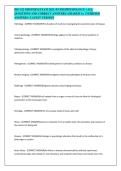
BIO 322 MIDTERM EXAM 2025 (PATHOPHYSIOLOGY) | ALL
QUESTIONS AND CORRECT ANSWERS | GRADED A+ | VERIFIED
ANSWERS | LATEST VERSION
Pathology - (CORRECT ANSWER)The discipline of medicine investigating the essential nature of disease.
Clinical pathology - (CORRECT ANSWER)Pathology applied to the solution of clinical problems in
medicine.
Pathophysiology - (CORRECT ANSWER)The investigation of the abnormal physiology of injury,
dysfunction states, and disease.
Pathogenesis - (CORRECT ANSWER)The development of unhealthy conditions or disease.
Medical imaging - (CORRECT ANSWER)Investigates anatomical pathologies at the gross level.
Radiology - (CORRECT ANSWER)Diagnoses disease using imaging techniques.
Biopsy - (CORRECT ANSWER)A cell sample from an organ or mass of tissue to allow for histological
examination at the microscopic level.
Histology - (CORRECT ANSWER)The microscopic study of tissues and cells.
Illness - (CORRECT ANSWER)Sickness or deviation from a healthy state; the perception and response of
the person not being well.
Disease - (CORRECT ANSWER)A biologic or psychologic alteration that results in the malfunction of a
body organ or system.
Acute illness - (CORRECT ANSWER)An illness or disease characterized by relatively rapid onset,
constitutional signs and symptoms, short duration, and symptoms that lessen and resolve over time.
, 2
Chronic disease - (CORRECT ANSWER)Characterized by the need for long-term medical management or
rehabilitation, residual physical or cognitive disability, or permanent impairment or disability.
Germ Theory - (CORRECT ANSWER)States that specific microorganisms (pathogens) are capable of
causing infectious disease.
Biomedical Model - (CORRECT ANSWER)Views disease as the result of dysfunctional or injured cells,
tissues, and organs.
Homeostasis - (CORRECT ANSWER)The body's automatic regulation of the internal environment.
Multicausal (Multifactoral) Model - (CORRECT ANSWER)States that multiple factors at multiple levels
contribute to disease.
Stress/Stressors - (CORRECT ANSWER)Challenging demands on the body that initiate a neuroendocrine
response affecting multiple organ systems.
General Adaptation Syndrome - (CORRECT ANSWER)A neuroendocrine response to stress that proceeds
through three stages in response to prolonged threats or chronic stress.
Cellular hypoxia - (CORRECT ANSWER)Lack of oxygen and default use of anaerobic metabolism, usually
causing cellular injury.
Etiology - (CORRECT ANSWER)The original cause of cellular alteration, injury, or disease.
Ischemia - (CORRECT ANSWER)Blood flow below the minimum necessary to maintain cell homeostasis
and metabolic function.
QUESTIONS AND CORRECT ANSWERS | GRADED A+ | VERIFIED
ANSWERS | LATEST VERSION
Pathology - (CORRECT ANSWER)The discipline of medicine investigating the essential nature of disease.
Clinical pathology - (CORRECT ANSWER)Pathology applied to the solution of clinical problems in
medicine.
Pathophysiology - (CORRECT ANSWER)The investigation of the abnormal physiology of injury,
dysfunction states, and disease.
Pathogenesis - (CORRECT ANSWER)The development of unhealthy conditions or disease.
Medical imaging - (CORRECT ANSWER)Investigates anatomical pathologies at the gross level.
Radiology - (CORRECT ANSWER)Diagnoses disease using imaging techniques.
Biopsy - (CORRECT ANSWER)A cell sample from an organ or mass of tissue to allow for histological
examination at the microscopic level.
Histology - (CORRECT ANSWER)The microscopic study of tissues and cells.
Illness - (CORRECT ANSWER)Sickness or deviation from a healthy state; the perception and response of
the person not being well.
Disease - (CORRECT ANSWER)A biologic or psychologic alteration that results in the malfunction of a
body organ or system.
Acute illness - (CORRECT ANSWER)An illness or disease characterized by relatively rapid onset,
constitutional signs and symptoms, short duration, and symptoms that lessen and resolve over time.
, 2
Chronic disease - (CORRECT ANSWER)Characterized by the need for long-term medical management or
rehabilitation, residual physical or cognitive disability, or permanent impairment or disability.
Germ Theory - (CORRECT ANSWER)States that specific microorganisms (pathogens) are capable of
causing infectious disease.
Biomedical Model - (CORRECT ANSWER)Views disease as the result of dysfunctional or injured cells,
tissues, and organs.
Homeostasis - (CORRECT ANSWER)The body's automatic regulation of the internal environment.
Multicausal (Multifactoral) Model - (CORRECT ANSWER)States that multiple factors at multiple levels
contribute to disease.
Stress/Stressors - (CORRECT ANSWER)Challenging demands on the body that initiate a neuroendocrine
response affecting multiple organ systems.
General Adaptation Syndrome - (CORRECT ANSWER)A neuroendocrine response to stress that proceeds
through three stages in response to prolonged threats or chronic stress.
Cellular hypoxia - (CORRECT ANSWER)Lack of oxygen and default use of anaerobic metabolism, usually
causing cellular injury.
Etiology - (CORRECT ANSWER)The original cause of cellular alteration, injury, or disease.
Ischemia - (CORRECT ANSWER)Blood flow below the minimum necessary to maintain cell homeostasis
and metabolic function.


