
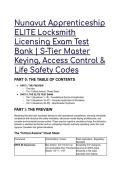
Nunavut Apprenticeship
ELITE Locksmith
Licensing Exam Test
Bank | S-Tier Master
Keying, Access Control &
Life Safety Codes
PART 0: THE TABLE OF CONTENTS
● PART I: THE PREVIEW
○ The Intro
○ The "Critical Axioms" Cheat Sheet
● PART II: THE ELITE TEST BANK
○ Tier 1 (Questions 1–18) - Foundational Syntax & Application
○ Tier 2 (Questions 19–37) - Complex Application & Simulation
○ Tier 3 (Questions 38–55) - Grandmaster Synthesis
PART I: THE PREVIEW
Mastering this test bank translates directly to elite operational competence, ensuring immediate
compliance with absolute life safety mandates, advanced master keying architectures, and
complex environmental access control. These precise cognitive simulations forge the distinction
between a standard technician and an undisputed industry authority operating under the most
rigorous Canadian and global standards.
The "Critical Axioms" Cheat Sheet
Framework Critical Metric / Axiom Field Application / Regulatory
Standard
NFPA 80 Clearances Max bottom: 3/4" (19 mm) to Exceeding 3/4" clearance
noncombustible floor. Perimeter requires an NFPA-listed
(Steel): 1/8" +/- 1/16" threshold or fire-rated
automatic door bottom.
,Framework Critical Metric / Axiom Field Application / Regulatory
Standard
SFIC A2 Mathematics Total pin stack = 23. Control Bottom pin always equals the
shear = Control Cut + 10. lowest operating cut. MACS
limits do not apply to A2 SFIC.
NBC Egress (3.4.6.16) Max 90 N force for 3s triggers a Requires permanent
max 15s release. instructional signage. Hardware
must instantly fail-safe upon
FACP activation.
OSDP Security v2.2 AES-128 encryption via Secure "Installation mode" (default
Channel Protocol. SCBK-D key) must be disabled
post-pairing to thwart
interception.
Arctic Diagnostics Petroleum fluids fail below Sub-zero hydraulic failure
-20°C. Require High-VI causes catastrophic slamming.
Synthetics. Always use raised threshold
seals to prevent freezing.
ULC-S319 Class 1 Minimum 30-minute standby Power-limited outputs classified
battery duration. as Class 2 (CSA C22.1). Total
Ah = (Total Amps x Hours).
PART II: THE ELITE TEST BANK
Tier 1 - Foundational Syntax & Application
Q1: An apprentice in Nunavut is preparing for an inter-provincial examination. Based on the
principles of the Skilled Trades and Apprenticeship program, which entity is PRIMARILY
responsible for developing the national standard and examinations for these trades? A) The
Diver Certification Board of Canada (DCBC) B) The Nunavut Apprenticeship Unit independently
C) The Red Seal Program in collaboration with the skilled trades industry D) The Underwriters
Laboratories of Canada (ULC)
● Answer: C (The Red Seal Program in collaboration with the skilled trades industry)
● Distractor Analysis:
○ A is incorrect: The DCBC strictly regulates commercial divers, which is a separate
classification within the technical trades group.
○ B is incorrect: Local territorial units manage registration and technical training
blocks (e.g., 8 weeks of theory at Nunavut Arctic College), but do not forge the
national examinations.
○ D is incorrect: ULC governs product safety standards (like CAN/ULC-S319), not
human occupational trade certifications.
The Mentor's Analysis: When pursuing national occupational mobility, the immediate priority is
understanding the origin of your credential. By utilizing the Red Seal Program framework, you
bypass the common trap of confusing local administrative oversight with national standard
development. Professional Intuition: National occupational standards are forged by industry
consensus under the Red Seal Program, ensuring inter-provincial mobility.
Q2: A hollow metal fire door is being audited in a commercial corridor. Based on the principles
of NFPA 80, what is the MAXIMUM allowable clearance under the bottom of the door to the
finished noncombustible floor? A) 1/8 inch (3.2 mm) B) 3/8 inch (9.5 mm) C) 3/4 inch (19 mm)
, D) 1 inch (25.4 mm)
● Answer: C (3/4 inch (19 mm))
● Distractor Analysis:
○ A is incorrect: This dictates the lateral perimeter clearance (head and jambs) for
swinging doors, not the vertical undercut.
○ B is incorrect: This 3/8-inch standard applies strictly to specialized assemblies
where the door bottom is more than 38 inches above the floor, such as counter
shutters.
○ D is incorrect: A 1-inch clearance fundamentally compromises the fire assembly,
allowing lethal smoke and superheated gas propagation.
The Mentor's Analysis: When inspecting fire-rated assemblies, the immediate priority is verifying
absolute compartmentalization integrity. By utilizing NFPA 80 Section 4.8.4, you bypass the
common trap of confusing lateral perimeter tolerances with vertical sill clearances. Professional
Intuition: Bottom clearances must never exceed 3/4 inch; if flooring modifications
increase this gap, an NFPA-listed threshold or automatic door bottom must bridge the
void.
Q3: A technician is pinning a Best SFIC A2 core. The operating change key has a cut depth of 4
in the first chamber, and there is no master key. Based on the principles of the A2 system, what
is the CORRECT bottom pin length for this chamber? A) 0 B) 2 C) 4 D) 5
● Answer: C (4)
● Distractor Analysis:
○ A is incorrect: A 0 pin corresponds strictly to a 0 cut depth, which is structurally valid
in SFIC but incorrect for a 4 cut.
○ B is incorrect: This represents an arbitrary mathematical miscalculation or a MACS
assumption entirely divorced from A2 logic.
○ D is incorrect: Novices often erroneously add a +1 physical increment to the cut
depth due to misinterpreting manufacturer charts.
The Mentor's Analysis: When calculating an A2 pin stack, the immediate priority is establishing
the foundational operating shear line. By utilizing the direct cut-to-bottom-pin correlation, you
bypass the common trap of overcomplicating the lowest shear line calculation. Professional
Intuition: In the A2 system, the bottom pin is always exactly equal to the shallowest cut
operating at the operating shear line.
Q4: An egress door is equipped with a magnetic lock and a delayed egress mechanism. Based
on the principles of the National Building Code of Canada (NBC) 3.4.6.16, what is the
MAXIMUM physical force required to initiate the release sequence? A) 15 N B) 40 N C) 90 N D)
120 N
● Answer: C (90 N)
● Distractor Analysis:
○ A is incorrect: 15 refers to the maximum allowable countdown delay in seconds, not
the physical force vector.
○ B is incorrect: 40 N is often referenced in barrier-free interior door opening forces,
but not for initiating emergency delayed egress.
○ D is incorrect: 120 N far exceeds the life-safety mandate, creating a dangerous
physical barrier for occupants with limited strength during a panic scenario.
The Mentor's Analysis: When installing delayed egress hardware, the immediate priority is
ensuring panic forces reliably and legally trigger the countdown timer. By utilizing the 90 N
maximum threshold, you bypass the common trap of improperly calibrating sensor bars or panic
hardware, which could illegally trap occupants. Professional Intuition: Life safety codes
ELITE Locksmith
Licensing Exam Test
Bank | S-Tier Master
Keying, Access Control &
Life Safety Codes
PART 0: THE TABLE OF CONTENTS
● PART I: THE PREVIEW
○ The Intro
○ The "Critical Axioms" Cheat Sheet
● PART II: THE ELITE TEST BANK
○ Tier 1 (Questions 1–18) - Foundational Syntax & Application
○ Tier 2 (Questions 19–37) - Complex Application & Simulation
○ Tier 3 (Questions 38–55) - Grandmaster Synthesis
PART I: THE PREVIEW
Mastering this test bank translates directly to elite operational competence, ensuring immediate
compliance with absolute life safety mandates, advanced master keying architectures, and
complex environmental access control. These precise cognitive simulations forge the distinction
between a standard technician and an undisputed industry authority operating under the most
rigorous Canadian and global standards.
The "Critical Axioms" Cheat Sheet
Framework Critical Metric / Axiom Field Application / Regulatory
Standard
NFPA 80 Clearances Max bottom: 3/4" (19 mm) to Exceeding 3/4" clearance
noncombustible floor. Perimeter requires an NFPA-listed
(Steel): 1/8" +/- 1/16" threshold or fire-rated
automatic door bottom.
,Framework Critical Metric / Axiom Field Application / Regulatory
Standard
SFIC A2 Mathematics Total pin stack = 23. Control Bottom pin always equals the
shear = Control Cut + 10. lowest operating cut. MACS
limits do not apply to A2 SFIC.
NBC Egress (3.4.6.16) Max 90 N force for 3s triggers a Requires permanent
max 15s release. instructional signage. Hardware
must instantly fail-safe upon
FACP activation.
OSDP Security v2.2 AES-128 encryption via Secure "Installation mode" (default
Channel Protocol. SCBK-D key) must be disabled
post-pairing to thwart
interception.
Arctic Diagnostics Petroleum fluids fail below Sub-zero hydraulic failure
-20°C. Require High-VI causes catastrophic slamming.
Synthetics. Always use raised threshold
seals to prevent freezing.
ULC-S319 Class 1 Minimum 30-minute standby Power-limited outputs classified
battery duration. as Class 2 (CSA C22.1). Total
Ah = (Total Amps x Hours).
PART II: THE ELITE TEST BANK
Tier 1 - Foundational Syntax & Application
Q1: An apprentice in Nunavut is preparing for an inter-provincial examination. Based on the
principles of the Skilled Trades and Apprenticeship program, which entity is PRIMARILY
responsible for developing the national standard and examinations for these trades? A) The
Diver Certification Board of Canada (DCBC) B) The Nunavut Apprenticeship Unit independently
C) The Red Seal Program in collaboration with the skilled trades industry D) The Underwriters
Laboratories of Canada (ULC)
● Answer: C (The Red Seal Program in collaboration with the skilled trades industry)
● Distractor Analysis:
○ A is incorrect: The DCBC strictly regulates commercial divers, which is a separate
classification within the technical trades group.
○ B is incorrect: Local territorial units manage registration and technical training
blocks (e.g., 8 weeks of theory at Nunavut Arctic College), but do not forge the
national examinations.
○ D is incorrect: ULC governs product safety standards (like CAN/ULC-S319), not
human occupational trade certifications.
The Mentor's Analysis: When pursuing national occupational mobility, the immediate priority is
understanding the origin of your credential. By utilizing the Red Seal Program framework, you
bypass the common trap of confusing local administrative oversight with national standard
development. Professional Intuition: National occupational standards are forged by industry
consensus under the Red Seal Program, ensuring inter-provincial mobility.
Q2: A hollow metal fire door is being audited in a commercial corridor. Based on the principles
of NFPA 80, what is the MAXIMUM allowable clearance under the bottom of the door to the
finished noncombustible floor? A) 1/8 inch (3.2 mm) B) 3/8 inch (9.5 mm) C) 3/4 inch (19 mm)
, D) 1 inch (25.4 mm)
● Answer: C (3/4 inch (19 mm))
● Distractor Analysis:
○ A is incorrect: This dictates the lateral perimeter clearance (head and jambs) for
swinging doors, not the vertical undercut.
○ B is incorrect: This 3/8-inch standard applies strictly to specialized assemblies
where the door bottom is more than 38 inches above the floor, such as counter
shutters.
○ D is incorrect: A 1-inch clearance fundamentally compromises the fire assembly,
allowing lethal smoke and superheated gas propagation.
The Mentor's Analysis: When inspecting fire-rated assemblies, the immediate priority is verifying
absolute compartmentalization integrity. By utilizing NFPA 80 Section 4.8.4, you bypass the
common trap of confusing lateral perimeter tolerances with vertical sill clearances. Professional
Intuition: Bottom clearances must never exceed 3/4 inch; if flooring modifications
increase this gap, an NFPA-listed threshold or automatic door bottom must bridge the
void.
Q3: A technician is pinning a Best SFIC A2 core. The operating change key has a cut depth of 4
in the first chamber, and there is no master key. Based on the principles of the A2 system, what
is the CORRECT bottom pin length for this chamber? A) 0 B) 2 C) 4 D) 5
● Answer: C (4)
● Distractor Analysis:
○ A is incorrect: A 0 pin corresponds strictly to a 0 cut depth, which is structurally valid
in SFIC but incorrect for a 4 cut.
○ B is incorrect: This represents an arbitrary mathematical miscalculation or a MACS
assumption entirely divorced from A2 logic.
○ D is incorrect: Novices often erroneously add a +1 physical increment to the cut
depth due to misinterpreting manufacturer charts.
The Mentor's Analysis: When calculating an A2 pin stack, the immediate priority is establishing
the foundational operating shear line. By utilizing the direct cut-to-bottom-pin correlation, you
bypass the common trap of overcomplicating the lowest shear line calculation. Professional
Intuition: In the A2 system, the bottom pin is always exactly equal to the shallowest cut
operating at the operating shear line.
Q4: An egress door is equipped with a magnetic lock and a delayed egress mechanism. Based
on the principles of the National Building Code of Canada (NBC) 3.4.6.16, what is the
MAXIMUM physical force required to initiate the release sequence? A) 15 N B) 40 N C) 90 N D)
120 N
● Answer: C (90 N)
● Distractor Analysis:
○ A is incorrect: 15 refers to the maximum allowable countdown delay in seconds, not
the physical force vector.
○ B is incorrect: 40 N is often referenced in barrier-free interior door opening forces,
but not for initiating emergency delayed egress.
○ D is incorrect: 120 N far exceeds the life-safety mandate, creating a dangerous
physical barrier for occupants with limited strength during a panic scenario.
The Mentor's Analysis: When installing delayed egress hardware, the immediate priority is
ensuring panic forces reliably and legally trigger the countdown timer. By utilizing the 90 N
maximum threshold, you bypass the common trap of improperly calibrating sensor bars or panic
hardware, which could illegally trap occupants. Professional Intuition: Life safety codes


