Research Methods summary mid-term
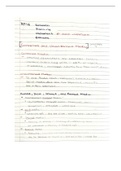
Randomized controlled trials
What you need to know:
• Understand selection bias
• Understand how randomization eliminates selection bias
• Become familiar with notation
• Become familiar with helpful statistics
Notation
Suppose there are two potential outcomes Y for individual i:
• Y1i health status with insurance
• Y0i health status without insurance
• Causal effect of insurance Y1i – Y0i
Fundamental problem: only one of the two paths is observed
What do we measure?
Difference in group means = Avgn[Y1i|Di=1] – Avgn’[Yoi|Di=o]
AVG = average over individuals n
Y = outcome
Di = dummy for individuals 1=yes 0=no
Suppose that treatment has the same effect κ for everybody:
Y1i – Y0i = κ
Selection bias:
Difference in group means
= Avgn[Y1i|Di=1] – Avgn’[Yoi|Di=o]
= Avgn[Y0i|Di=1] + κ – Avgn’[Yoi|Di=o]
= κ + Avgn[Y0i|Di=1] – Avgn’[Yoi|Di=o]
= average causal effect + selection bias
Average causal effect (κ) + selection bias (AVGn [Y0i|Di=1] – AVGn’(Y0i|Di=0])
The difference in group means captures the causal effect if: AVGn [Y0i|Di=1] =
AVGn’(Y0i|Di=0], because both groups are the same
, When we think about averages and we have a large group, we use ‘E’ (population) instead of
AVG, so: E [Y1i|Di=1] – E (Y0i|Di=0]
Some useful statistics
- Estimated treatment coefficient: effect of the treatment.
- Estimated standard error
- T-value ETC/ESE
o Big enough, smaller than -2 or bigger than +2 → we can reject the 0-hypotheses
(because of the 95% confidence interval)
- P-value that the coefficient equals 0,
Randomized controlled trials
What you need to know:
• Understand selection bias
• Understand how randomization eliminates selection bias
• Become familiar with notation
• Become familiar with helpful statistics
Notation
Suppose there are two potential outcomes Y for individual i:
• Y1i health status with insurance
• Y0i health status without insurance
• Causal effect of insurance Y1i – Y0i
Fundamental problem: only one of the two paths is observed
What do we measure?
Difference in group means = Avgn[Y1i|Di=1] – Avgn’[Yoi|Di=o]
AVG = average over individuals n
Y = outcome
Di = dummy for individuals 1=yes 0=no
Suppose that treatment has the same effect κ for everybody:
Y1i – Y0i = κ
Selection bias:
Difference in group means
= Avgn[Y1i|Di=1] – Avgn’[Yoi|Di=o]
= Avgn[Y0i|Di=1] + κ – Avgn’[Yoi|Di=o]
= κ + Avgn[Y0i|Di=1] – Avgn’[Yoi|Di=o]
= average causal effect + selection bias
Average causal effect (κ) + selection bias (AVGn [Y0i|Di=1] – AVGn’(Y0i|Di=0])
The difference in group means captures the causal effect if: AVGn [Y0i|Di=1] =
AVGn’(Y0i|Di=0], because both groups are the same
, When we think about averages and we have a large group, we use ‘E’ (population) instead of
AVG, so: E [Y1i|Di=1] – E (Y0i|Di=0]
Some useful statistics
- Estimated treatment coefficient: effect of the treatment.
- Estimated standard error
- T-value ETC/ESE
o Big enough, smaller than -2 or bigger than +2 → we can reject the 0-hypotheses
(because of the 95% confidence interval)
- P-value that the coefficient equals 0,