
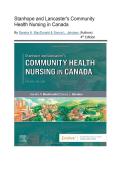
Stanhope and Lancaster's Community
Health Nursing in Canada
By Sandra A. MacDonald & Sonya L. Jakubec (Authors)
4th Edition
,TABLE OF CONTENTS
UNIT I: Background and Roles for Community Health Nursing
1. Community Health Nursing
2. The Evolution of Community Health Nursing in Canada
3. Community Health Nursing in Canada: Settings, Functions, and Roles
UNIT II: Community Health Foundations and Principles
4. Health Promotion
5. Evidence-Informed Practice in Community Health Nursing
6. Ethics in Community Health Nursing Practice
7. Diversity and Relational Practice in Community Health Nursing
8. Epidemiological Applications
9. Working With the Community
10. Health Program Planning and Evaluation
UNIT III: Stakeholders and Populations of Community Health Nursing Practice
11. Working With the Individual as Client: Health and Wellness Across the Lifespan
12. Working With Families
13. Working with Groups, Teams, and Partners
14. Indigenous Health: Working with First Nations People, Inuit, and Métis
15. Working with Working with People Who Experience Structural Vulnerabilities
UNIT IV: Specific Domains of Community Health Practice
16. Communicable and Infectious Disease Prevention and Control
17. Environmental Health
18. Disaster Management
,TEST BANK
Stanhope and Lancaster's Community Health Nursing in Canada, 4th
Edition ,MacDonald & Jakubec
Multiple Choice Questions
UNIT I: BACKGROUND AND ROLES FOR COMMUNITY HEALTH
NURSING
CHAPTER 1: Community Health Nursing
1. Which of the following best defines community health nursing (CHN)?
A) Nursing care provided exclusively in hospital outpatient departments
B) A synthesis of nursing and public health practice applied to promoting and preserving the health of
populations
C) Nursing focused solely on the treatment of acute illness in community settings
D) A specialized field limited to home care nursing
Answer: B
Rationale: Community health nursing is defined as a synthesis of nursing practice and public health
practice applied to promoting and preserving the health of entire populations. It extends beyond
individual care to encompass population-level health promotion, disease prevention, and health
protection. Options A, C, and D are too narrow in scope.
2. The primary focus of community health nursing practice is:
A) Individual patient recovery from acute illness
B) The health of entire populations and communities
C) Specialized surgical interventions
D) Pharmaceutical management of chronic diseases
Answer: B
Rationale: The primary focus of CHN is on populations and communities rather than on individuals
alone. While CHNs do work with individuals, the overarching goal is to improve the health status of the
aggregate or population. This distinguishes CHN from acute care nursing.
3. Which principle is fundamental to community health nursing?
A) Care is directed primarily at the individual level
, B) The client is a passive recipient of care
C) Health promotion and illness prevention are priorities
D) Services are limited to those who can pay
Answer: C
Rationale: Health promotion and illness prevention are foundational principles of CHN. CHNs work
proactively to prevent disease and promote wellness rather than focusing solely on treating existing
illness. The client is viewed as an active partner, and services should be accessible to all.
4. In community health nursing, the term "aggregate" refers to:
A) A single family unit
B) A subgroup within the population that shares one or more characteristics
C) The total number of nurses in a region
D) A hospital department
Answer: B
Rationale: An aggregate is a subgroup or subpopulation that shares one or more common
characteristics, such as age, gender, health status, or geographic location. Aggregates are important in
CHN because they allow nurses to target interventions to specific groups within the larger community.
5. Which of the following is a core function of public health that guides community health nursing?
A) Surgical intervention
B) Assessment, policy development, and assurance
C) Pharmaceutical dispensing
D) Inpatient rehabilitation
Answer: B
Rationale: The three core functions of public health—assessment, policy development, and assurance—
serve as the foundation for CHN practice. Assessment involves identifying health needs; policy
development involves creating plans and policies; and assurance ensures that services are available and
accessible.
6. A community health nurse conducts a windshield survey. This activity is an example of:
A) Policy development
B) Community health assessment
C) Assurance of health services
D) Tertiary prevention
Answer: B
Rationale: A windshield survey is a form of community health assessment in which the nurse observes
the community by driving or walking through it to identify environmental, social, and health-related
characteristics. This is part of the assessment core function.
Health Nursing in Canada
By Sandra A. MacDonald & Sonya L. Jakubec (Authors)
4th Edition
,TABLE OF CONTENTS
UNIT I: Background and Roles for Community Health Nursing
1. Community Health Nursing
2. The Evolution of Community Health Nursing in Canada
3. Community Health Nursing in Canada: Settings, Functions, and Roles
UNIT II: Community Health Foundations and Principles
4. Health Promotion
5. Evidence-Informed Practice in Community Health Nursing
6. Ethics in Community Health Nursing Practice
7. Diversity and Relational Practice in Community Health Nursing
8. Epidemiological Applications
9. Working With the Community
10. Health Program Planning and Evaluation
UNIT III: Stakeholders and Populations of Community Health Nursing Practice
11. Working With the Individual as Client: Health and Wellness Across the Lifespan
12. Working With Families
13. Working with Groups, Teams, and Partners
14. Indigenous Health: Working with First Nations People, Inuit, and Métis
15. Working with Working with People Who Experience Structural Vulnerabilities
UNIT IV: Specific Domains of Community Health Practice
16. Communicable and Infectious Disease Prevention and Control
17. Environmental Health
18. Disaster Management
,TEST BANK
Stanhope and Lancaster's Community Health Nursing in Canada, 4th
Edition ,MacDonald & Jakubec
Multiple Choice Questions
UNIT I: BACKGROUND AND ROLES FOR COMMUNITY HEALTH
NURSING
CHAPTER 1: Community Health Nursing
1. Which of the following best defines community health nursing (CHN)?
A) Nursing care provided exclusively in hospital outpatient departments
B) A synthesis of nursing and public health practice applied to promoting and preserving the health of
populations
C) Nursing focused solely on the treatment of acute illness in community settings
D) A specialized field limited to home care nursing
Answer: B
Rationale: Community health nursing is defined as a synthesis of nursing practice and public health
practice applied to promoting and preserving the health of entire populations. It extends beyond
individual care to encompass population-level health promotion, disease prevention, and health
protection. Options A, C, and D are too narrow in scope.
2. The primary focus of community health nursing practice is:
A) Individual patient recovery from acute illness
B) The health of entire populations and communities
C) Specialized surgical interventions
D) Pharmaceutical management of chronic diseases
Answer: B
Rationale: The primary focus of CHN is on populations and communities rather than on individuals
alone. While CHNs do work with individuals, the overarching goal is to improve the health status of the
aggregate or population. This distinguishes CHN from acute care nursing.
3. Which principle is fundamental to community health nursing?
A) Care is directed primarily at the individual level
, B) The client is a passive recipient of care
C) Health promotion and illness prevention are priorities
D) Services are limited to those who can pay
Answer: C
Rationale: Health promotion and illness prevention are foundational principles of CHN. CHNs work
proactively to prevent disease and promote wellness rather than focusing solely on treating existing
illness. The client is viewed as an active partner, and services should be accessible to all.
4. In community health nursing, the term "aggregate" refers to:
A) A single family unit
B) A subgroup within the population that shares one or more characteristics
C) The total number of nurses in a region
D) A hospital department
Answer: B
Rationale: An aggregate is a subgroup or subpopulation that shares one or more common
characteristics, such as age, gender, health status, or geographic location. Aggregates are important in
CHN because they allow nurses to target interventions to specific groups within the larger community.
5. Which of the following is a core function of public health that guides community health nursing?
A) Surgical intervention
B) Assessment, policy development, and assurance
C) Pharmaceutical dispensing
D) Inpatient rehabilitation
Answer: B
Rationale: The three core functions of public health—assessment, policy development, and assurance—
serve as the foundation for CHN practice. Assessment involves identifying health needs; policy
development involves creating plans and policies; and assurance ensures that services are available and
accessible.
6. A community health nurse conducts a windshield survey. This activity is an example of:
A) Policy development
B) Community health assessment
C) Assurance of health services
D) Tertiary prevention
Answer: B
Rationale: A windshield survey is a form of community health assessment in which the nurse observes
the community by driving or walking through it to identify environmental, social, and health-related
characteristics. This is part of the assessment core function.


