
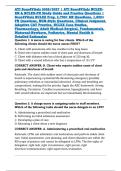
ATI BoardVitals 2026/2027 | ATI BoardVitals NCLEX-
RN & NCLEX-PN Study Guide and Practice Questions |
BoardVitals NCLEX Prep, 3,700+ RN Questions, 1,800+
PN Questions, NGN-Style Questions, Clinical Judgment,
Adaptive CAT Practice, NCLEX Case Studies,
Pharmacology, Adult Medical-Surgical, Fundamentals,
Maternal-Newborn, Pediatrics, Mental Health &
Detailed Rationales
Question 1: A nurse is caring for four clients. Which of the
following clients should the nurse assess FIRST?
A. Client with pneumonia who has crackles in the lung bases
B. Client who reports sudden onset of chest pain and shortness of breath
C. Client with diabetes who has a blood glucose of 220 mg/dL
D. Client with a wound infection who has a temperature of 101.2°F
CORRECT ANSWER: B. Client who reports sudden onset of chest
pain and shortness of breath
Rationale: The client with sudden onset of chest pain and shortness of
breath is experiencing a potential life-threatening emergency (possibly
pulmonary embolism or myocardial infarction). Airway and breathing are
compromised, making this the priority. Apply the ABC framework: Airway,
Breathing, Circulation. Crackles in pneumonia, hyperglycemia, and fever
with wound infection are important but not immediately life-threatening.
Question 2: A charge nurse is assigning tasks to staff members.
Which of the following tasks should the nurse delegate to an LPN?
A. Administering a prescribed oral medication
B. Performing an initial admission assessment
C. Developing a plan of care
D. Educating a client about a new diagnosis
CORRECT ANSWER: A. Administering a prescribed oral medication
Rationale: LPNs can administer oral medications and perform stable client
care. Initial assessments, care planning, and client education are within the
RN scope of practice and cannot be delegated to LPNs. The five rights of
delegation: right task, right circumstance, right person, right
direction/communication, right supervision/evaluation.
,Question 3: A nurse is providing a handoff report to the oncoming
shift. Which of the following should the nurse include?
A. Current assessment findings and pending tasks
B. The client's entire medical history
C. Personal opinions about the client
D. The client's room number and diagnosis only
CORRECT ANSWER: A. Current assessment findings and pending
tasks
Rationale: An effective handoff report includes current assessment findings,
pending tasks, and priority concerns. The client's entire medical history is
not necessary. Personal opinions should not be included. Room number
and diagnosis alone are insufficient. Use the SBAR format: Situation,
Background, Assessment, Recommendation.
Question 4: A nurse is preparing to administer a medication. Which
of the following actions should the nurse take to ensure the right
patient?
A. Ask the client, "What is your name?"
B. Verify the client's name and date of birth against the MAR using two
identifiers
C. Check the client's room number
D. Ask the client's family member to identify the client
CORRECT ANSWER: B. Verify the client's name and date of birth
against the MAR using two identifiers
Rationale: The correct method for verifying patient identification is to use
two identifiers (e.g., name and date of birth) and compare them to the
MAR. Asking only the client's name or using room numbers is insufficient.
Family members are not reliable identifiers. The "Rights of Medication
Administration" include Right Patient, Right Medication, Right Dose, Right
Route, Right Time, Right Documentation, Right Reason, Right Response,
and Right to Refuse.
,Question 5: A nurse is caring for a client who is confused and
attempting to remove their IV line. Which of the following actions
should the nurse take first?
A. Apply soft wrist restraints
B. Ask a family member to sit with the client
C. Administer a sedative
D. Notify the provider
CORRECT ANSWER: B. Ask a family member to sit with the client
Rationale: The least restrictive intervention should be used first. Asking a
family member to sit with the client is the least restrictive option. Restraints,
sedatives, and provider notification should follow if less restrictive measures
are ineffective. Restraints require a provider order and frequent monitoring.
Question 6: A nurse is delegating client care to an assistive
personnel (AP). Which of the following tasks should the nurse
delegate to the AP?
A. Administering enteral feedings via gastrostomy tube
B. Obtaining a sterile urine specimen from an indwelling catheter
C. Measuring a client's intake and output
D. Assessing a client's wound for signs of infection
CORRECT ANSWER: C. Measuring a client's intake and output
Rationale: I&O measurement is within the scope of practice for APs and
requires no clinical judgment. Enteral feedings, sterile specimen collection,
and wound assessment require nursing judgment and licensure. APs can
measure and record but cannot interpret findings.
Question 7: A charge nurse is making client assignments on a
medical-surgical unit. Which client should the charge nurse assign
to the most experienced registered nurse?
A. A client who needs preoperative teaching for a cholecystectomy
B. A client with diabetes mellitus who needs insulin administration
C. A client with unstable angina who is experiencing chest pain
D. A client with a new colostomy who needs stoma care teaching
, CORRECT ANSWER: C. A client with unstable angina who is
experiencing chest pain
Rationale: The client with unstable angina requires advanced cardiac
assessment skills and immediate intervention if rhythm changes occur. This
client is unstable and needs the most experienced nurse. The other clients
are more stable with predictable care needs.
Question 8: A nurse is caring for a client who refuses a blood
transfusion due to religious beliefs. Which of the following actions
should the nurse take?
A. Administer the blood transfusion without consent
B. Contact the provider to discuss alternative treatments
C. Notify the facility's ethics committee immediately
D. Ask the family to convince the client to accept the transfusion
CORRECT ANSWER: B. Contact the provider to discuss alternative
treatments
Rationale: The client has the right to refuse treatment based on religious
beliefs. The nurse should respect this decision, document it, and collaborate
with the provider to explore alternatives (e.g., iron therapy, erythropoietin).
The ethics committee may be consulted later if needed.
Question 9: A nurse on a psychiatric unit is caring for a client who
is being discharged. Which of the following actions demonstrates
proper documentation?
A. Documenting that the client was "hostile and aggressive"
B. Using the client's exact words in quotation marks
C. Documenting only negative behaviors
D. Writing a note that the client "seems depressed"
CORRECT ANSWER: B. Using the client's exact words in quotation
marks
Rationale: Documentation should be objective, factual, and use the client's
exact words when quoting them. Terms like "hostile," "aggressive," and
RN & NCLEX-PN Study Guide and Practice Questions |
BoardVitals NCLEX Prep, 3,700+ RN Questions, 1,800+
PN Questions, NGN-Style Questions, Clinical Judgment,
Adaptive CAT Practice, NCLEX Case Studies,
Pharmacology, Adult Medical-Surgical, Fundamentals,
Maternal-Newborn, Pediatrics, Mental Health &
Detailed Rationales
Question 1: A nurse is caring for four clients. Which of the
following clients should the nurse assess FIRST?
A. Client with pneumonia who has crackles in the lung bases
B. Client who reports sudden onset of chest pain and shortness of breath
C. Client with diabetes who has a blood glucose of 220 mg/dL
D. Client with a wound infection who has a temperature of 101.2°F
CORRECT ANSWER: B. Client who reports sudden onset of chest
pain and shortness of breath
Rationale: The client with sudden onset of chest pain and shortness of
breath is experiencing a potential life-threatening emergency (possibly
pulmonary embolism or myocardial infarction). Airway and breathing are
compromised, making this the priority. Apply the ABC framework: Airway,
Breathing, Circulation. Crackles in pneumonia, hyperglycemia, and fever
with wound infection are important but not immediately life-threatening.
Question 2: A charge nurse is assigning tasks to staff members.
Which of the following tasks should the nurse delegate to an LPN?
A. Administering a prescribed oral medication
B. Performing an initial admission assessment
C. Developing a plan of care
D. Educating a client about a new diagnosis
CORRECT ANSWER: A. Administering a prescribed oral medication
Rationale: LPNs can administer oral medications and perform stable client
care. Initial assessments, care planning, and client education are within the
RN scope of practice and cannot be delegated to LPNs. The five rights of
delegation: right task, right circumstance, right person, right
direction/communication, right supervision/evaluation.
,Question 3: A nurse is providing a handoff report to the oncoming
shift. Which of the following should the nurse include?
A. Current assessment findings and pending tasks
B. The client's entire medical history
C. Personal opinions about the client
D. The client's room number and diagnosis only
CORRECT ANSWER: A. Current assessment findings and pending
tasks
Rationale: An effective handoff report includes current assessment findings,
pending tasks, and priority concerns. The client's entire medical history is
not necessary. Personal opinions should not be included. Room number
and diagnosis alone are insufficient. Use the SBAR format: Situation,
Background, Assessment, Recommendation.
Question 4: A nurse is preparing to administer a medication. Which
of the following actions should the nurse take to ensure the right
patient?
A. Ask the client, "What is your name?"
B. Verify the client's name and date of birth against the MAR using two
identifiers
C. Check the client's room number
D. Ask the client's family member to identify the client
CORRECT ANSWER: B. Verify the client's name and date of birth
against the MAR using two identifiers
Rationale: The correct method for verifying patient identification is to use
two identifiers (e.g., name and date of birth) and compare them to the
MAR. Asking only the client's name or using room numbers is insufficient.
Family members are not reliable identifiers. The "Rights of Medication
Administration" include Right Patient, Right Medication, Right Dose, Right
Route, Right Time, Right Documentation, Right Reason, Right Response,
and Right to Refuse.
,Question 5: A nurse is caring for a client who is confused and
attempting to remove their IV line. Which of the following actions
should the nurse take first?
A. Apply soft wrist restraints
B. Ask a family member to sit with the client
C. Administer a sedative
D. Notify the provider
CORRECT ANSWER: B. Ask a family member to sit with the client
Rationale: The least restrictive intervention should be used first. Asking a
family member to sit with the client is the least restrictive option. Restraints,
sedatives, and provider notification should follow if less restrictive measures
are ineffective. Restraints require a provider order and frequent monitoring.
Question 6: A nurse is delegating client care to an assistive
personnel (AP). Which of the following tasks should the nurse
delegate to the AP?
A. Administering enteral feedings via gastrostomy tube
B. Obtaining a sterile urine specimen from an indwelling catheter
C. Measuring a client's intake and output
D. Assessing a client's wound for signs of infection
CORRECT ANSWER: C. Measuring a client's intake and output
Rationale: I&O measurement is within the scope of practice for APs and
requires no clinical judgment. Enteral feedings, sterile specimen collection,
and wound assessment require nursing judgment and licensure. APs can
measure and record but cannot interpret findings.
Question 7: A charge nurse is making client assignments on a
medical-surgical unit. Which client should the charge nurse assign
to the most experienced registered nurse?
A. A client who needs preoperative teaching for a cholecystectomy
B. A client with diabetes mellitus who needs insulin administration
C. A client with unstable angina who is experiencing chest pain
D. A client with a new colostomy who needs stoma care teaching
, CORRECT ANSWER: C. A client with unstable angina who is
experiencing chest pain
Rationale: The client with unstable angina requires advanced cardiac
assessment skills and immediate intervention if rhythm changes occur. This
client is unstable and needs the most experienced nurse. The other clients
are more stable with predictable care needs.
Question 8: A nurse is caring for a client who refuses a blood
transfusion due to religious beliefs. Which of the following actions
should the nurse take?
A. Administer the blood transfusion without consent
B. Contact the provider to discuss alternative treatments
C. Notify the facility's ethics committee immediately
D. Ask the family to convince the client to accept the transfusion
CORRECT ANSWER: B. Contact the provider to discuss alternative
treatments
Rationale: The client has the right to refuse treatment based on religious
beliefs. The nurse should respect this decision, document it, and collaborate
with the provider to explore alternatives (e.g., iron therapy, erythropoietin).
The ethics committee may be consulted later if needed.
Question 9: A nurse on a psychiatric unit is caring for a client who
is being discharged. Which of the following actions demonstrates
proper documentation?
A. Documenting that the client was "hostile and aggressive"
B. Using the client's exact words in quotation marks
C. Documenting only negative behaviors
D. Writing a note that the client "seems depressed"
CORRECT ANSWER: B. Using the client's exact words in quotation
marks
Rationale: Documentation should be objective, factual, and use the client's
exact words when quoting them. Terms like "hostile," "aggressive," and


