

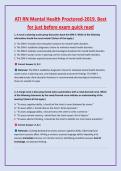
ATI RN Mental Health Proctored-2019. Best
for just before exam quick read
1. A nurse is planning a peer group discussion about the DSM-5. Which of the following
information should the nurse include? (Select all that apply.)
A. The DSM-5 includes client education handouts for mental health disorders.
B. The DSM-5 establishes diagnostic criteria for individual mental health disorders.
C. The DSM-5 indicates recommended pharmacological treatment for mental health disorders.
D. The DSM-5 assists nurses in planning care for clients who have mental health disorders.
E. The DSM-5 indicates expected assessment findings of mental health disorders.
Correct Answer: B, D, E
Rationale: The DSM-5 establishes diagnostic criteria for individual mental health disorders,
assists nurses in planning care, and indicates expected assessment findings. The DSM-5
does not include client education handouts or recommended pharmacological treatments;
those are outside its scope .
2. A charge nurse is discussing mental status examinations with a newly licensed nurse. Which
of the following statements by the newly licensed nurse indicates an understanding of the
teaching? (Select all that apply.)
A. "To assess cognitive ability, I should ask the client to count backward by sevens."
B. "To assess affect, I should observe the client's facial expression."
C. "To assess language ability, I should instruct the client to write a sentence."
D. "To assess remote memory, I should have the client repeat a list of objects."
E. "To assess abstract thinking, I should ask the client to identify our most recent presidents."
Correct Answer: A, B, C
Rationale: Counting backward by sevens assesses cognitive ability. Observing facial
expression assesses affect. Writing a sentence assesses language ability. Repeating a list
assesses immediate memory, not remote memory. Identifying presidents assesses fund of
knowledge, not abstract thinking .
,3. A nurse is told during change of shift report that a client is stuporous. When assessing the
client, which of the following findings should the nurse expect?
A. The client arouses briefly in response to a sternal rub.
B. The client has a Glasgow Coma Scale score less than 7.
C. The client exhibits decorticate rigidity.
D. The client is alert but disoriented to time and place.
Correct Answer: A
Rationale: A stuporous client requires vigorous or painful stimuli (such as a sternal rub) to
elicit a brief response. A GCS less than 7 indicates coma. Decorticate rigidity indicates a deeper
level of unconsciousness. Being alert but disoriented is a much higher level of consciousness .
4. A nurse in an outpatient mental health clinic is preparing to conduct an initial client
interview. Which of the following actions should the nurse identify as the priority?
A. Coordinate holistic care with social services.
B. Identify the client's perception of her mental health status.
C. Include the client's family in the interview.
D. Teach the client about her current mental health disorder.
Correct Answer: B
Rationale: During the initial interview, the priority is to gather data and understand the
client's perspective on their own mental health status. Coordinating care, including family, and
teaching come after assessment .
5. A nurse is performing a mental status assessment on an older adult client who has
dementia. Which of the following questions should the nurse ask to assess the client's remote
memory?
A. "What year did you graduate from high school?"
B. "What did you eat for breakfast this morning?"
C. "Can you count backward from 20 by twos?"
D. "Do you know where you are right now?"
Correct Answer: A
, Rationale: Remote memory is assessed by asking questions that determine the client's
ability to remember things from the distant past that can be validated, such as graduation year.
Breakfast recall tests recent memory. Counting backward tests calculation. Orientation
questions test orientation .
6. A nurse is planning care for a client who has a mental health disorder. Which of the
following actions should the nurse include as a psychobiological intervention?
A. Assist the client with systematic desensitization therapy.
B. Teach the client appropriate coping mechanisms.
C. Assess the client for comorbid health conditions.
D. Monitor the client for adverse effects of medications.
Correct Answer: D
Rationale: Psychobiological interventions focus on the physical and biological aspects of
care, including medication management and monitoring for side effects. Systematic
desensitization is a behavioral intervention. Teaching coping mechanisms is a psychosocial
intervention. Assessing comorbid conditions is part of assessment, not a specific
psychobiological intervention .
7. A nurse is orienting a new client to a mental health unit. When explaining the unit's
community meetings, which of the following statements should the nurse make?
A. "You and a group of other clients will meet to discuss your treatment plans."
B. "Community meetings have a specific agenda that is established by staff."
C. "You and the other clients will meet with staff to discuss common problems."
D. "Community meetings are an excellent opportunity to explore your personal mental health
issues."
Correct Answer: C
Rationale: Community meetings are held to discuss common problems among clients and
staff. They are not for individual treatment plans, have agendas that include client input, and are
not the appropriate venue for exploring deeply personal issues .
, 8. A nurse is caring for a client who has borderline personality disorder. The nurse and client
choose a room and find the client cutting his flesh with a paperclip. Which of the following
actions should the nurse take first?
A. Identify the client's feelings that led to the self-injurious behavior.
B. Ask the client why he is hurting himself.
C. Take the paperclip away from the client.
D. Tell the client he will be placed in seclusion.
Correct Answer: A
Rationale: Using the nursing process priority-setting framework, the nurse must first collect
data from the client before formulating a plan of action or implementing an intervention.
Identifying the client's feelings is the assessment step. Taking the paperclip away and asking
"why" questions are not therapeutic and do not address the underlying cause .
9. A nurse is discussing the characteristics of a nurse-client relationship with a newly licensed
nurse. Which of the following characteristics should the nurse include? (Select all that apply.)
A. The needs of both participants are met.
B. An emotional commitment exists between the participants.
C. It is goal-directed.
D. Behavioral change is encouraged.
E. A termination date is established.
Correct Answer: C, D, E
Rationale: A therapeutic nurse-client relationship is goal-directed, encourages behavioral
change, and has a termination date. The relationship focuses on the client's needs, not both
participants' needs, and does not involve an emotional commitment between participants .
10. A nurse is planning care for a client who has a mental health disorder. Which of the
following actions should the nurse include as a primary prevention intervention?
A. Educating clients on health promotion techniques to reduce the risk of depression
B. Performing screenings for depression at community health programs
C. Establishing rehabilitation programs to decrease the effects of depression
D. Providing support groups for clients at risk for depression
Correct Answer: A
for just before exam quick read
1. A nurse is planning a peer group discussion about the DSM-5. Which of the following
information should the nurse include? (Select all that apply.)
A. The DSM-5 includes client education handouts for mental health disorders.
B. The DSM-5 establishes diagnostic criteria for individual mental health disorders.
C. The DSM-5 indicates recommended pharmacological treatment for mental health disorders.
D. The DSM-5 assists nurses in planning care for clients who have mental health disorders.
E. The DSM-5 indicates expected assessment findings of mental health disorders.
Correct Answer: B, D, E
Rationale: The DSM-5 establishes diagnostic criteria for individual mental health disorders,
assists nurses in planning care, and indicates expected assessment findings. The DSM-5
does not include client education handouts or recommended pharmacological treatments;
those are outside its scope .
2. A charge nurse is discussing mental status examinations with a newly licensed nurse. Which
of the following statements by the newly licensed nurse indicates an understanding of the
teaching? (Select all that apply.)
A. "To assess cognitive ability, I should ask the client to count backward by sevens."
B. "To assess affect, I should observe the client's facial expression."
C. "To assess language ability, I should instruct the client to write a sentence."
D. "To assess remote memory, I should have the client repeat a list of objects."
E. "To assess abstract thinking, I should ask the client to identify our most recent presidents."
Correct Answer: A, B, C
Rationale: Counting backward by sevens assesses cognitive ability. Observing facial
expression assesses affect. Writing a sentence assesses language ability. Repeating a list
assesses immediate memory, not remote memory. Identifying presidents assesses fund of
knowledge, not abstract thinking .
,3. A nurse is told during change of shift report that a client is stuporous. When assessing the
client, which of the following findings should the nurse expect?
A. The client arouses briefly in response to a sternal rub.
B. The client has a Glasgow Coma Scale score less than 7.
C. The client exhibits decorticate rigidity.
D. The client is alert but disoriented to time and place.
Correct Answer: A
Rationale: A stuporous client requires vigorous or painful stimuli (such as a sternal rub) to
elicit a brief response. A GCS less than 7 indicates coma. Decorticate rigidity indicates a deeper
level of unconsciousness. Being alert but disoriented is a much higher level of consciousness .
4. A nurse in an outpatient mental health clinic is preparing to conduct an initial client
interview. Which of the following actions should the nurse identify as the priority?
A. Coordinate holistic care with social services.
B. Identify the client's perception of her mental health status.
C. Include the client's family in the interview.
D. Teach the client about her current mental health disorder.
Correct Answer: B
Rationale: During the initial interview, the priority is to gather data and understand the
client's perspective on their own mental health status. Coordinating care, including family, and
teaching come after assessment .
5. A nurse is performing a mental status assessment on an older adult client who has
dementia. Which of the following questions should the nurse ask to assess the client's remote
memory?
A. "What year did you graduate from high school?"
B. "What did you eat for breakfast this morning?"
C. "Can you count backward from 20 by twos?"
D. "Do you know where you are right now?"
Correct Answer: A
, Rationale: Remote memory is assessed by asking questions that determine the client's
ability to remember things from the distant past that can be validated, such as graduation year.
Breakfast recall tests recent memory. Counting backward tests calculation. Orientation
questions test orientation .
6. A nurse is planning care for a client who has a mental health disorder. Which of the
following actions should the nurse include as a psychobiological intervention?
A. Assist the client with systematic desensitization therapy.
B. Teach the client appropriate coping mechanisms.
C. Assess the client for comorbid health conditions.
D. Monitor the client for adverse effects of medications.
Correct Answer: D
Rationale: Psychobiological interventions focus on the physical and biological aspects of
care, including medication management and monitoring for side effects. Systematic
desensitization is a behavioral intervention. Teaching coping mechanisms is a psychosocial
intervention. Assessing comorbid conditions is part of assessment, not a specific
psychobiological intervention .
7. A nurse is orienting a new client to a mental health unit. When explaining the unit's
community meetings, which of the following statements should the nurse make?
A. "You and a group of other clients will meet to discuss your treatment plans."
B. "Community meetings have a specific agenda that is established by staff."
C. "You and the other clients will meet with staff to discuss common problems."
D. "Community meetings are an excellent opportunity to explore your personal mental health
issues."
Correct Answer: C
Rationale: Community meetings are held to discuss common problems among clients and
staff. They are not for individual treatment plans, have agendas that include client input, and are
not the appropriate venue for exploring deeply personal issues .
, 8. A nurse is caring for a client who has borderline personality disorder. The nurse and client
choose a room and find the client cutting his flesh with a paperclip. Which of the following
actions should the nurse take first?
A. Identify the client's feelings that led to the self-injurious behavior.
B. Ask the client why he is hurting himself.
C. Take the paperclip away from the client.
D. Tell the client he will be placed in seclusion.
Correct Answer: A
Rationale: Using the nursing process priority-setting framework, the nurse must first collect
data from the client before formulating a plan of action or implementing an intervention.
Identifying the client's feelings is the assessment step. Taking the paperclip away and asking
"why" questions are not therapeutic and do not address the underlying cause .
9. A nurse is discussing the characteristics of a nurse-client relationship with a newly licensed
nurse. Which of the following characteristics should the nurse include? (Select all that apply.)
A. The needs of both participants are met.
B. An emotional commitment exists between the participants.
C. It is goal-directed.
D. Behavioral change is encouraged.
E. A termination date is established.
Correct Answer: C, D, E
Rationale: A therapeutic nurse-client relationship is goal-directed, encourages behavioral
change, and has a termination date. The relationship focuses on the client's needs, not both
participants' needs, and does not involve an emotional commitment between participants .
10. A nurse is planning care for a client who has a mental health disorder. Which of the
following actions should the nurse include as a primary prevention intervention?
A. Educating clients on health promotion techniques to reduce the risk of depression
B. Performing screenings for depression at community health programs
C. Establishing rehabilitation programs to decrease the effects of depression
D. Providing support groups for clients at risk for depression
Correct Answer: A


