

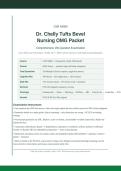
CNR N4000
Dr. Chelly Tufts Bevel
Nursing OMG Packet
Comprehensive 150-Question Examination
Goes With You Everywhere • Study 24/7 • 100% Correct Answers with Study-Guide Rationales
Course CNR N4000 — Nursing (Dr. Chelly Tufts Bevel)
Format OMG Packet — portable, high-yield study companion
Total Questions 150 Multiple-Choice (4 options, single best answer)
Cognitive Mix 30% Recall | 50% Application | 20% Analysis
Style Mix 75% Scenario-based | 25% Direct recall / calculation
Sections 8 NCLEX-aligned competency sections
Coverage Fundamentals → Pharm → Med-Surg → OB/Peds → MH → Critical Care → Leadership → NCLE
Version NCLEX-RN Test Plan aligned
Examination Instructions
• Each question has ONE best answer. Select the single option that best reflects entry-level RN clinical judgment.
• Rationales double as a study guide: clinical reasoning + why distractors are wrong + NCLEX test-taking
strategy.
• Prioritization questions use ABC, Maslow, acute-vs-chronic, and unstable-vs-stable frameworks. Master the
framework first.
• Commonly confused pairs (hyper- vs hypokalemia, respiratory vs metabolic acidosis, preload vs afterload,
systolic vs diastolic HF) are embedded as distractors — learn to discriminate.
• Medication-calculation items use realistic orders and standard formulas (Desired/Have × Quantity; Volume ×
gtt/mL ÷ minutes).
• When in doubt on the NCLEX: assess before acting, never delegate assessment/teaching/evaluating, use the
least-restrictive intervention, and always ensure patient safety first.
Take this packet everywhere. Study it 24/7. Become the nurse your patients deserve.
,CNR N4000 — Dr. Chelly Tufts Bevel Nursing OMG Packet Comprehensive Exam | 150 Questions
Section 1: Nursing Fundamentals and Core Concepts
ADPIE, vital signs, assessment priorities, documentation, and infection control — the foundation for every other section in
the OMG Packet.
Q1: A nurse is caring for four clients. Using the nursing process, which step should the nurse complete
FIRST before formulating a plan of care?
A. Identify goals and outcomes for each client
B. Collect and organize assessment data to establish a database [CORRECT]
C. Implement ordered interventions safely
D. Evaluate the effectiveness of prior interventions
Correct Answer: B
Rationale: ADPIE (Assessment, Diagnosis, Planning, Implementation, Evaluation) always begins with Assessment —
gathering subjective and objective data to build the client database. Goals (Planning) and interventions (Implementation)
cannot be safe or individualized without first completing a thorough assessment. Evaluation is the final step, measuring
whether outcomes were met.
Q2: A nurse obtains a blood pressure of 148/96 mmHg on a client with no prior hypertension history. What
is the PRIORITY nursing action?
A. Document the finding and recheck at the next scheduled vital signs
B. Recheck the blood pressure in the opposite arm after the client rests for 5 minutes [CORRECT]
C. Administer a PRN antihypertensive immediately
D. Call the provider to request a new BP medication order
Correct Answer: B
Rationale: Before treating or reporting an unexpected single elevated BP, the nurse should verify accuracy by rechecking
after rest and in the opposite arm. Documenting without confirmation (A) risks acting on erroneous data; administering
PRN antihypertensive (C) or calling the provider (D) prematurely bypasses the assessment step. Test-taking tip: when one
vital sign is abnormal, the answer is usually to reassess — not to intervene.
Q3: A client’s radial pulse is 52 beats/min and irregular. What is the most appropriate nursing action?
A. Document the finding as bradycardia
B. Assess the apical pulse for one full minute [CORRECT]
C. Administer atropine 1 mg IV push
D. Recheck the radial pulse in 4 hours
Correct Answer: B
Rationale: Any irregular peripheral pulse must be confirmed by an apical pulse counted for a full 60 seconds, because the
irregularity may cause the radial rate to undercount true heart rate. Documenting (A) without apical confirmation misses
dysrhythmias. Atropine (C) is reserved for symptomatic bradycardia with a provider order. Waiting 4 hours (D) is unsafe.
Goes With You Everywhere / Study 24/7 — NCLEX-Style Preparation Page 2
,CNR N4000 — Dr. Chelly Tufts Bevel Nursing OMG Packet Comprehensive Exam | 150 Questions
Q4: Which vital sign finding requires the MOST immediate nursing intervention?
A. Temperature 37.4°C (99.3°F) in a postoperative day 1 client
B. Respiratory rate 28 breaths/min with SpO₂ 90% on room air [CORRECT]
C. Heart rate 88 beats/min and regular in a resting adult
D. Blood pressure 118/74 mmHg after ambulation
Correct Answer: B
Rationale: Respiratory compromise is always prioritized using the ABC framework. Tachypnea (28) with hypoxemia (SpO₂
90%) signals respiratory distress requiring immediate oxygen and further assessment. The other findings are within normal
limits or expected postoperative mild elevation. Test-taking tip: any answer involving airway, breathing, or oxygenation is
almost always the priority.
Q5: A nursing student is documenting care and writes "Client seems angry, probably because family did
not visit." Which documentation principle is violated?
A. Documentation must be factual, objective, and free from interpretation or assumptions [CORRECT]
B. Documentation must be completed within 24 hours
C. Documentation must include only subjective data
D. Documentation must use the patient’s exact words only
Correct Answer: A
Rationale: Charting must be factual and objective — recording what is observed (e.g., "client threw cup, shouted ‘leave me
alone’") rather than interpretations ("seems angry, probably because..."). The latter inserts nurse opinion and unverified
assumption. Documenting within 24 hours is also required but is not the principle violated here. Use quotes for patient
statements, not for nurse conclusions.
Q6: A nurse is using SBAR to hand off a client to the oncoming shift. Which statement best represents the
"R" in SBAR?
A. "The client’s potassium is 3.0 mEq/L."
B. "The client is a 68-year-old admitted with heart failure."
C. "Please administer 40 mEq potassium chloride IV over 4 hours and recheck the level." [CORRECT]
D. "The client reports shortness of breath when lying flat."
Correct Answer: C
Rationale: SBAR = Situation, Background, Assessment, Recommendation. The "R" is the specific request or
recommendation — here, the potassium replacement order request. Situation is the current problem; Background is relevant
history; Assessment is the nurse’s analysis. Closing handoff with a clear recommendation ensures action.
Q7: A client is on contact precautions for Clostridioides difficile. Which PPE is required for entry into the
room?
A. Surgical mask and gloves only
B. Gown and gloves; soap-and-water hand hygiene (not alcohol-based rub) after removal [CORRECT]
C. N95 respirator, gown, gloves, and eye protection
D. Gloves only; alcohol-based rub is sufficient
Correct Answer: B
Rationale: C. difficile spores are resistant to alcohol-based hand rubs; soap and water is required. Contact precautions
require gown and gloves. N95 respirators are for airborne precautions (TB, measles, varicella). Surgical masks are for
droplet precautions. Knowing organism-specific precautions is a high-yield NCLEX topic.
Goes With You Everywhere / Study 24/7 — NCLEX-Style Preparation Page 3
, CNR N4000 — Dr. Chelly Tufts Bevel Nursing OMG Packet Comprehensive Exam | 150 Questions
Q8: A client with pulmonary tuberculosis is admitted. Which isolation room assignment is appropriate?
A. A private room with positive pressure and door open
B. A private airborne infection isolation room with negative pressure and door closed [CORRECT]
C. A semi-private room with a client on droplet precautions
D. A private room with standard precautions only
Correct Answer: B
Rationale: TB requires airborne precautions: a private negative-pressure room (AIIR) with at least 6–12 air exchanges per
hour, door closed, and N95 or higher respirator for staff. Positive pressure would push contaminated air out. Cohorting
with droplet precautions is unsafe. Standard precautions alone are insufficient for known airborne disease.
Q9: Which client finding should the nurse address FIRST using Maslow’s hierarchy?
A. A client who is anxious about an upcoming procedure
B. A client with a respiratory rate of 8 breaths/min after opioid administration [CORRECT]
C. A client who refuses to participate in group therapy
D. A client requesting spiritual counseling
Correct Answer: B
Rationale: Maslow prioritizes physiological needs (breathing) over safety, love/belonging, esteem, or self-actualization. A
respiratory rate of 8 after an opioid indicates opioid-induced respiratory depression — a life-threatening physiological
emergency requiring naloxone and stimulation. Anxiety, therapy refusal, and spiritual needs are real but lower on the
hierarchy.
Q10: A client’s oral temperature is 39.2°C (102.6°F). Which additional finding indicates the nurse should
intervene immediately?
A. Heart rate 92 beats/min
B. Blood pressure 110/70 mmHg
C. Respiratory rate 12 breaths/min
D. Confusion and lethargy [CORRECT]
Correct Answer: D
Rationale: Fever with altered mental status (confusion, lethargy) suggests possible sepsis or serious CNS involvement and
requires immediate provider notification and sepsis workup. Mild tachycardia with fever is expected. The respiratory rate of
12 is within normal limits. Neurologic change in a febrile client is a red flag for sepsis-induced encephalopathy.
Q11: A nursing diagnosis differs from a medical diagnosis in that a nursing diagnosis:
A. Identifies a disease process requiring medical treatment
B. Describes a client’s response to actual or potential health problems that nurses can independently
address [CORRECT]
C. Is determined only by the physician
D. Is the same as a collaborative problem
Correct Answer: B
Rationale: A nursing diagnosis (e.g., "Ineffective Airway Clearance related to retained secretions") describes the client’s
response — what the nurse independently treats. A medical diagnosis (e.g., "pneumonia") identifies the disease.
Collaborative problems (e.g., potential complication: hemorrhage) require both medical and nursing action. NCLEX tests
this distinction often.
Goes With You Everywhere / Study 24/7 — NCLEX-Style Preparation Page 4
Dr. Chelly Tufts Bevel
Nursing OMG Packet
Comprehensive 150-Question Examination
Goes With You Everywhere • Study 24/7 • 100% Correct Answers with Study-Guide Rationales
Course CNR N4000 — Nursing (Dr. Chelly Tufts Bevel)
Format OMG Packet — portable, high-yield study companion
Total Questions 150 Multiple-Choice (4 options, single best answer)
Cognitive Mix 30% Recall | 50% Application | 20% Analysis
Style Mix 75% Scenario-based | 25% Direct recall / calculation
Sections 8 NCLEX-aligned competency sections
Coverage Fundamentals → Pharm → Med-Surg → OB/Peds → MH → Critical Care → Leadership → NCLE
Version NCLEX-RN Test Plan aligned
Examination Instructions
• Each question has ONE best answer. Select the single option that best reflects entry-level RN clinical judgment.
• Rationales double as a study guide: clinical reasoning + why distractors are wrong + NCLEX test-taking
strategy.
• Prioritization questions use ABC, Maslow, acute-vs-chronic, and unstable-vs-stable frameworks. Master the
framework first.
• Commonly confused pairs (hyper- vs hypokalemia, respiratory vs metabolic acidosis, preload vs afterload,
systolic vs diastolic HF) are embedded as distractors — learn to discriminate.
• Medication-calculation items use realistic orders and standard formulas (Desired/Have × Quantity; Volume ×
gtt/mL ÷ minutes).
• When in doubt on the NCLEX: assess before acting, never delegate assessment/teaching/evaluating, use the
least-restrictive intervention, and always ensure patient safety first.
Take this packet everywhere. Study it 24/7. Become the nurse your patients deserve.
,CNR N4000 — Dr. Chelly Tufts Bevel Nursing OMG Packet Comprehensive Exam | 150 Questions
Section 1: Nursing Fundamentals and Core Concepts
ADPIE, vital signs, assessment priorities, documentation, and infection control — the foundation for every other section in
the OMG Packet.
Q1: A nurse is caring for four clients. Using the nursing process, which step should the nurse complete
FIRST before formulating a plan of care?
A. Identify goals and outcomes for each client
B. Collect and organize assessment data to establish a database [CORRECT]
C. Implement ordered interventions safely
D. Evaluate the effectiveness of prior interventions
Correct Answer: B
Rationale: ADPIE (Assessment, Diagnosis, Planning, Implementation, Evaluation) always begins with Assessment —
gathering subjective and objective data to build the client database. Goals (Planning) and interventions (Implementation)
cannot be safe or individualized without first completing a thorough assessment. Evaluation is the final step, measuring
whether outcomes were met.
Q2: A nurse obtains a blood pressure of 148/96 mmHg on a client with no prior hypertension history. What
is the PRIORITY nursing action?
A. Document the finding and recheck at the next scheduled vital signs
B. Recheck the blood pressure in the opposite arm after the client rests for 5 minutes [CORRECT]
C. Administer a PRN antihypertensive immediately
D. Call the provider to request a new BP medication order
Correct Answer: B
Rationale: Before treating or reporting an unexpected single elevated BP, the nurse should verify accuracy by rechecking
after rest and in the opposite arm. Documenting without confirmation (A) risks acting on erroneous data; administering
PRN antihypertensive (C) or calling the provider (D) prematurely bypasses the assessment step. Test-taking tip: when one
vital sign is abnormal, the answer is usually to reassess — not to intervene.
Q3: A client’s radial pulse is 52 beats/min and irregular. What is the most appropriate nursing action?
A. Document the finding as bradycardia
B. Assess the apical pulse for one full minute [CORRECT]
C. Administer atropine 1 mg IV push
D. Recheck the radial pulse in 4 hours
Correct Answer: B
Rationale: Any irregular peripheral pulse must be confirmed by an apical pulse counted for a full 60 seconds, because the
irregularity may cause the radial rate to undercount true heart rate. Documenting (A) without apical confirmation misses
dysrhythmias. Atropine (C) is reserved for symptomatic bradycardia with a provider order. Waiting 4 hours (D) is unsafe.
Goes With You Everywhere / Study 24/7 — NCLEX-Style Preparation Page 2
,CNR N4000 — Dr. Chelly Tufts Bevel Nursing OMG Packet Comprehensive Exam | 150 Questions
Q4: Which vital sign finding requires the MOST immediate nursing intervention?
A. Temperature 37.4°C (99.3°F) in a postoperative day 1 client
B. Respiratory rate 28 breaths/min with SpO₂ 90% on room air [CORRECT]
C. Heart rate 88 beats/min and regular in a resting adult
D. Blood pressure 118/74 mmHg after ambulation
Correct Answer: B
Rationale: Respiratory compromise is always prioritized using the ABC framework. Tachypnea (28) with hypoxemia (SpO₂
90%) signals respiratory distress requiring immediate oxygen and further assessment. The other findings are within normal
limits or expected postoperative mild elevation. Test-taking tip: any answer involving airway, breathing, or oxygenation is
almost always the priority.
Q5: A nursing student is documenting care and writes "Client seems angry, probably because family did
not visit." Which documentation principle is violated?
A. Documentation must be factual, objective, and free from interpretation or assumptions [CORRECT]
B. Documentation must be completed within 24 hours
C. Documentation must include only subjective data
D. Documentation must use the patient’s exact words only
Correct Answer: A
Rationale: Charting must be factual and objective — recording what is observed (e.g., "client threw cup, shouted ‘leave me
alone’") rather than interpretations ("seems angry, probably because..."). The latter inserts nurse opinion and unverified
assumption. Documenting within 24 hours is also required but is not the principle violated here. Use quotes for patient
statements, not for nurse conclusions.
Q6: A nurse is using SBAR to hand off a client to the oncoming shift. Which statement best represents the
"R" in SBAR?
A. "The client’s potassium is 3.0 mEq/L."
B. "The client is a 68-year-old admitted with heart failure."
C. "Please administer 40 mEq potassium chloride IV over 4 hours and recheck the level." [CORRECT]
D. "The client reports shortness of breath when lying flat."
Correct Answer: C
Rationale: SBAR = Situation, Background, Assessment, Recommendation. The "R" is the specific request or
recommendation — here, the potassium replacement order request. Situation is the current problem; Background is relevant
history; Assessment is the nurse’s analysis. Closing handoff with a clear recommendation ensures action.
Q7: A client is on contact precautions for Clostridioides difficile. Which PPE is required for entry into the
room?
A. Surgical mask and gloves only
B. Gown and gloves; soap-and-water hand hygiene (not alcohol-based rub) after removal [CORRECT]
C. N95 respirator, gown, gloves, and eye protection
D. Gloves only; alcohol-based rub is sufficient
Correct Answer: B
Rationale: C. difficile spores are resistant to alcohol-based hand rubs; soap and water is required. Contact precautions
require gown and gloves. N95 respirators are for airborne precautions (TB, measles, varicella). Surgical masks are for
droplet precautions. Knowing organism-specific precautions is a high-yield NCLEX topic.
Goes With You Everywhere / Study 24/7 — NCLEX-Style Preparation Page 3
, CNR N4000 — Dr. Chelly Tufts Bevel Nursing OMG Packet Comprehensive Exam | 150 Questions
Q8: A client with pulmonary tuberculosis is admitted. Which isolation room assignment is appropriate?
A. A private room with positive pressure and door open
B. A private airborne infection isolation room with negative pressure and door closed [CORRECT]
C. A semi-private room with a client on droplet precautions
D. A private room with standard precautions only
Correct Answer: B
Rationale: TB requires airborne precautions: a private negative-pressure room (AIIR) with at least 6–12 air exchanges per
hour, door closed, and N95 or higher respirator for staff. Positive pressure would push contaminated air out. Cohorting
with droplet precautions is unsafe. Standard precautions alone are insufficient for known airborne disease.
Q9: Which client finding should the nurse address FIRST using Maslow’s hierarchy?
A. A client who is anxious about an upcoming procedure
B. A client with a respiratory rate of 8 breaths/min after opioid administration [CORRECT]
C. A client who refuses to participate in group therapy
D. A client requesting spiritual counseling
Correct Answer: B
Rationale: Maslow prioritizes physiological needs (breathing) over safety, love/belonging, esteem, or self-actualization. A
respiratory rate of 8 after an opioid indicates opioid-induced respiratory depression — a life-threatening physiological
emergency requiring naloxone and stimulation. Anxiety, therapy refusal, and spiritual needs are real but lower on the
hierarchy.
Q10: A client’s oral temperature is 39.2°C (102.6°F). Which additional finding indicates the nurse should
intervene immediately?
A. Heart rate 92 beats/min
B. Blood pressure 110/70 mmHg
C. Respiratory rate 12 breaths/min
D. Confusion and lethargy [CORRECT]
Correct Answer: D
Rationale: Fever with altered mental status (confusion, lethargy) suggests possible sepsis or serious CNS involvement and
requires immediate provider notification and sepsis workup. Mild tachycardia with fever is expected. The respiratory rate of
12 is within normal limits. Neurologic change in a febrile client is a red flag for sepsis-induced encephalopathy.
Q11: A nursing diagnosis differs from a medical diagnosis in that a nursing diagnosis:
A. Identifies a disease process requiring medical treatment
B. Describes a client’s response to actual or potential health problems that nurses can independently
address [CORRECT]
C. Is determined only by the physician
D. Is the same as a collaborative problem
Correct Answer: B
Rationale: A nursing diagnosis (e.g., "Ineffective Airway Clearance related to retained secretions") describes the client’s
response — what the nurse independently treats. A medical diagnosis (e.g., "pneumonia") identifies the disease.
Collaborative problems (e.g., potential complication: hemorrhage) require both medical and nursing action. NCLEX tests
this distinction often.
Goes With You Everywhere / Study 24/7 — NCLEX-Style Preparation Page 4


