

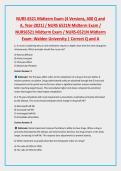
NURS 6521 Midterm Exam (4 Versions, 400 Q and
A, Year-2021) / NURS 6521N Midterm Exam /
NURS6521 Midterm Exam / NURS-6521N Midterm
Exam: Walden University | Correct Q and A
1. A nurse is explaining why an oral medication requires a higher dose than the same drug given
intravenously. Which principle should the nurse cite?
A) Passive diffusion
B) Active transport
C) First-pass effect
D) Glomerular filtration
Correct Answer: C
Rationale: The first-pass effect refers to the metabolism of a drug in the liver before it
reaches systemic circulation. Drugs administered orally are absorbed through the GI tract and
transported via the portal vein to the liver, where a significant portion may be metabolized
before reaching target tissues. This necessitates higher oral doses compared to parenteral
routes that bypass this initial hepatic metabolism.
2. A 70-year-old patient with renal impairment is prescribed a medication primarily eliminated
by the kidneys. The nurse should anticipate which change in drug half-life?
A) Decreased half-life
B) Increased half-life
C) Unchanged half-life
D) Immediate elimination
Correct Answer: B
Rationale: Renal impairment reduces the kidney's ability to clear drugs. When a drug is
primarily eliminated by the kidneys and renal function declines, the drug remains in the body
longer, increasing its half-life. This requires dose adjustments to prevent toxicity.
3. Which statement accurately describes the therapeutic index of a drug?
A) The ratio of ED50 to TD50
B) The ratio of TD50 to ED50
,C) The ratio of LD50 to ED50
D) The ratio of ED50 to LD50
Correct Answer: B
Rationale: The therapeutic index is calculated as TD50/ED50 (toxic dose 50 divided by
effective dose 50). A drug with a narrow therapeutic index requires careful monitoring because
small changes in dose can produce toxic effects. Digoxin and lithium are classic examples of
narrow therapeutic index drugs.
4. A patient who has received regular doses of an agonist for two weeks reports decreased
effectiveness. This phenomenon is best described as:
A) Idiosyncratic reaction
B) Tachyphylaxis
C) Therapeutic index decline
D) Potentiation
Correct Answer: B
Rationale: Tachyphylaxis refers to rapidly developing tolerance to a drug after repeated
administration. The drug will decrease in effectiveness because the body's response diminishes
quickly with continuous exposure.
5. A medication that is a weak acid is more likely to be excreted in urine when the urine is:
A) Acidic
B) Alkaline
C) Neutral
D) Concentrated
Correct Answer: B
Rationale: Weak acids are ionized in alkaline urine and ionized drugs are poorly reabsorbed
across the renal tubular membrane, promoting excretion. Conversely, acidic urine would
promote reabsorption of weak acids. This principle guides interventions like alkalinizing urine to
enhance elimination of acidic drugs.
6. Which of the following is TRUE about drugs with a high volume of distribution (Vd)?
A) They remain primarily in the plasma compartment
B) They are extensively distributed to body tissues
C) They have rapid renal elimination
D) They require lower loading doses
,Correct Answer: B
Rationale: A high volume of distribution indicates that a drug has distributed extensively
into body tissues rather than remaining in the vascular space. Drugs with high Vd often require
higher loading doses to achieve therapeutic plasma concentrations.
7. The cytochrome P450 enzyme system is primarily responsible for:
A) Phase II conjugation reactions
B) Phase I metabolism of drugs
C) Renal excretion of drugs
D) Drug absorption in the intestine
Correct Answer: B
Rationale: The CYP450 system catalyzes Phase I metabolic reactions, including oxidation,
reduction, and hydrolysis. These reactions typically make drugs more polar and easier to
excrete. CYP450 enzymes are a major source of drug-drug interactions.
8. A patient taking a highly protein-bound drug has a low serum albumin level. The nurse should
monitor for:
A) Decreased drug effect
B) Increased free drug concentration
C) Decreased volume of distribution
D) Increased renal clearance
Correct Answer: B
Rationale: When serum albumin is low, fewer protein-binding sites are available. More drug
remains free (unbound) in the plasma, potentially increasing pharmacologic effect and risk of
toxicity. This is particularly important with drugs like phenytoin and warfarin.
9. A 60-year-old patient is taking multiple medications. The nurse understands that
polypharmacy can increase the risk of adverse effects primarily by:
A) Increasing renal elimination
B) Displacing protein-bound drugs
C) Decreasing hepatic blood flow
D) Both B and C
Correct Answer: D
, Rationale: Polypharmacy increases adverse effect risk through multiple mechanisms,
including displacement of protein-bound drugs (increasing free drug levels) and competition for
hepatic metabolism. Additionally, age-related decreases in hepatic blood flow and enzyme
activity compound this risk.
10. Which route of administration bypasses the first-pass effect entirely?
A) Oral
B) Rectal
C) Intravenous
D) Sublingual
Correct Answers: C and D
Rationale: Both intravenous and sublingual routes bypass hepatic first-pass metabolism. IV
drugs enter systemic circulation directly. Sublingual drugs are absorbed through the venous
drainage of the oral mucosa directly into the systemic circulation, avoiding the portal vein.
11. A patient develops a rash after starting a new antibiotic. This is an example of:
A) Pharmacotherapeutics
B) Pharmacokinetics
C) Pharmacodynamics
D) Pharmacogenetics
Correct Answer: C
Rationale: Pharmacodynamics describes the biochemical and physiologic effects of drugs on
the body, including adverse effects. A rash represents the body's response to the drug's actions.
12. A drug's efficacy refers to:
A) The dose required to produce a response
B) How well a drug produces its desired effect
C) The speed of drug absorption
D) The drug's half-life
Correct Answer: B
Rationale: Efficacy is the maximal therapeutic response a drug can produce. It differs from
potency, which refers to the amount of drug needed to produce a given effect. A drug may be
highly potent but have low efficacy, or vice versa.
A, Year-2021) / NURS 6521N Midterm Exam /
NURS6521 Midterm Exam / NURS-6521N Midterm
Exam: Walden University | Correct Q and A
1. A nurse is explaining why an oral medication requires a higher dose than the same drug given
intravenously. Which principle should the nurse cite?
A) Passive diffusion
B) Active transport
C) First-pass effect
D) Glomerular filtration
Correct Answer: C
Rationale: The first-pass effect refers to the metabolism of a drug in the liver before it
reaches systemic circulation. Drugs administered orally are absorbed through the GI tract and
transported via the portal vein to the liver, where a significant portion may be metabolized
before reaching target tissues. This necessitates higher oral doses compared to parenteral
routes that bypass this initial hepatic metabolism.
2. A 70-year-old patient with renal impairment is prescribed a medication primarily eliminated
by the kidneys. The nurse should anticipate which change in drug half-life?
A) Decreased half-life
B) Increased half-life
C) Unchanged half-life
D) Immediate elimination
Correct Answer: B
Rationale: Renal impairment reduces the kidney's ability to clear drugs. When a drug is
primarily eliminated by the kidneys and renal function declines, the drug remains in the body
longer, increasing its half-life. This requires dose adjustments to prevent toxicity.
3. Which statement accurately describes the therapeutic index of a drug?
A) The ratio of ED50 to TD50
B) The ratio of TD50 to ED50
,C) The ratio of LD50 to ED50
D) The ratio of ED50 to LD50
Correct Answer: B
Rationale: The therapeutic index is calculated as TD50/ED50 (toxic dose 50 divided by
effective dose 50). A drug with a narrow therapeutic index requires careful monitoring because
small changes in dose can produce toxic effects. Digoxin and lithium are classic examples of
narrow therapeutic index drugs.
4. A patient who has received regular doses of an agonist for two weeks reports decreased
effectiveness. This phenomenon is best described as:
A) Idiosyncratic reaction
B) Tachyphylaxis
C) Therapeutic index decline
D) Potentiation
Correct Answer: B
Rationale: Tachyphylaxis refers to rapidly developing tolerance to a drug after repeated
administration. The drug will decrease in effectiveness because the body's response diminishes
quickly with continuous exposure.
5. A medication that is a weak acid is more likely to be excreted in urine when the urine is:
A) Acidic
B) Alkaline
C) Neutral
D) Concentrated
Correct Answer: B
Rationale: Weak acids are ionized in alkaline urine and ionized drugs are poorly reabsorbed
across the renal tubular membrane, promoting excretion. Conversely, acidic urine would
promote reabsorption of weak acids. This principle guides interventions like alkalinizing urine to
enhance elimination of acidic drugs.
6. Which of the following is TRUE about drugs with a high volume of distribution (Vd)?
A) They remain primarily in the plasma compartment
B) They are extensively distributed to body tissues
C) They have rapid renal elimination
D) They require lower loading doses
,Correct Answer: B
Rationale: A high volume of distribution indicates that a drug has distributed extensively
into body tissues rather than remaining in the vascular space. Drugs with high Vd often require
higher loading doses to achieve therapeutic plasma concentrations.
7. The cytochrome P450 enzyme system is primarily responsible for:
A) Phase II conjugation reactions
B) Phase I metabolism of drugs
C) Renal excretion of drugs
D) Drug absorption in the intestine
Correct Answer: B
Rationale: The CYP450 system catalyzes Phase I metabolic reactions, including oxidation,
reduction, and hydrolysis. These reactions typically make drugs more polar and easier to
excrete. CYP450 enzymes are a major source of drug-drug interactions.
8. A patient taking a highly protein-bound drug has a low serum albumin level. The nurse should
monitor for:
A) Decreased drug effect
B) Increased free drug concentration
C) Decreased volume of distribution
D) Increased renal clearance
Correct Answer: B
Rationale: When serum albumin is low, fewer protein-binding sites are available. More drug
remains free (unbound) in the plasma, potentially increasing pharmacologic effect and risk of
toxicity. This is particularly important with drugs like phenytoin and warfarin.
9. A 60-year-old patient is taking multiple medications. The nurse understands that
polypharmacy can increase the risk of adverse effects primarily by:
A) Increasing renal elimination
B) Displacing protein-bound drugs
C) Decreasing hepatic blood flow
D) Both B and C
Correct Answer: D
, Rationale: Polypharmacy increases adverse effect risk through multiple mechanisms,
including displacement of protein-bound drugs (increasing free drug levels) and competition for
hepatic metabolism. Additionally, age-related decreases in hepatic blood flow and enzyme
activity compound this risk.
10. Which route of administration bypasses the first-pass effect entirely?
A) Oral
B) Rectal
C) Intravenous
D) Sublingual
Correct Answers: C and D
Rationale: Both intravenous and sublingual routes bypass hepatic first-pass metabolism. IV
drugs enter systemic circulation directly. Sublingual drugs are absorbed through the venous
drainage of the oral mucosa directly into the systemic circulation, avoiding the portal vein.
11. A patient develops a rash after starting a new antibiotic. This is an example of:
A) Pharmacotherapeutics
B) Pharmacokinetics
C) Pharmacodynamics
D) Pharmacogenetics
Correct Answer: C
Rationale: Pharmacodynamics describes the biochemical and physiologic effects of drugs on
the body, including adverse effects. A rash represents the body's response to the drug's actions.
12. A drug's efficacy refers to:
A) The dose required to produce a response
B) How well a drug produces its desired effect
C) The speed of drug absorption
D) The drug's half-life
Correct Answer: B
Rationale: Efficacy is the maximal therapeutic response a drug can produce. It differs from
potency, which refers to the amount of drug needed to produce a given effect. A drug may be
highly potent but have low efficacy, or vice versa.


