

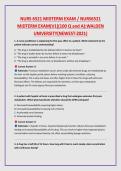
NURS 6521 MIDTERM EXAM / NURS6521
MIDTERM EXAM(V1)(100 Q and A):WALDEN
UNIVERSITY(NEWEST-2021)
1. A nurse practitioner is explaining the first-pass effect to a patient. Which statement by the
patient indicates correct understanding?
A. "The drug is metabolized by the kidneys before it reaches my heart."
B. "The drug is broken down by my liver before it enters my bloodstream."
C. "The drug is excreted in my urine before it can work."
D. "The drug is absorbed directly into my bloodstream without any breakdown."
Correct Answer: B
Rationale: First-pass metabolism occurs when orally administered drugs are metabolized by
the liver via the hepatic portal system before reaching systemic circulation, reducing
bioavailability. This is why oral doses are often higher than IV doses for drugs with extensive
first-pass effects. The kidneys are responsible for excretion, not first-pass metabolism.
Sublingual and IV routes bypass first-pass metabolism.
2. A patient with hepatic cirrhosis is prescribed a drug that undergoes extensive first-pass
metabolism. Which pharmacokinetic alteration should the APRN anticipate?
A. Decreased bioavailability requiring higher doses
B. Increased bioavailability increasing risk of toxicity
C. Accelerated renal clearance
D. Enhanced protein binding
Correct Answer: B
Rationale: In hepatic cirrhosis, impaired hepatocyte function reduces first-pass metabolism,
leading to increased bioavailability of the drug. This can result in higher-than-expected plasma
concentrations and increased toxicity risk, often necessitating dosage reduction.
3. A drug has a half-life of 12 hours. How long will it take to reach steady-state concentration
with continuous dosing?
,A. 12 hours
B. 24 hours
C. 48 to 60 hours
D. 72 hours
Correct Answer: C
Rationale: Steady state is achieved after approximately 4–5 half-lives. For a drug with a 12-
hour half-life, steady state occurs in 48–60 hours. At steady state, the rate of drug
administration equals the rate of elimination.
4. Which of the following best defines bioavailability?
A. The rate at which a drug is metabolized by the liver
B. The fraction of administered drug that reaches systemic circulation in active form
C. The extent of drug distribution into body tissues
D. The time required for drug elimination
Correct Answer: B
Rationale: Bioavailability is the fraction of the administered dose that reaches systemic
circulation unchanged. IV administration has 100% bioavailability because it bypasses
absorption barriers. Oral bioavailability is affected by first-pass metabolism, drug solubility, and
formulation factors.
5. A patient is taking a drug that is 98% protein-bound. A second drug that competes for the
same albumin binding site is added. What is the most likely clinical consequence?
A. Decreased effect of the first drug
B. Increased free fraction of the first drug, potentially causing toxicity
C. No change because only bound drug is active
D. Accelerated renal excretion of the first drug
Correct Answer: B
Rationale: When two drugs compete for the same plasma protein binding site, the drug
with higher affinity can displace the other, increasing the free (unbound) fraction. Only free
drug is pharmacologically active, so this can transiently cause toxicity until redistribution,
metabolism, or excretion occurs.
,6. A patient with hypoalbuminemia is prescribed a highly protein-bound drug. The APRN
should monitor for:
A. Decreased drug effect due to reduced protein binding
B. Increased free drug concentration and enhanced effects
C. Rapid renal clearance of the drug
D. No change in drug response
Correct Answer: B
Rationale: Hypoalbuminemia reduces the number of binding sites, increasing the free
fraction of highly protein-bound drugs. This can enhance both therapeutic and adverse effects
even when total serum concentrations appear therapeutic.
7. Which organ is primarily responsible for drug metabolism?
A. Kidneys
B. Lungs
C. Liver
D. Intestines
Correct Answer: C
Rationale: The liver is the primary site of drug metabolism, particularly via the cytochrome
P450 enzyme system. Hepatic metabolism converts drugs into more water-soluble compounds
for excretion.
8. Which organ is primarily responsible for drug excretion?
A. Liver
B. Kidneys
C. Lungs
D. Skin
Correct Answer: B
Rationale: The kidneys are the primary organs of drug excretion. Renal excretion involves
glomerular filtration, tubular secretion, and tubular reabsorption. Renal impairment can lead to
drug accumulation and toxicity.
9. A drug with a narrow therapeutic index requires:
, A. Less frequent monitoring
B. Therapeutic drug monitoring to avoid toxicity
C. Higher doses for efficacy
D. No dosage adjustments
Correct Answer: B
Rationale: Drugs with a narrow therapeutic index (e.g., warfarin, digoxin, lithium,
phenytoin) have a small margin between therapeutic and toxic doses, requiring close
therapeutic drug monitoring.
10. Which statement accurately distinguishes pharmacodynamics from pharmacokinetics?
A. Pharmacodynamics is what the body does to the drug.
B. Pharmacokinetics is what the drug does to the body.
C. Pharmacodynamics is what the drug does to the body.
D. Pharmacokinetics is how drugs bind to receptors.
Correct Answer: C
Rationale: Pharmacodynamics describes the biochemical and physiological effects of drugs
on the body, including mechanisms of action and dose-response relationships.
Pharmacokinetics describes what the body does to the drug (ADME: absorption, distribution,
metabolism, excretion).
11. A patient asks why the oral dose of a medication is higher than the IV dose. The APRN
explains that this is due to:
A. Passive diffusion
B. Active transport
C. First-pass metabolism
D. Glomerular filtration
Correct Answer: C
Rationale: The first-pass effect reduces the amount of active drug reaching systemic
circulation after oral administration, requiring higher oral doses to achieve therapeutic effects
equivalent to parenteral administration.
12. A drug that binds to a receptor and activates it is called:
MIDTERM EXAM(V1)(100 Q and A):WALDEN
UNIVERSITY(NEWEST-2021)
1. A nurse practitioner is explaining the first-pass effect to a patient. Which statement by the
patient indicates correct understanding?
A. "The drug is metabolized by the kidneys before it reaches my heart."
B. "The drug is broken down by my liver before it enters my bloodstream."
C. "The drug is excreted in my urine before it can work."
D. "The drug is absorbed directly into my bloodstream without any breakdown."
Correct Answer: B
Rationale: First-pass metabolism occurs when orally administered drugs are metabolized by
the liver via the hepatic portal system before reaching systemic circulation, reducing
bioavailability. This is why oral doses are often higher than IV doses for drugs with extensive
first-pass effects. The kidneys are responsible for excretion, not first-pass metabolism.
Sublingual and IV routes bypass first-pass metabolism.
2. A patient with hepatic cirrhosis is prescribed a drug that undergoes extensive first-pass
metabolism. Which pharmacokinetic alteration should the APRN anticipate?
A. Decreased bioavailability requiring higher doses
B. Increased bioavailability increasing risk of toxicity
C. Accelerated renal clearance
D. Enhanced protein binding
Correct Answer: B
Rationale: In hepatic cirrhosis, impaired hepatocyte function reduces first-pass metabolism,
leading to increased bioavailability of the drug. This can result in higher-than-expected plasma
concentrations and increased toxicity risk, often necessitating dosage reduction.
3. A drug has a half-life of 12 hours. How long will it take to reach steady-state concentration
with continuous dosing?
,A. 12 hours
B. 24 hours
C. 48 to 60 hours
D. 72 hours
Correct Answer: C
Rationale: Steady state is achieved after approximately 4–5 half-lives. For a drug with a 12-
hour half-life, steady state occurs in 48–60 hours. At steady state, the rate of drug
administration equals the rate of elimination.
4. Which of the following best defines bioavailability?
A. The rate at which a drug is metabolized by the liver
B. The fraction of administered drug that reaches systemic circulation in active form
C. The extent of drug distribution into body tissues
D. The time required for drug elimination
Correct Answer: B
Rationale: Bioavailability is the fraction of the administered dose that reaches systemic
circulation unchanged. IV administration has 100% bioavailability because it bypasses
absorption barriers. Oral bioavailability is affected by first-pass metabolism, drug solubility, and
formulation factors.
5. A patient is taking a drug that is 98% protein-bound. A second drug that competes for the
same albumin binding site is added. What is the most likely clinical consequence?
A. Decreased effect of the first drug
B. Increased free fraction of the first drug, potentially causing toxicity
C. No change because only bound drug is active
D. Accelerated renal excretion of the first drug
Correct Answer: B
Rationale: When two drugs compete for the same plasma protein binding site, the drug
with higher affinity can displace the other, increasing the free (unbound) fraction. Only free
drug is pharmacologically active, so this can transiently cause toxicity until redistribution,
metabolism, or excretion occurs.
,6. A patient with hypoalbuminemia is prescribed a highly protein-bound drug. The APRN
should monitor for:
A. Decreased drug effect due to reduced protein binding
B. Increased free drug concentration and enhanced effects
C. Rapid renal clearance of the drug
D. No change in drug response
Correct Answer: B
Rationale: Hypoalbuminemia reduces the number of binding sites, increasing the free
fraction of highly protein-bound drugs. This can enhance both therapeutic and adverse effects
even when total serum concentrations appear therapeutic.
7. Which organ is primarily responsible for drug metabolism?
A. Kidneys
B. Lungs
C. Liver
D. Intestines
Correct Answer: C
Rationale: The liver is the primary site of drug metabolism, particularly via the cytochrome
P450 enzyme system. Hepatic metabolism converts drugs into more water-soluble compounds
for excretion.
8. Which organ is primarily responsible for drug excretion?
A. Liver
B. Kidneys
C. Lungs
D. Skin
Correct Answer: B
Rationale: The kidneys are the primary organs of drug excretion. Renal excretion involves
glomerular filtration, tubular secretion, and tubular reabsorption. Renal impairment can lead to
drug accumulation and toxicity.
9. A drug with a narrow therapeutic index requires:
, A. Less frequent monitoring
B. Therapeutic drug monitoring to avoid toxicity
C. Higher doses for efficacy
D. No dosage adjustments
Correct Answer: B
Rationale: Drugs with a narrow therapeutic index (e.g., warfarin, digoxin, lithium,
phenytoin) have a small margin between therapeutic and toxic doses, requiring close
therapeutic drug monitoring.
10. Which statement accurately distinguishes pharmacodynamics from pharmacokinetics?
A. Pharmacodynamics is what the body does to the drug.
B. Pharmacokinetics is what the drug does to the body.
C. Pharmacodynamics is what the drug does to the body.
D. Pharmacokinetics is how drugs bind to receptors.
Correct Answer: C
Rationale: Pharmacodynamics describes the biochemical and physiological effects of drugs
on the body, including mechanisms of action and dose-response relationships.
Pharmacokinetics describes what the body does to the drug (ADME: absorption, distribution,
metabolism, excretion).
11. A patient asks why the oral dose of a medication is higher than the IV dose. The APRN
explains that this is due to:
A. Passive diffusion
B. Active transport
C. First-pass metabolism
D. Glomerular filtration
Correct Answer: C
Rationale: The first-pass effect reduces the amount of active drug reaching systemic
circulation after oral administration, requiring higher oral doses to achieve therapeutic effects
equivalent to parenteral administration.
12. A drug that binds to a receptor and activates it is called:


