
HCQM FINAL EXAMINATION
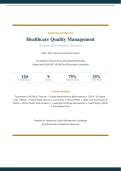
Healthcare Quality Management
& Patient Safety Competency Assessment
Comprehensive Examination
120-Question Practice Exam with Detailed Rationales
Aligned with 2026-2027 HCQM Final Examination Standards
120 9 75% 25%
Total Questions Sections Scenario-Based Direct Recall
CONTENT DOMAINS
Foundations of HCQM & Theorists • Quality Measurement & Benchmarking • PDSA / Six Sigma /
Lean / DMAIC • Patient Safety Science & Just Culture • RCA & FMEA • CMS, Joint Commission &
NCQA • EHR & Quality Data Analytics • Leadership & Change Management • Health Equity, SDOH
& Value-Based Care
Prepared for Healthcare Quality Management Candidates
Final Examination Preparation Resource
, Examination Overview & Section Map
This 120-question comprehensive examination assesses competency in Healthcare Quality Management and
Patient Safety aligned with the 2026/2027 HCQM Final Examination standards. Each question includes a detailed
rationale explaining why the correct answer is correct, why each distractor is wrong, and how the concept applies
in real healthcare settings.
Section 1: Foundations of Healthcare Quality Management (Q1-14)
Definitions, history, key theorists (Donabedian, Deming, Juran, Crosby, Berwick), and quality frameworks (IOM/NAM
aims).
Section 2: Quality Measurement, Metrics, and Benchmarking (Q15-28)
Donabedian Structure-Process-Outcome model, indicators, scorecards, and benchmarking methodology.
Section 3: Quality Improvement Methodologies and Tools (Q29-45)
PDSA, Model for Improvement, Six Sigma, Lean, DMAIC, and PI tools (Pareto, Fishbone, Run, Control charts).
Section 4: Patient Safety Science and Competency (Q46-60)
Safety culture, Just Culture, human factors engineering, and High Reliability Organizations (HROs).
Section 5: Error Analysis and Risk Management (Q61-73)
Root Cause Analysis (RCA), Failure Mode and Effects Analysis (FMEA), and error reporting systems.
Section 6: Regulatory, Accreditation, and Compliance (Q74-87)
CMS Conditions of Participation, Joint Commission standards, NCQA, HCAHPS, Hospital Compare, and quality reporting
programs.
Section 7: Healthcare Informatics and Quality Data Analytics (Q88-99)
EHR, registries, dashboards, data governance, and quality data analytics.
Section 8: Leadership, Culture, and Change Management (Q100-110)
Quality culture, transformational leadership, teamwork, Lewin, Kotter, and Rogers' diffusion of innovation.
Section 9: Health Equity, Population Health, and Value-Based Care (Q111-120)
Social determinants of health, equity, value-based purchasing, bundled payments, ACOs, and population health management.
Cognitive Level Distribution
Recall (30%) — Direct identification of theorists, frameworks, and definitions.
Application (50%) — Clinical and administrative scenarios requiring application of QI and safety principles.
Analysis (20%) — Comparison of methodologies, critique of scenarios, and synthesis of concepts.
How to Read Each Question
Each question presents a stem, four options (A-D), and a rationale. The correct option is marked [CORRECT] in
green, and the explicit Correct Answer line follows. Rationales explain the underlying principle, identify why
distractors are wrong, and end with a practical study tip for the HCQM final examination.
,HCQM Final Examination 2026/2027 — Healthcare Quality Management & Patient Safety
120-Question Practice Exam
SECTION 1: Foundations of Healthcare Quality Management (Q1-14)
Definitions, history, key theorists (Donabedian, Deming, Juran, Crosby, Berwick), and quality frameworks (IOM/NAM
aims).
Q1.
The Institute of Medicine (now National Academy of Medicine) report Crossing the Quality Chasm (2001)
defined six aims for high-quality healthcare. Which set correctly lists all six aims?
A. Safe, Effective, Patient-Centered, Timely, Efficient, and Equitable. [CORRECT]
B. Safe, Effective, Affordable, Timely, Equitable, and Sustainable.
C. Quality, Access, Cost, Outcomes, Patient-Centered, and Safe.
D. Effective, Efficient, Equitable, Ethical, Engaging, and Evidence-Based.
Correct Answer: A — Safe, Effective, Patient-Centered, Timely, Efficient, and Equitable.
Rationale: The IOM/NAM six aims—known by the mnemonic STEEEP (Safe, Timely, Effective, Efficient,
Equitable, Patient-Centered)—are the foundational framework for 21st-century healthcare quality and frame
nearly every HCQM competency assessed on this exam. The other options substitute plausible-sounding aims
(Affordable, Sustainable, Ethical, Engaging) that are not part of the original six. Study tip: memorize STEEEP
and pair each aim with a measurable indicator (e.g., 'Safe' pairs with hospital-acquired infection rates).
Q2.
A quality director states, 'We inspect charts after discharge to identify defects and report noncompliance to the
compliance committee.' Which approach to quality does this statement best represent?
A. Quality Assurance (QA), which is retrospective, inspection-focused, and detects defects after the
fact. [CORRECT]
B. Quality Improvement (QI), which is proactive, system-focused, and aims to prevent defects.
C. Continuous Quality Improvement (CQI), which embeds iterative improvement into daily work.
D. Total Quality Management (TQM), which integrates quality across all organizational functions.
Correct Answer: A — Quality Assurance (QA), which is retrospective, inspection-focused, and detects
defects...
Rationale: Quality Assurance (QA) is retrospective and inspection-based—checking charts after the fact to
catch defects—whereas Quality Improvement (QI) is proactive and system-focused on preventing defects
through iterative change. This QA-vs-QI distinction is one of the most commonly confused concept pairs on the
HCQM final; the keywords 'inspect,' 'after,' and 'report noncompliance' signal QA. Test tip: 'find and fix' = QA;
'prevent and improve' = QI.
Q3.
Avedis Donabedian's foundational model for evaluating healthcare quality uses three interrelated components.
Which set correctly identifies these three components?
A. Structure, Process, and Outcome. [CORRECT]
B. Standards, Performance, and Outcomes.
C. System, Process, and Output.
D. Strategy, Practice, and Operations.
Correct Answer: A — Structure, Process, and Outcome.
HCQM Final Examination • Study Guide Page 3
, HCQM Final Examination 2026/2027 — Healthcare Quality Management & Patient Safety
120-Question Practice Exam
Rationale: Donabedian's triad—Structure (the settings, staff, and resources in which care is delivered), Process
(the activities of giving and receiving care), and Outcome (the effects of care on health status and
satisfaction)—is the dominant framework for classifying quality measures. The other options sound plausible
but are not Donabedian's terms. Study tip: Structure = 'what we have'; Process = 'what we do'; Outcome = 'what
happens as a result.'
Q4.
A hospital is measuring its nurse-to-patient ratio, availability of ICU beds, and presence of a computerized order
entry system. According to Donabedian's model, these measures are best classified as:
A. Structure measures, because they describe the resources and settings in which care is delivered.
[CORRECT]
B. Process measures, because they describe the activities of giving care.
C. Outcome measures, because they describe the effects of care on patients.
D. Balancing measures, because they prevent improvement in one area at the expense of another.
Correct Answer: A — Structure measures, because they describe the resources and settings in which
care is d...
Rationale: Structure measures capture the physical, organizational, and human resources used to deliver
care—nurse staffing ratios, bed availability, technology, credentials—distinct from Process (what is done) and
Outcome (what results). Misclassifying these as Process or Outcome is a common exam error; the keywords
'ratio,' 'availability,' and 'presence of' all signal infrastructure. Study tip: if the measure describes 'what we have,'
it is Structure.
Q5.
A hospital tracks the percentage of heart failure patients discharged with written instructions, the rate of
prophylactic antibiotic administration within one hour prior to surgery, and the rate of bedside handoff
compliance. These are best classified as:
A. Process measures, because they describe the activities of giving and receiving care. [CORRECT]
B. Structure measures, because they describe the resources for care.
C. Outcome measures, because they describe the results of care.
D. Balancing measures, because they detect unintended consequences.
Correct Answer: A — Process measures, because they describe the activities of giving and receiving care.
Rationale: Process measures capture what is actually done—administration of medications, documentation at
discharge, handoff compliance—making them the most actionable measure type for direct improvement work.
Structure describes resources, Outcome describes results, and Balancing measures detect trade-offs; the
keywords 'percentage of patients who received' and 'rate of' signal a Process measure. Study tip: 'did we do the
right thing?' = Process.
Q6.
A health system reports its 30-day risk-standardized mortality rate after acute myocardial infarction, its 30-day
hospital readmission rate for heart failure, and its rate of hospital-acquired pressure injuries. These are best
classified as:
A. Outcome measures, because they capture the effects of care on patient health. [CORRECT]
B. Process measures, because they capture what is done.
C. Structure measures, because they capture the care environment.
D. Process balancing measures, because they detect trade-offs.
HCQM Final Examination • Study Guide Page 4
Healthcare Quality Management
& Patient Safety Competency Assessment
Comprehensive Examination
120-Question Practice Exam with Detailed Rationales
Aligned with 2026-2027 HCQM Final Examination Standards
120 9 75% 25%
Total Questions Sections Scenario-Based Direct Recall
CONTENT DOMAINS
Foundations of HCQM & Theorists • Quality Measurement & Benchmarking • PDSA / Six Sigma /
Lean / DMAIC • Patient Safety Science & Just Culture • RCA & FMEA • CMS, Joint Commission &
NCQA • EHR & Quality Data Analytics • Leadership & Change Management • Health Equity, SDOH
& Value-Based Care
Prepared for Healthcare Quality Management Candidates
Final Examination Preparation Resource
, Examination Overview & Section Map
This 120-question comprehensive examination assesses competency in Healthcare Quality Management and
Patient Safety aligned with the 2026/2027 HCQM Final Examination standards. Each question includes a detailed
rationale explaining why the correct answer is correct, why each distractor is wrong, and how the concept applies
in real healthcare settings.
Section 1: Foundations of Healthcare Quality Management (Q1-14)
Definitions, history, key theorists (Donabedian, Deming, Juran, Crosby, Berwick), and quality frameworks (IOM/NAM
aims).
Section 2: Quality Measurement, Metrics, and Benchmarking (Q15-28)
Donabedian Structure-Process-Outcome model, indicators, scorecards, and benchmarking methodology.
Section 3: Quality Improvement Methodologies and Tools (Q29-45)
PDSA, Model for Improvement, Six Sigma, Lean, DMAIC, and PI tools (Pareto, Fishbone, Run, Control charts).
Section 4: Patient Safety Science and Competency (Q46-60)
Safety culture, Just Culture, human factors engineering, and High Reliability Organizations (HROs).
Section 5: Error Analysis and Risk Management (Q61-73)
Root Cause Analysis (RCA), Failure Mode and Effects Analysis (FMEA), and error reporting systems.
Section 6: Regulatory, Accreditation, and Compliance (Q74-87)
CMS Conditions of Participation, Joint Commission standards, NCQA, HCAHPS, Hospital Compare, and quality reporting
programs.
Section 7: Healthcare Informatics and Quality Data Analytics (Q88-99)
EHR, registries, dashboards, data governance, and quality data analytics.
Section 8: Leadership, Culture, and Change Management (Q100-110)
Quality culture, transformational leadership, teamwork, Lewin, Kotter, and Rogers' diffusion of innovation.
Section 9: Health Equity, Population Health, and Value-Based Care (Q111-120)
Social determinants of health, equity, value-based purchasing, bundled payments, ACOs, and population health management.
Cognitive Level Distribution
Recall (30%) — Direct identification of theorists, frameworks, and definitions.
Application (50%) — Clinical and administrative scenarios requiring application of QI and safety principles.
Analysis (20%) — Comparison of methodologies, critique of scenarios, and synthesis of concepts.
How to Read Each Question
Each question presents a stem, four options (A-D), and a rationale. The correct option is marked [CORRECT] in
green, and the explicit Correct Answer line follows. Rationales explain the underlying principle, identify why
distractors are wrong, and end with a practical study tip for the HCQM final examination.
,HCQM Final Examination 2026/2027 — Healthcare Quality Management & Patient Safety
120-Question Practice Exam
SECTION 1: Foundations of Healthcare Quality Management (Q1-14)
Definitions, history, key theorists (Donabedian, Deming, Juran, Crosby, Berwick), and quality frameworks (IOM/NAM
aims).
Q1.
The Institute of Medicine (now National Academy of Medicine) report Crossing the Quality Chasm (2001)
defined six aims for high-quality healthcare. Which set correctly lists all six aims?
A. Safe, Effective, Patient-Centered, Timely, Efficient, and Equitable. [CORRECT]
B. Safe, Effective, Affordable, Timely, Equitable, and Sustainable.
C. Quality, Access, Cost, Outcomes, Patient-Centered, and Safe.
D. Effective, Efficient, Equitable, Ethical, Engaging, and Evidence-Based.
Correct Answer: A — Safe, Effective, Patient-Centered, Timely, Efficient, and Equitable.
Rationale: The IOM/NAM six aims—known by the mnemonic STEEEP (Safe, Timely, Effective, Efficient,
Equitable, Patient-Centered)—are the foundational framework for 21st-century healthcare quality and frame
nearly every HCQM competency assessed on this exam. The other options substitute plausible-sounding aims
(Affordable, Sustainable, Ethical, Engaging) that are not part of the original six. Study tip: memorize STEEEP
and pair each aim with a measurable indicator (e.g., 'Safe' pairs with hospital-acquired infection rates).
Q2.
A quality director states, 'We inspect charts after discharge to identify defects and report noncompliance to the
compliance committee.' Which approach to quality does this statement best represent?
A. Quality Assurance (QA), which is retrospective, inspection-focused, and detects defects after the
fact. [CORRECT]
B. Quality Improvement (QI), which is proactive, system-focused, and aims to prevent defects.
C. Continuous Quality Improvement (CQI), which embeds iterative improvement into daily work.
D. Total Quality Management (TQM), which integrates quality across all organizational functions.
Correct Answer: A — Quality Assurance (QA), which is retrospective, inspection-focused, and detects
defects...
Rationale: Quality Assurance (QA) is retrospective and inspection-based—checking charts after the fact to
catch defects—whereas Quality Improvement (QI) is proactive and system-focused on preventing defects
through iterative change. This QA-vs-QI distinction is one of the most commonly confused concept pairs on the
HCQM final; the keywords 'inspect,' 'after,' and 'report noncompliance' signal QA. Test tip: 'find and fix' = QA;
'prevent and improve' = QI.
Q3.
Avedis Donabedian's foundational model for evaluating healthcare quality uses three interrelated components.
Which set correctly identifies these three components?
A. Structure, Process, and Outcome. [CORRECT]
B. Standards, Performance, and Outcomes.
C. System, Process, and Output.
D. Strategy, Practice, and Operations.
Correct Answer: A — Structure, Process, and Outcome.
HCQM Final Examination • Study Guide Page 3
, HCQM Final Examination 2026/2027 — Healthcare Quality Management & Patient Safety
120-Question Practice Exam
Rationale: Donabedian's triad—Structure (the settings, staff, and resources in which care is delivered), Process
(the activities of giving and receiving care), and Outcome (the effects of care on health status and
satisfaction)—is the dominant framework for classifying quality measures. The other options sound plausible
but are not Donabedian's terms. Study tip: Structure = 'what we have'; Process = 'what we do'; Outcome = 'what
happens as a result.'
Q4.
A hospital is measuring its nurse-to-patient ratio, availability of ICU beds, and presence of a computerized order
entry system. According to Donabedian's model, these measures are best classified as:
A. Structure measures, because they describe the resources and settings in which care is delivered.
[CORRECT]
B. Process measures, because they describe the activities of giving care.
C. Outcome measures, because they describe the effects of care on patients.
D. Balancing measures, because they prevent improvement in one area at the expense of another.
Correct Answer: A — Structure measures, because they describe the resources and settings in which
care is d...
Rationale: Structure measures capture the physical, organizational, and human resources used to deliver
care—nurse staffing ratios, bed availability, technology, credentials—distinct from Process (what is done) and
Outcome (what results). Misclassifying these as Process or Outcome is a common exam error; the keywords
'ratio,' 'availability,' and 'presence of' all signal infrastructure. Study tip: if the measure describes 'what we have,'
it is Structure.
Q5.
A hospital tracks the percentage of heart failure patients discharged with written instructions, the rate of
prophylactic antibiotic administration within one hour prior to surgery, and the rate of bedside handoff
compliance. These are best classified as:
A. Process measures, because they describe the activities of giving and receiving care. [CORRECT]
B. Structure measures, because they describe the resources for care.
C. Outcome measures, because they describe the results of care.
D. Balancing measures, because they detect unintended consequences.
Correct Answer: A — Process measures, because they describe the activities of giving and receiving care.
Rationale: Process measures capture what is actually done—administration of medications, documentation at
discharge, handoff compliance—making them the most actionable measure type for direct improvement work.
Structure describes resources, Outcome describes results, and Balancing measures detect trade-offs; the
keywords 'percentage of patients who received' and 'rate of' signal a Process measure. Study tip: 'did we do the
right thing?' = Process.
Q6.
A health system reports its 30-day risk-standardized mortality rate after acute myocardial infarction, its 30-day
hospital readmission rate for heart failure, and its rate of hospital-acquired pressure injuries. These are best
classified as:
A. Outcome measures, because they capture the effects of care on patient health. [CORRECT]
B. Process measures, because they capture what is done.
C. Structure measures, because they capture the care environment.
D. Process balancing measures, because they detect trade-offs.
HCQM Final Examination • Study Guide Page 4


